


Today you will see it full of people having picnics, playing music or rowing on the lake, but this park has a far from peaceful past. Where you now find palm trees and parrots, there stood for about a century and a half a military fortress that the people of Barcelona hated. Understanding that change, from prison to garden, is the best way to look at everything inside. That is why the Ciutadella is one of the key stops on your first day in the city.
Barcelona backed the losing side in the War of the Spanish Succession, and the city fell on September 11, 1714, after a long siege. Philip V then ordered a citadel built to secure his control over Barcelona and all of Catalonia. According to the Parliament of Catalonia, work began on March 1, 1716, lasted until 1748 and was led by the Flemish military engineer Próspero de Verboom. It was an 18th-century, pentagon-shaped fortress that never defended the city against an army, but was very effective at repressing its people. To build it, part of the La Ribera neighborhood was torn down, and thousands of people had to leave their homes.
The Ciutadella became the most hated place in Barcelona. Prisoners were locked up there, and hundreds of them were executed on the esplanade or the glacis, in full view of everyone. The most feared part was the Tower of Sant Joan, where the prisoners considered most dangerous were held.
After decades of public pressure, in 1869 General Prim's government handed the fortress over to the city and ordered it torn down. The condition was that the land had to become a public park. The master builder Josep Fontserè signed the park design in 1872, with a motto that sums it all up: "gardens are to cities what lungs are to the human body." Work began in 1873. Until then, anyone who wanted nature had to head up to Montjuïc hill or the Collserola hills. The Ciutadella was Barcelona's first park planned as an urban park.
The park was still half finished when mayor Francesc Rius i Taulet decided to hold the 1888 Universal Exposition there. Its main gateway was the Arc de Triomf in Barcelona, and several buildings from that fair are still standing today.
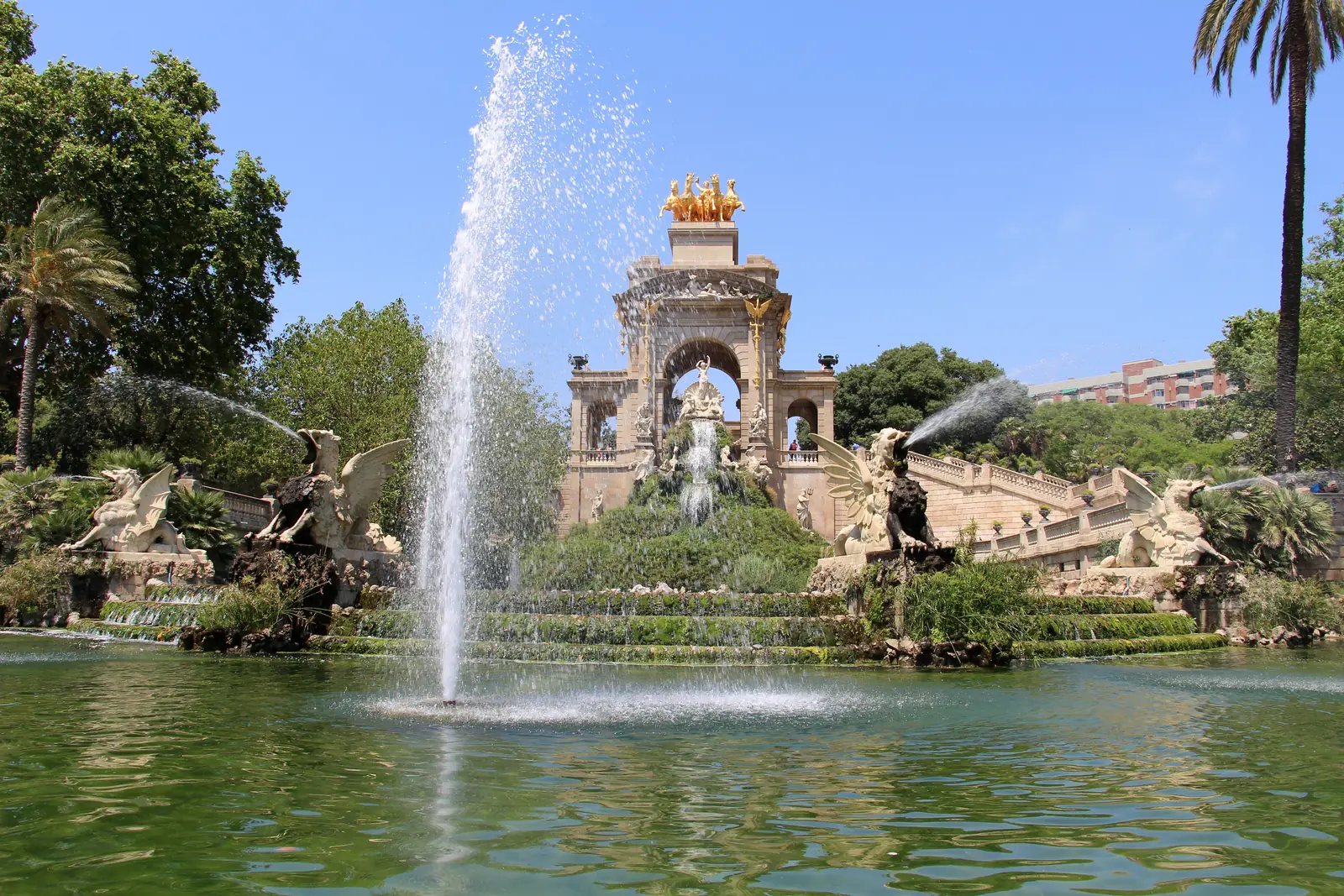
This is the park's most famous sight. Josep Fontserè designed it in 1875 and it was inaugurated in 1881, according to Barcelona City Council. It sits on the fortress's old parade ground and is shaped like a classical triumphal arch blended with rocks, with two wings of staircases on either side and a two-level pond.
Antoni Gaudí worked here at the very start of his career, as Fontserè's assistant. He handled the hydraulic design and created the artificial grotto beneath the fountain, which at first housed an aquarium, Barcelona's first. To get the water up to the top, Fontserè designed a raised reservoir that is now part of Pompeu Fabra University.
On top shines the Chariot of Aurora, by Rossend Nobas, an allegory of progress made of cast iron. For years it looked black, but the 2009 restoration brought back its original gilding, and many locals were surprised to learn it had always been gold. In the center of the fountain is the Birth of Venus group, standing on a shell.
Where to look
Climb the side staircases up to the central pavilion. From the top you can see the pond, the jets and, in the background, the rest of the park. Keep in mind that the fountain is sometimes switched off for cleaning, and then the jets are not running.
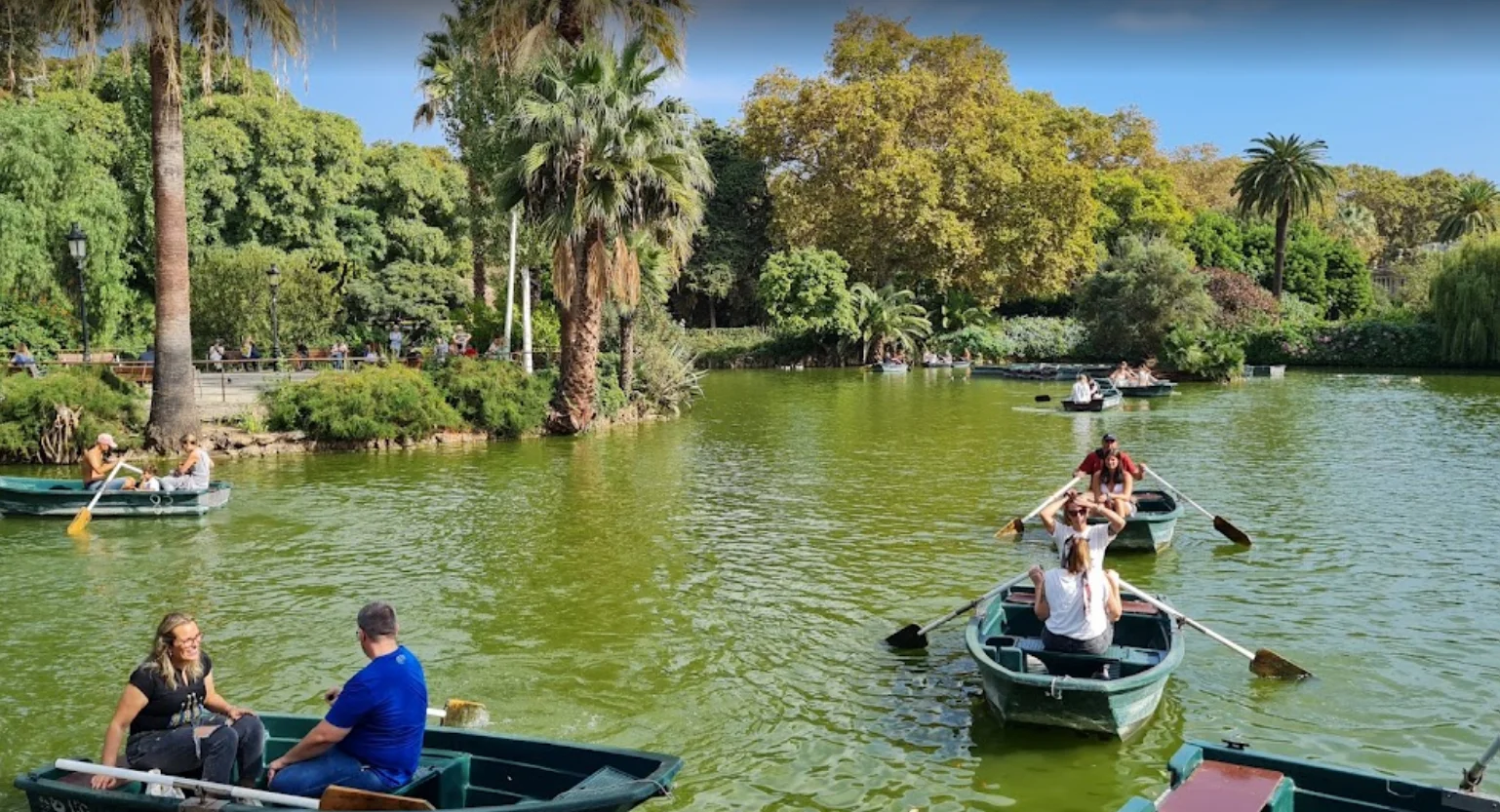
Fontserè started the park with the lake itself. It is a calm pond surrounded by century-old trees, with water plants and plenty of birds. Look out for the grey herons that live there. In the middle of the park you can rent a rowboat and take a spin around the lake.
All over the park you will also hear the parakeets that have taken over the palm trees. Some are so tame they come right up to people.
The rowboats are usually described as a calm, cheap, picture-postcard outing, popular with families and couples. Our take: they are worth it as a short break, not as a sight in their own right. A ride lasts 30 minutes and costs €7 to €11 per boat (roughly €2 to €7 per person). The best part is the view of the Cascada Monumental from the water. If you only have an hour or two for the park, put the Cascada, the Mammoth, the Hivernacle and the Umbracle first, and save the boat for when you feel like a rest. If the Cascada is switched off for cleaning, the boat ride loses some of its charm, so check before you go.
Tip. The ticket booth is right on the lake and you do not need to book. According to Barcelona City Council, half an hour costs €7 for a boat for 1 or 2 people, €10 for 3 and €11 for 4 or 5 (prices published for the April to September season). It is open from 10:00 a.m. to 8:00 p.m. from April to September and from 10:00 a.m. to 6:00 p.m. from October to March, so in winter do not leave it until late afternoon. On weekdays or in the morning you can row without waiting. On weekend afternoons there is a line. In summer, go early or late in the day, because there is little shade on the lake.
Only three buildings of Philip V's fortress are still standing: the arsenal, the governor's palace (now the Verdaguer high school) and the chapel, which is still a military parish. The arsenal is now the Palau del Parlament, home of the Parliament of Catalonia, and it essentially keeps the structure Verboom gave it. The irony is hard to miss: the old center of military control over Barcelona is now the seat of Catalan self-government.
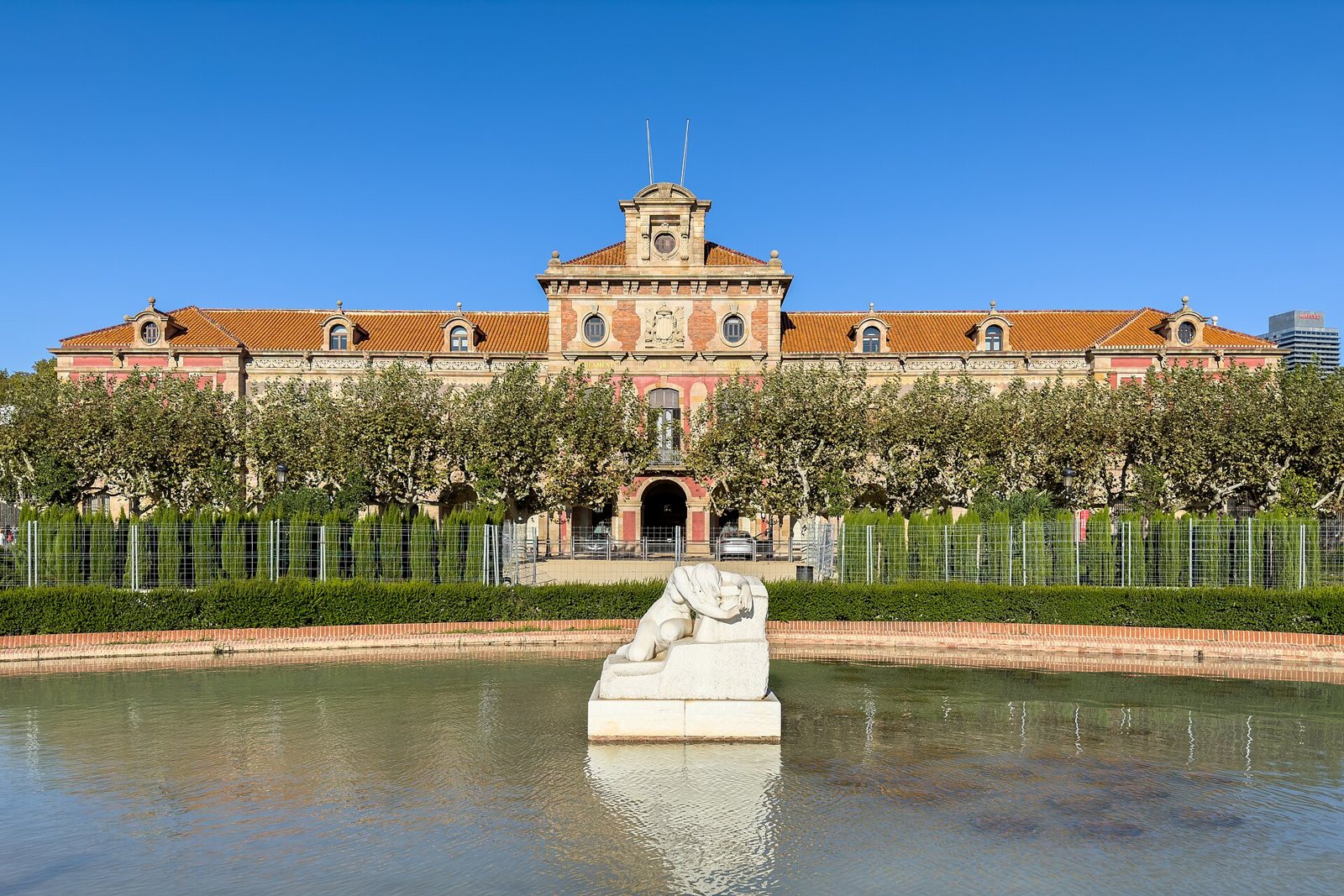
The building has had many lives. In 1889 the City Council agreed to turn it into a royal palace, and later it became an art museum. On December 6, 1932, it hosted the opening session of the Catalan Parliament, with president Francesc Macià. In 1939, when Franco's troops entered the city, it became a barracks, and the chamber stayed shut for 37 years. In April 1980, after new renovation work, it welcomed the restored Parliament for its first legislature.
Where to look
In front of the Parliament there is a garden with an oval pond and, in the middle, "El Desconsol" (Despair), Josep Llimona's sculpture of a grieving nude woman. The one you see is a copy. The original is in the National Art Museum of Catalonia (MNAC). On the building's facade there is a coat of arms taken from the gate of the old fortress.
Some people still think the Parliament only opens to the public on September 11, but that is not the case: you can go inside all year round on a free guided tour. It is worth it if you are interested in Catalan history and politics, because you get to walk through the Ciutadella's old arsenal, one of the few remains of the fortress, with a specialist guide. The tour lasts 45 minutes and runs Monday to Friday, whenever parliamentary business allows. You have to book it in advance on the Parliament of Catalonia website. If you are up to 9 people, you book as individual visitors and join an open tour. If you are 10 or more, you book as a group. On some special dates there are open days. For example, on Sunday, December 6, 2026, the anniversary of that first session in 1932, there are tours in Catalan every half hour.
Tip. Tours run in Spanish, Catalan and English, usually at 11:00 a.m. and in the afternoon. English tours are few (one or two a week), so if you want one, book at least a week ahead. You can pair it with the rowboats, because the lake is right next to the building.
If you walk into the park from the Arc de Triomf, along the Passeig de Lluís Companys, this is the first building you see. Lluís Domènech i Montaner, then a young architect, designed it as the café restaurant of the 1888 Exposition. It is considered one of the first examples of Barcelona Modernisme (Catalan Art Nouveau), with exposed brick, iron, ceramics, corner towers and battlements, like a castle.
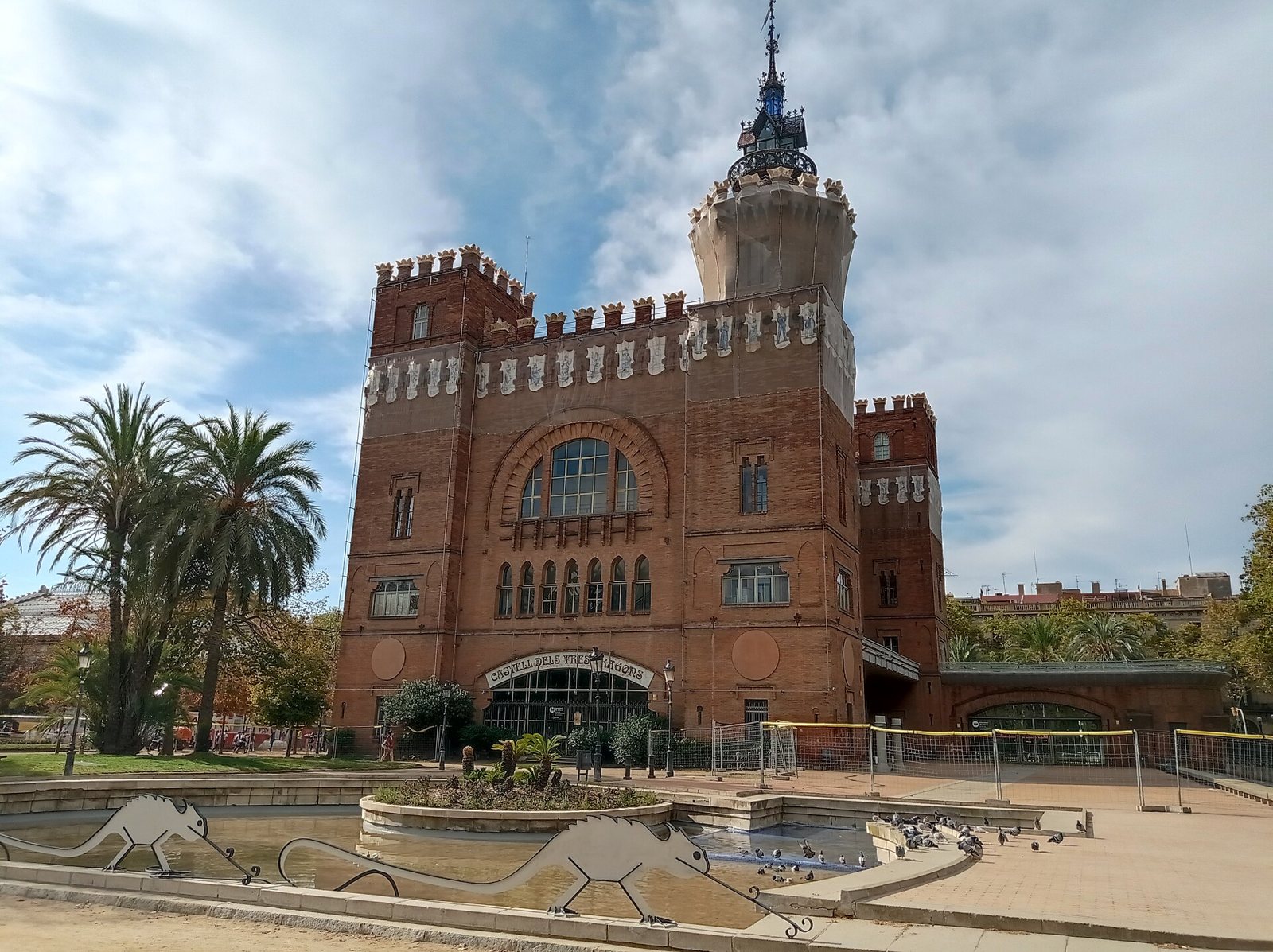
Construction began in September 1887 and ran so late that it was not finished for the opening of the Exposition on May 20, 1888. In the end, it only worked as a restaurant for the last months of the fair. The name, "Castle of the Three Dragons," comes from a comic play by Pitarra, "Lo castell dels tres dragons," which was on stage at the time. It later became a zoology museum and is now a research center of the Natural Sciences Museum of Barcelona, so you cannot visit the inside.
Many visitors are surprised to find a life-size mammoth among the trees. According to the City Council, in 1907 the city's Natural Sciences Board wanted to install several reproductions of prehistoric animals in the park, and the mammoth was the only one ever made. The idea came from the naturalists Jaume Almera and Artur Bofill, who had seen sculptures of prehistoric animals in a London park, and it was later revived by Norbert Font i Sagué. The sculpture is the work of Miquel Dalmau.
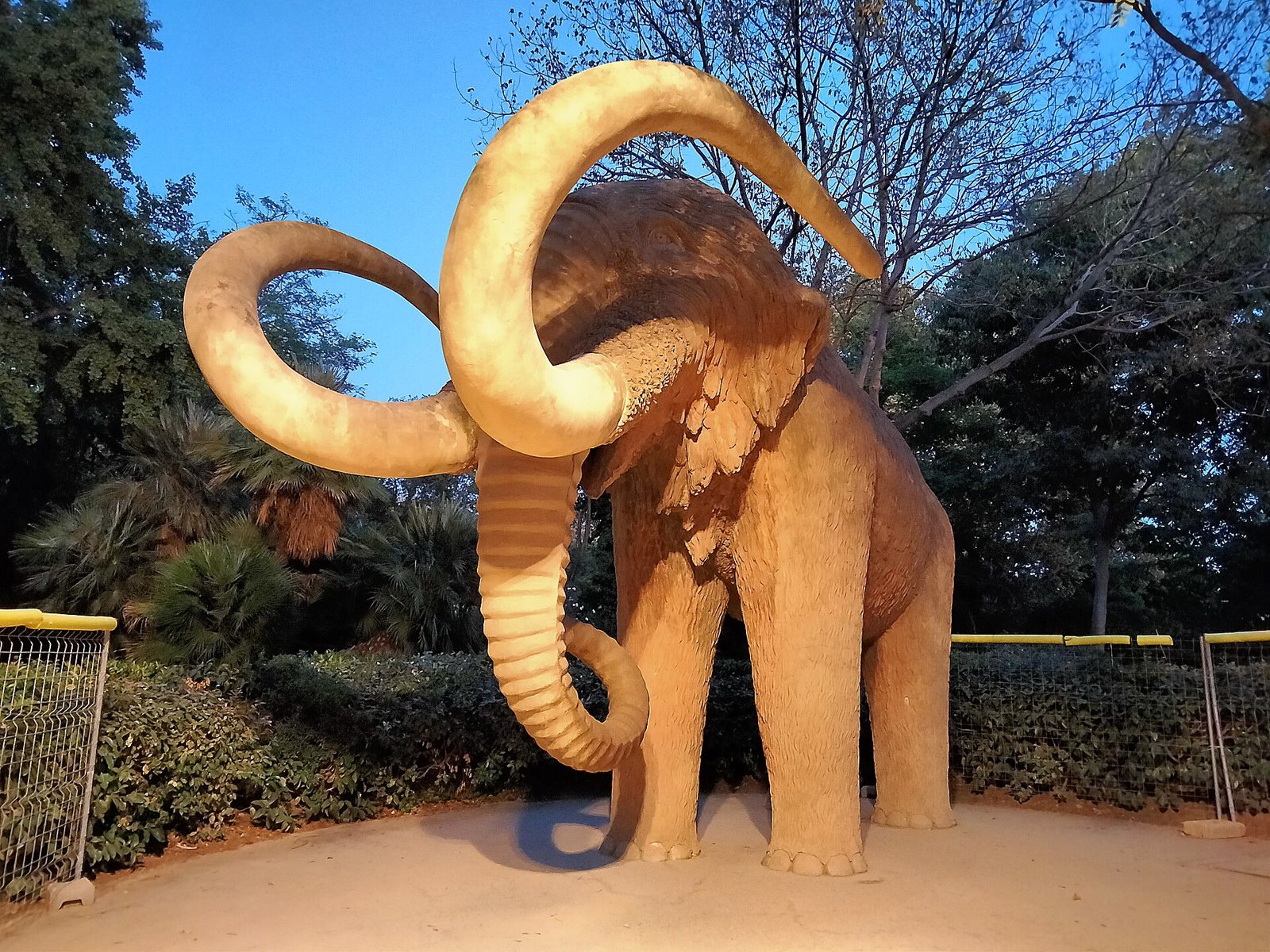
The mammoth was chosen because remains of this animal had been found in Catalonia. The rest of the "prehistoric garden" never got past the model stage.
On the Passeig de Picasso side is the park's so-called "science wing." The Hivernacle is an iron and glass greenhouse by Josep Amargós that was part of the 1888 Exposition buildings. Next door, the Umbracle does the opposite job: with a metal frame and wooden slats, it shades plants from damp forests while letting air and rain through. Between the two stands the Museu Martorell, the old geology museum.
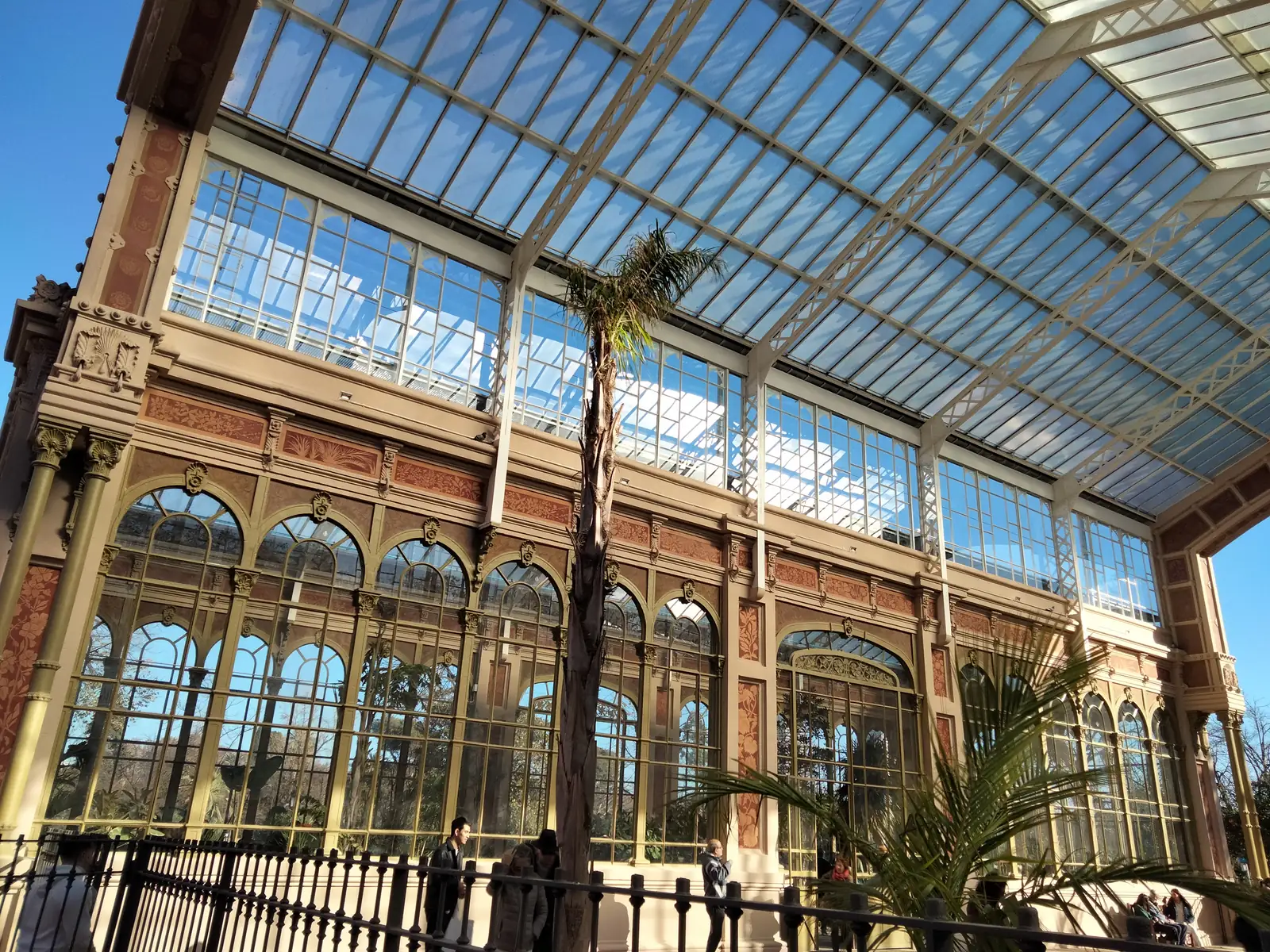
All three are a good example of how iron architecture, born in industry, made its way into civic buildings in the late 19th century. You usually see them from outside. The Umbracle, in particular, is not open inside.
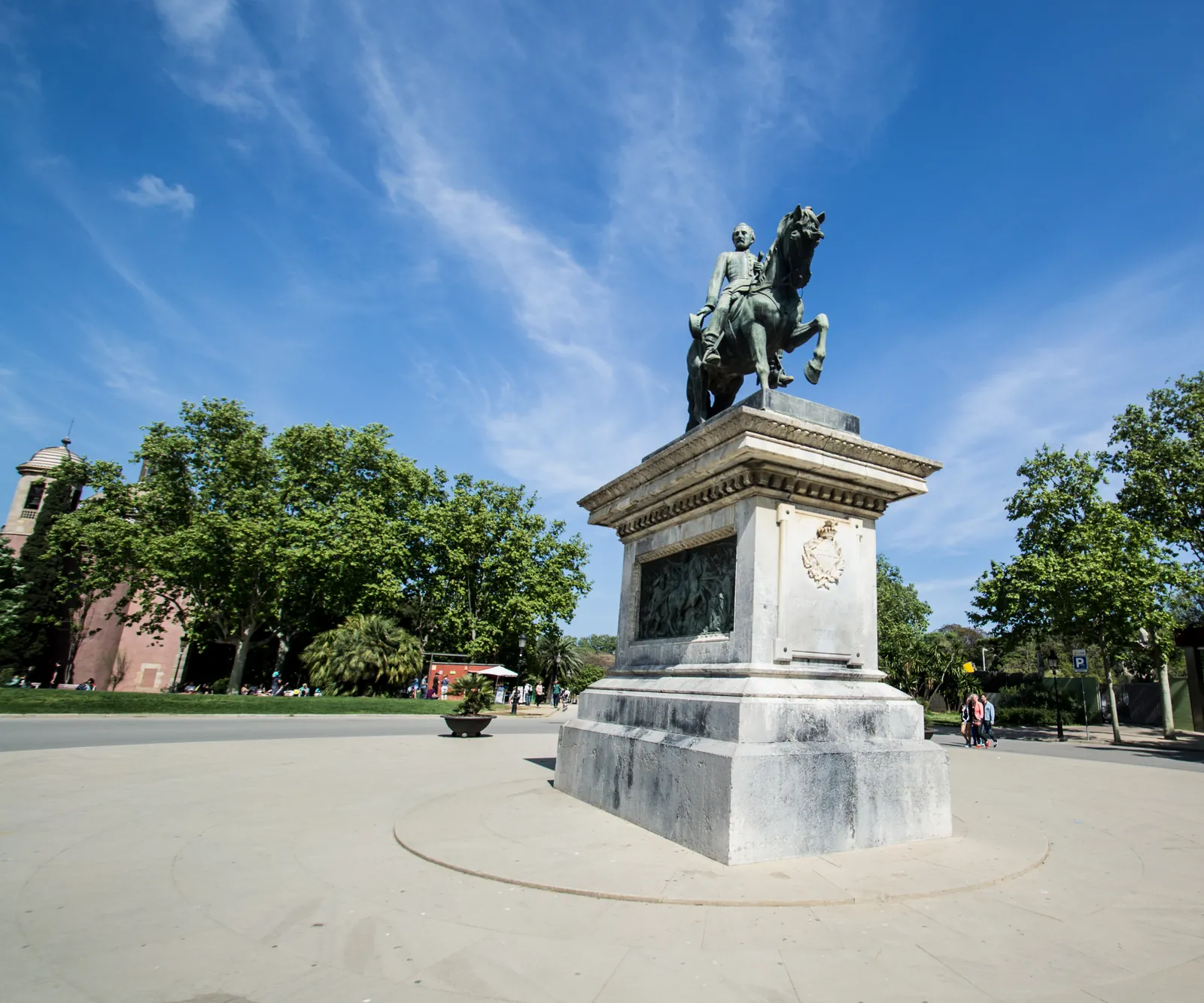
Prim, the general who handed the fortress over to the city, has his statue in the park, by Frederic Marès. Right across from it is the entrance to the Barcelona Zoo, which takes up half of the Ciutadella grounds, partly where the Exposition's Palace of Industry once stood before it was torn down.
According to the Barcelona City Council's listing, until December 20, 2026 it is open Monday to Friday from 10:00 a.m. to 4:30 p.m., and on Saturdays, Sundays and holidays from 10:00 a.m. to 5:30 p.m. Ticket booths close an hour earlier, and hours change with the season. General admission is €23 from age 13 and €13.90 for ages 3 to 12. Children under 3 get in free.
The zoo is usually recommended as a family outing of 2 to 4 hours. Our take: if you only have a few days in Barcelona, we would leave it off your list. It takes up half a day and costs €23 per adult. You get more out of that time in the park itself, in El Born or in the Gothic Quarter. On top of that, the zoo itself warns that some facilities and areas are temporarily closed for construction work. In winter it closes early, so it does not work as a last-minute plan either. The exception is families with young kids who have a free day. For them it can be a good option, and it is right next to the lake.
Tip. If you go, go first thing. It opens at 10:00 a.m., it is less crowded and the animals are more active. For now, you can only enter the zoo from inside the park, not from Carrer de Wellington.
Tip. The best time to see the park is a weekday morning, from 10:00 a.m. to 1:00 p.m. It is less crowded, there is no line for the rowboats and everything is open, including the zoo and the Parliament tours (with an 11:00 a.m. slot). Weekend afternoons have more of a local vibe, with families and musicians on the grass, but also bigger crowds and lines. Go then if that atmosphere is what you are after, not if you want to see the sights.
Tip. Pair the park with the neighborhood next door. Leave by the Passeig de Picasso side and you are a step away from El Born: here is what to see in El Born, Barcelona.
Our welcome tour of Barcelona starts under the Arc de Triomf and then heads into the Ciutadella, where your guide explains how a fortress turned into the city's green lung. From here you continue through El Born, the Gothic Quarter and El Raval, so you understand Barcelona from day one. It is 3 hours on foot, just your group, with an official guide, in English or Spanish, at 10:30 a.m. or 4:30 p.m. Kids 0 to 11 go free and you can cancel for free up to 48 hours before.
If you want more time in this area, our private El Born and Ciutadella tour focuses on the park and the neighborhood next to it. And to plan the rest of your first day, here are the things to do in the Gothic Quarter and a guide to visiting Barcelona Cathedral.
“I highly recommend this tour not only for first time visitors but also if you have been to Barcelona before.”
Cheryl · Viator, welcome tour with Phillippe, 2023
Before you go. Zoo hours change with the season and the fountain is sometimes switched off for cleaning: check the zoo's and the City Council's websites on the day. Photos of the Parliament (Kent Wang), the Castell dels Tres Dragons (Canaan) and the Mammoth (Enric): Wikimedia Commons, CC BY-SA 4.0. Facts checked against Barcelona City Council, the Parliament of Catalonia and the Barcelona Zoo in November 2026. Main photo: The Cascada Monumental. Photo: Fred Romero, CC BY 2.0, via Wikimedia Commons.
The must-sees are the Cascada Monumental fountain, the boating lake, the Parliament of Catalonia (the fortress's old arsenal), the Castell dels Tres Dragons, the Mammoth, the Hivernacle and the Umbracle. The Barcelona Zoo is also inside the grounds.
Yes. It is a public park and entry is free. You only pay if you go into the zoo or rent a rowboat on the lake.
It is open every day from 7:00 a.m. until dusk, according to Barcelona City Council.
Not entirely. The fountain was designed by Josep Fontserè. A young Antoni Gaudí worked as his assistant: he handled the hydraulic design and created the artificial grotto underneath.
Because the park sits on the site of the citadel (ciutadella in Catalan), the military fortress Philip V had built in the 18th century to control Barcelona after the siege of 1714. It was handed over to the city in 1869 to become a park.
If you are short on time in Barcelona, no. It takes up half a day and costs €23 per adult. Some areas are also temporarily closed for construction work. We mainly recommend it for families with young kids who have a free day.
Yes. There are free 45-minute guided tours, Monday to Friday, booked in advance on the Parliament's website. Tours run in Spanish, Catalan and English. English tours are few, so book at least a week ahead.
Yes. It is the second stop on our private welcome tour of Barcelona, which starts at the Arc de Triomf, and the star of our private El Born and Ciutadella tour. Both are led by an official guide, just for your group.