We already knew the Gothic from previous trips. This tour took us to the side we hadn't seen. The explanation of Palau Güell was extraordinary: we didn't understand why it was in the Raval and now it makes perfect sense.
Home / Private Tours in Barcelona / Tour of El Raval
Private guided walk through the Raval: the Royal Shipyards, Gaudí's Palau Güell, Sant Pau del Camp, the old Barrio Chino, the Rambla del Raval, the old Hospital de la Santa Creu, MACBA and the Keith Haring mural, the Boqueria and the Liceu. Tour with an official tour guide.
El Raval occupies the space left to the west of the medieval walls when the city grew outside its first walled perimeter, back in the 13th century. For six hundred years, it was the territory of what the city did not want visible within its walls: the mendicant orders that needed land for vegetable gardens, the municipal slaughterhouse, the hospitals for the poor and sick, the factories of the first Catalan industrialization of the 19th century, and the working-class population that arrived from all over Spain to work in them. The sum of these layers produced Barcelona’s densest, most contradictory, and most misunderstood neighborhood. Also its most interesting.
Over three hours on a private guided walk, the tour starts at the Royal Shipyards, where the galleys of the Crown of Aragon were built and now home to the Maritime Museum, and crosses the Raval: the Palau Güell, one of Gaudí’s first major works; Sant Pau del Camp, one of the oldest churches in Barcelona; the old Barrio Chino; the Rambla del Raval with Botero’s cat; the old Hospital de la Santa Creu, founded in 1401 and now home to the Library of Catalonia; Richard Meier’s MACBA and the Keith Haring mural; the Boqueria market; and the Liceu opera house, rebuilt after the 1994 fire. This tour isn’t here to clean up the Raval’s image. It’s here to understand it for what it is.
The walk starts by the port, at the Royal Shipyards, and crosses the Raval: the Palau Güell and Sant Pau del Camp, the old Barrio Chino, the Rambla del Raval, the old Hospital de la Santa Creu, MACBA and Plaça de Vicenç Martorell, before coming out onto La Rambla through the Boqueria and ending in front of the Liceu.
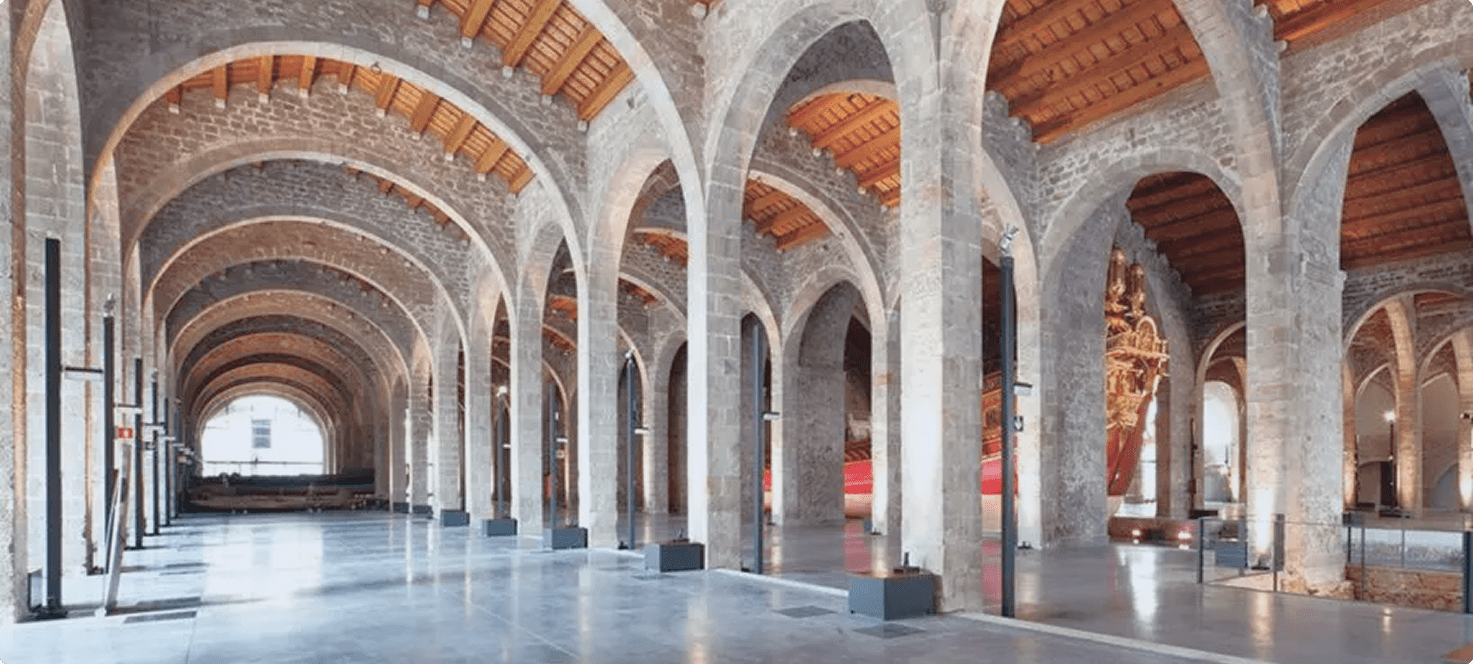
The royal shipyards where the galleys of the Crown of Aragon were built. They were founded by Peter the Great in the late 13th century, Peter the Ceremonious roofed them with great naves in the 14th century, and much of what you see today comes from expansions in the 16th and 17th centuries. It is one of Europe’s great works of civil architecture and now houses the Barcelona Maritime Museum. Your guide explains the link between the shipyards, the port and the trade expansion that made Barcelona one of the great cities of the medieval Mediterranean.
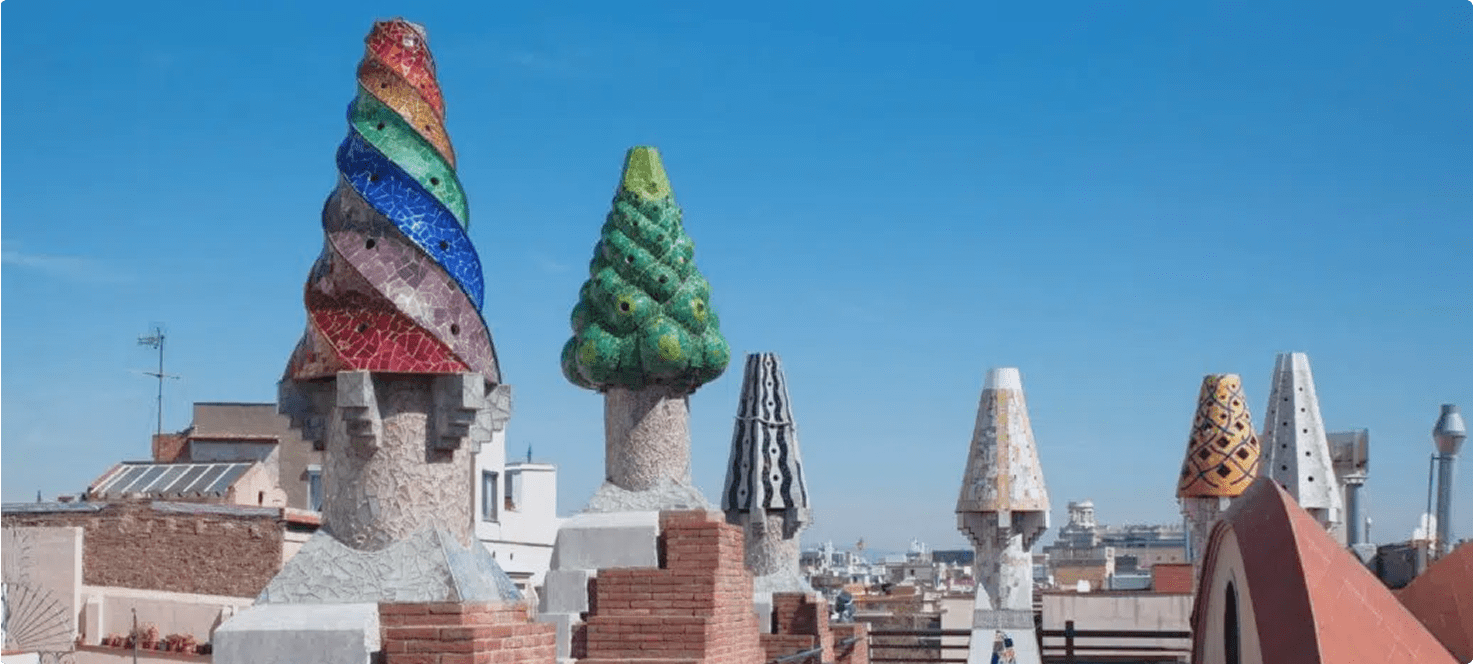
Built between 1886 and 1890 by Antoni Gaudí for the industrialist Eusebi Güell, it is one of his first major works in Barcelona and a UNESCO World Heritage Site since 1984. Your guide explains the two parabolic arches of the façade, the wrought-iron work on the doors, the rooftop with its trencadís chimneys (the broken-tile mosaic technique Gaudí later used at Park Güell) and why Güell chose this plot in the Raval, then a neighborhood with a very bad reputation, for his home.
One of the oldest churches in Barcelona, although when it was founded it stood outside the city, in the fields: hence its name, Sant Pau del Camp, ‘Saint Paul of the Fields’. The Benedictine monastery already existed in the early 10th century, and its Romanesque church and cloister survive intact. Its barrel vault is a textbook example for explaining Romanesque architecture. Today it is surrounded by 19th-century blocks and is one of the most valuable and least visited medieval buildings in the Raval.
The square is named after the CNT anarcho-syndicalist leader murdered in 1923 by gunmen hired by employers, and today it is home to the Filmoteca de Catalunya, opened in 2012 in a building by Josep Lluís Mateo. This is the heart of the old Barrio Chino, a name the journalist Francesc Madrid popularized in 1925 by comparing it to San Francisco’s Chinatown underworld, even though there was never a Chinese community here. It was the land of brothels, gambling dens and variety halls portrayed by Jean Genet, who lived here in the early 1930s. Keith Haring painted his anti-AIDS mural in this very square in 1989. Your guide explains the workers’ struggles of the early 20th century and what the urban planning of recent decades swept away.
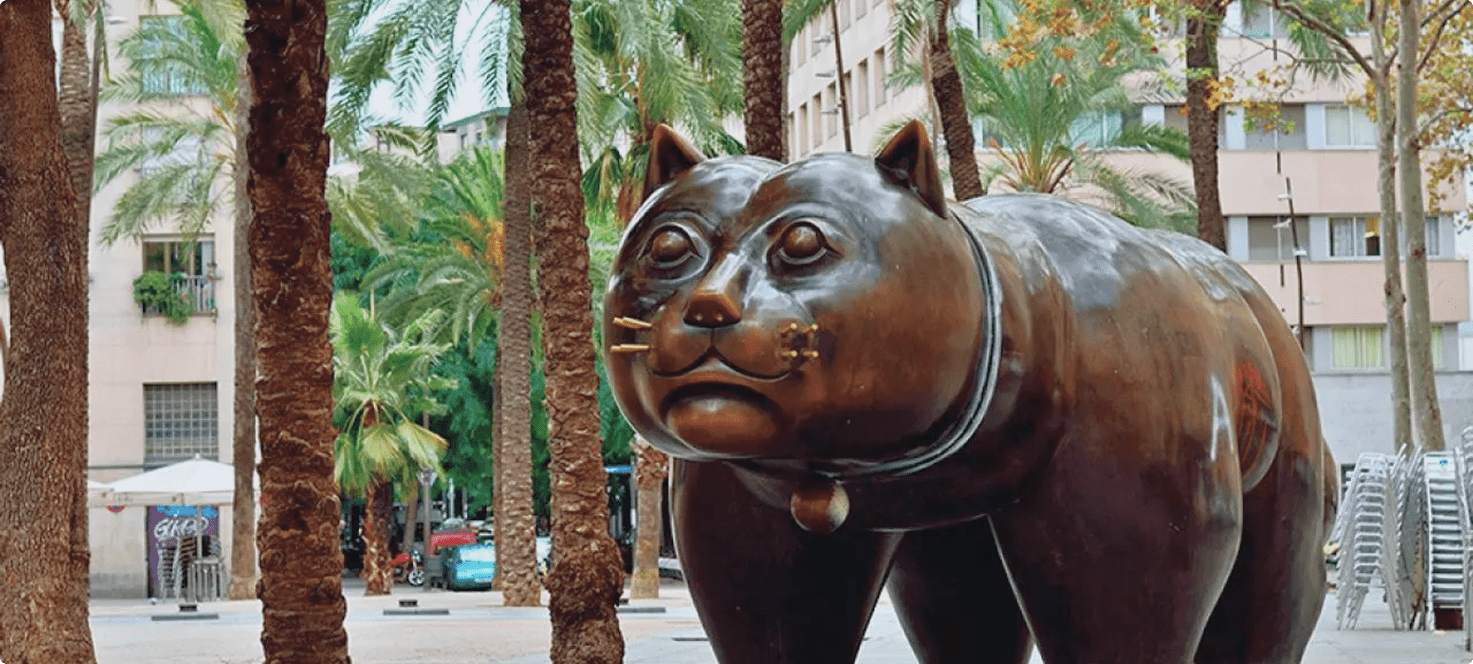
The Rambla del Raval opened in 2000 after several blocks of 19th-century buildings were torn down, one of the major projects the City Council used to open up space in the densest part of the neighborhood. Here stands Fernando Botero’s Cat, which the city bought in 1987 and which, after moving around several locations, has been here since 2003. Your guide explains the thinking behind the project, its consequences for the residents who had to leave and why the debate over gentrification in the Raval is still open.
Founded in 1401 by order of King Martí l’Humà, it was for almost five hundred years the largest hospital in Barcelona. It was in its rooms that Antoni Gaudí died on June 10, 1926, three days after being run over by a streetcar on Gran Via: his state of neglect led the rescue services to take him for a beggar. Today the Gothic building houses the Biblioteca de Catalunya and the Institut d’Estudis Catalans. The inner courtyard, which is open to the public, is one of the most surprising and least visited spaces in the city.
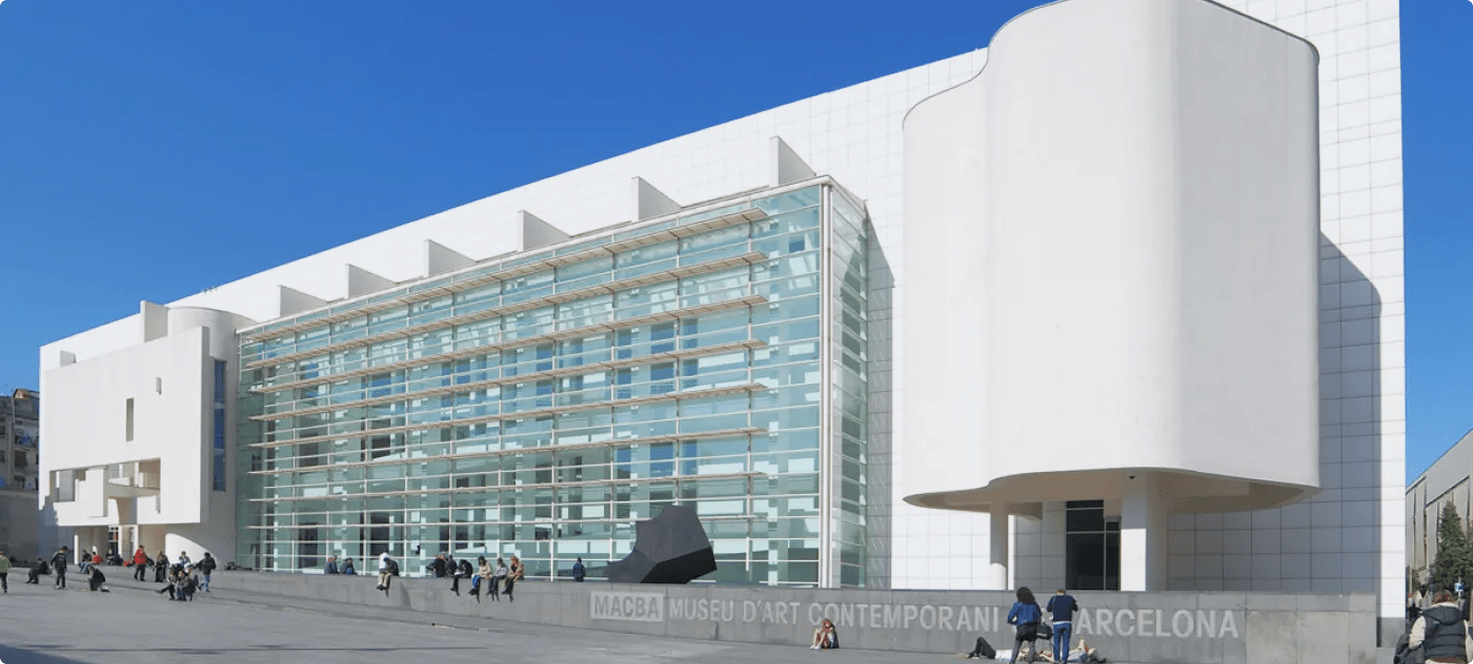
Designed by Richard Meier and opened in 1995. The white building facing Plaça dels Àngels was, together with the CCCB, the first big step in the cultural regeneration of the Raval. The square became one of the best-known skate spots in Europe, and today the museum’s expansion and the planned redesign of the square have sparked a debate in the neighborhood about who the space is for. Your guide explains the City Council’s cultural strategy in the 1990s and what’s at stake thirty years later. Next door, on Plaça de Joan Coromines, is the reproduction of Keith Haring’s mural Todos juntos podemos parar el sida (Together We Can Stop AIDS), which he painted in 1989 in Plaça de Salvador Seguí; the original was lost and MACBA reproduced it in 2014 with the approval of the artist’s foundation.
One of the Raval’s most neighborly squares. It is named after Vicenç Martorell, the engineer who in 1925 headed Barcelona’s first municipal mapping office. On one corner, on Carrer de les Ramelleres, you can still see the turning wheel of the old foundling home, where between 1853 and 1931 newborns whose families couldn’t support them were left anonymously. The square also has a memorial to Antonio Machín, the Cuban singer so closely tied to the neighborhood.
Barcelona’s most famous market grew out of the open-air stalls set up in front of the old Boqueria city gate. From 1840 a market was built on the site of the convent of Sant Josep, confiscated after 1835, and the great iron roof that defines it today dates from 1914. Your guide explains its history and the difference between the stalls aimed at tourists and the ones that serve local residents, a contrast that sums up what has happened to the Raval over the last thirty years.
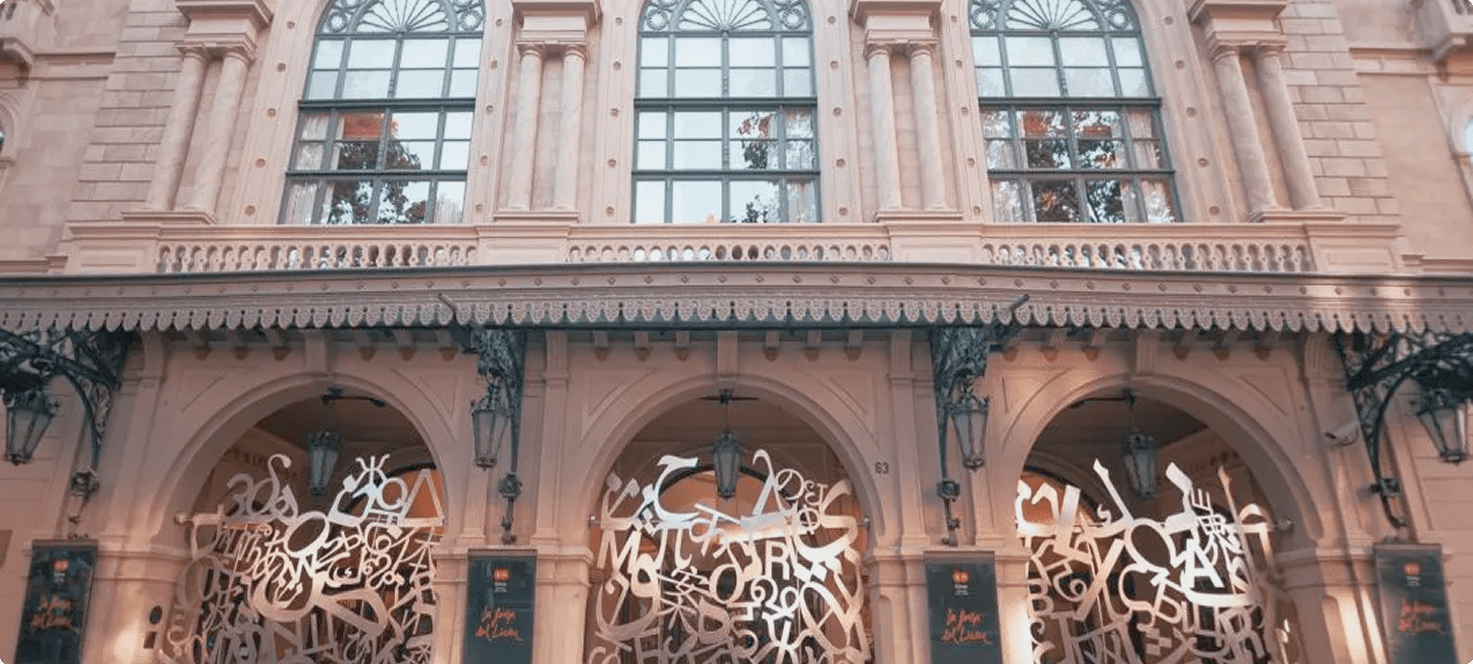
Opened in 1847, the Liceu is one of Europe’s great opera houses and was built with private money as a symbol of Catalonia’s new industrial bourgeoisie. It survived a fire in 1861, the anarchist attack of 1893 (of the two bombs thrown from the fifth floor during a performance, only one exploded, killing about twenty people) and the January 1994 fire that destroyed it completely. Your guide tells these stories and the reopening in 1999.
INCLUDED
NOT INCLUDED
The price is per group, not per person: the total is split among everyone, so the more people in your group, the less each person pays.
| People | Total | Per person |
|---|---|---|
| 1 person | €326.70 | €326.70 / person |
| 2 people | €314.60 | €157.30 / person |
| 3 people | €326.70 | €108.90 / person |
| 4 people | €387.20 | €96.80 / person |
| 5 people | €453.75 | €90.75 / person |
| 6 people or more | — | €84.70 / person |
| People | Total | Per person |
|---|---|---|
| 1 person | €326.70 | €326.70 / person |
| 2 people | €314.60 | €157.30 / person |
| 3 people | €326.70 | €108.90 / person |
| 4 people | €387.20 | €96.80 / person |
| 5 people | €453.75 | €90.75 / person |
| 6 people or more | — | €84.70 / person |
* Children (0 to 11 years old): free of charge. No hidden charges or reservation surcharges.
The Raval tour is one of the most popular tours for those who already know the Gothic Quarter and want to go one step further: book in advance if you arrive in high season. The tour runs in two daily time slots:
* We recommend booking at least 7 days in advance. In high season (May-September) the guides work at full capacity: the earlier you book, the more scheduling options you will have available.
Your guide will be waiting for you at the main door of Drassanes, next to the Avinguda de les Drassanes. After booking we will provide you with the guide’s telephone number so that you can be reached without complications.
Entrance to Drassanes
Free cancellation available
You can cancel free of charge up to 48 hours before the tour start time. Cancellations made less than 48 hours in advance or no-shows will not be refunded.
To get to know the old town of Barcelona in detail, the ideal is to combine the tour of the Raval with the private tour of the Gothic Quarter and the Cathedral. The two together cover the two halves of the historic center with different logics: the Gothic is the institutional and medieval Barcelona -the Roman, the episcopal, the monarchic-; the Raval is the Barcelona that was left out of that story, the working class, the industrial, the one that the city tried to control for centuries. Done on consecutive days, they give a complete reading of the old town that neither tour provides separately. If you want to add a third layer, the private tour of El Born and the Citadel closes the triangle of the historic center from the east.
The Palau Güell is part of the complete exterior tour, which is free of charge: the Rambla façade with the parabolic arches, the iron forging and the historical and architectural context that the guide explains on site. The entrance to the interior of the building is optional and can be purchased separately at the ticket office or on the Palau Güell website. If you would like to include the interior, please indicate this when booking and the guide will adjust the itinerary to coincide with the access schedule.
The Raval is safe for tourists, and on this tour you are always accompanied by an official tour guide who knows the neighborhood thoroughly and knows exactly where to go at all times. This eliminates any uncertainty about areas or streets. As a general recommendation -valid in any central neighborhood of Barcelona-, do not leave your belongings unattended at any time, especially in crowded areas such as La Boqueria or La Rambla, and avoid getting into poorly lit alleys or walking at night in areas you do not know. The southern sector of the Raval has a more residential and quiet character than its historical reputation suggests, but as in any big city, common sense is the best guide.
The private Raval tour works well for kids from about 6 or 7: the scale of the Royal Shipyards, the Palau Güell façade, Botero’s cat on the Rambla del Raval or the bustle of the Boqueria appeal to all ages. Your guide adapts the language and level of detail to the group. Children ages 0 to 11 don’t pay for the tour. Let us know their ages when booking.
Yes, and we recommend it. The three hours of the tour cover the main stops with their context, but the Raval has layers that deserve time of their own. Carrer de Joaquín Costa is a good example: historic bars like Casa Almirall, with its Modernista counter, sit a few steps from brand-new spots. History and the present on the same street.
The Raval has a direct link to Gaudí because the Palau Güell, one of his first major works in Barcelona (1886–1890), is here and not in the Eixample: it predates Casa Batlló, Casa Milà and the Sagrada Família as we know it today. If you want to go deeper into Gaudí and Modernisme, our private Modernisme tour, our Antoni Gaudí tour and our private Sagrada Família tour are the natural next steps.
The difference between the Raval tour and the Mysterious Barcelona tour is the focus: the Raval tour is an urban and social history tour that explains how the neighborhood was formed, what institutions defined it and how different eras transformed it. The Private Tour of Mysterious and Forbidden Barcelona focuses on dark episodes, legends and places steeped in black history that cross several neighborhoods. They share some geographical points, but the content is different. Many visitors do both on different days.
The private tour of the Raval is booked directly from the booking button on this page. You can also contact us by WhatsApp if you have any doubts before booking: we will advise you on which tours to combine according to the time you have in Barcelona and what you want to see.
We already knew the Gothic from previous trips. This tour took us to the side we hadn't seen. The explanation of Palau Güell was extraordinary: we didn't understand why it was in the Raval and now it makes perfect sense.
The Chinatown section was the most amazing. The guide knew every street with real names, dates and people. These are not anecdotes, this is real history. The courtyard of the Hospital de la Santa Creu left us speechless.
We have been visiting Barcelona for three years and had never entered the courtyard of the Hospital de la Santa Creu. The guide knew exactly when Gaudí died there and how he got there. No guidebook tells us that.
Visiting the Boqueria with someone who explains what stall to look at and why is completely different from going in alone.
If you have any questions or special needs before booking, write to us — we reply in less than 24 hours.