Private guided tour · El Born · La Ciutadella · Barcelona

Private tour of El Born and the Ciutadella with an official guide

Private tour of the Arc de Triomf, Ciutadella Park with the Castell dels Tres Dragons and the Cascade, the Catalan Parliament, the Mercat del Born, Passeig del Born, the Fossar de les Moreres, Santa Maria del Mar, Carrer de Montcada and the Picasso Museum, the Convent de Sant Agustí and the Palau de la Música. Tour with an official tour guide.

Rating on TripAdvisor and Viator
0 ★
Exterior and interior duration
0 h
Certified official tour guides
0 +
Exclusive private groups
0 %
About this tour

Private tour of El Born and the Ciutadella: two thousand years of history in one kilometer

El Born and the Ciutadella are the two spaces that best explain why Barcelona is the way it is: a neighborhood that for centuries concentrated the economic and cultural activity of the Crown of Aragon, and a park that occupies the site of the military fortress with which Philip V punished the city after the War of the Spanish Succession. Exploring them together in 3 hours is not just a historical walk (it is understanding the conflict between the city and the State that has defined Barcelona since 1714.

The tour starts under the Arc de Triomf and enters Ciutadella Park: the Castell dels Tres Dragons, the Cascade the young Gaudí worked on and the Parliament. From there it moves into El Born: the Mercat del Born with the remains of the demolished neighborhood, Passeig del Born, the Fossar de les Moreres and Santa Maria del Mar, Carrer de Montcada with the Picasso Museum, the Convent de Sant Agustí and Domènech i Montaner’s Palau de la Música. A private visit: no audio guides, no shared groups, at your group’s own pace.


What we'll visit

Tour itinerary: from the Arc de Triomf to the Palau de la Música

The tour starts under the Arc de Triomf, crosses Ciutadella Park and enters El Born through the old market, ending in front of the Palau de la Música.

Arc de Triomf (Passeig de Lluís Companys)

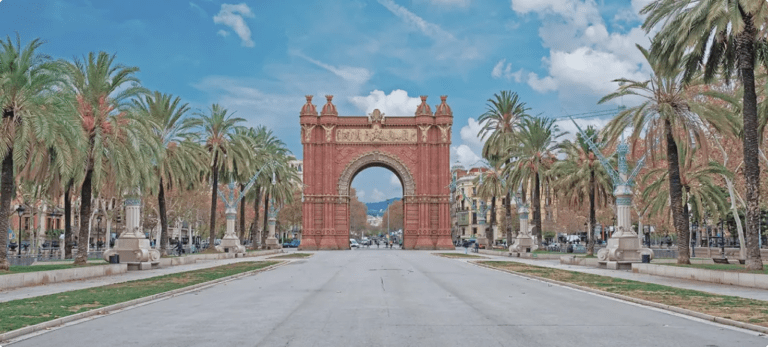
Built by Josep Vilaseca i Casanovas in 1888 as the main gateway to the Barcelona Universal Exposition. The arch does not commemorate any military victory: it is a showcase of the Catalan industrial bourgeoisie to Europe, built in exposed Moorish-Mudéjar brick when Modernisme was beginning to take shape just a few meters away. The frieze on the lintel depicts Barcelona welcoming the nations of the world, with the coats of arms of all Spanish provinces on the cornice. A political gesture as well as an architectural one.

Castell dels Tres Dragons (Ciutadella Park)

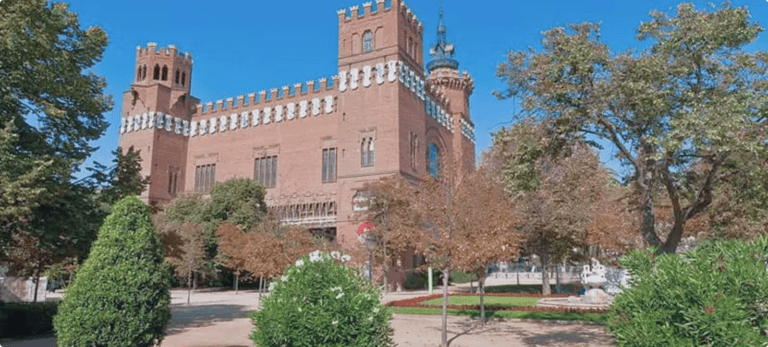
We enter Ciutadella Park, laid out on the site of the fortress Philip V ordered built after the defeat of 1714 and handed over to the city in 1869. The first building we come to is the Castell dels Tres Dragons, built by Lluís Domènech i Montaner in 1887-1888 as the café-restaurant of the Universal Exposition. Its popular name comes from a satirical play by Serafí Pitarra, and with its exposed brick, iron and ceramics it heralds the Modernisme that was to come. It has been an applied-arts workshop, a history museum and a zoology museum, and today it is one of the sites of Barcelona’s Natural Sciences Museum.

The monumental Cascade (Gaudí's fountain)

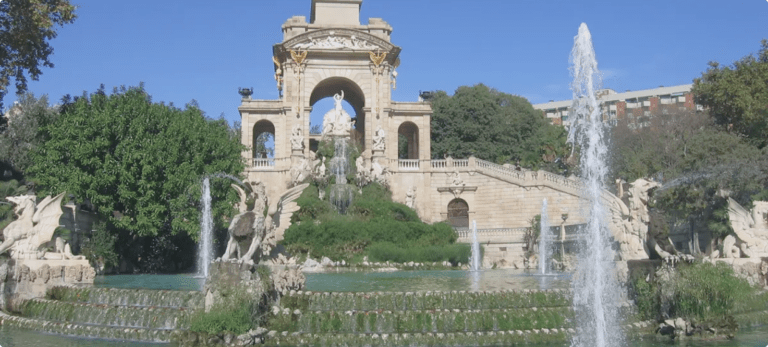
The park’s monumental waterfall, designed by Josep Fontserè, was built from 1875 onward and is one of the earliest known works of Antoni Gaudí, who worked on it while still an architecture student. The ensemble recalls Rome’s Trevi Fountain. Your guide points out the details that foreshadow the style Gaudí would develop in the decades that followed.

The Parliament of Catalonia

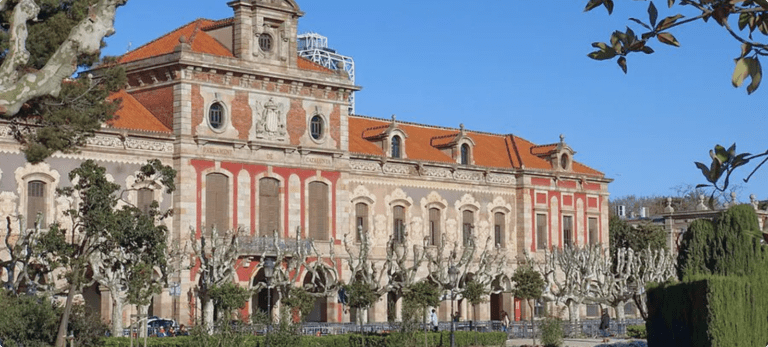
It occupies the former Arsenal of the Ciutadella, one of the few buildings left from the Bourbon fortress, built between 1716 and 1748. When the state handed the site over to the city, the Arsenal became a royal palace in the late 19th century; it was the seat of the Catalan Parliament during the Second Republic and has been again since 1980. The irony is plain: the building raised to control Barcelona now houses the institution that represents Catalan self-government.

Mercat del Born (former Central Market of Barcelona)

Built between 1874 and 1876 to a design by Josep Fontserè, it was for decades Barcelona’s great central wholesale market. It closed in 1971 and was meant to become a library, but excavations in the early 2000s uncovered the remains of the La Ribera neighborhood that Philip V ordered torn down to clear the open ground around the Ciutadella: streets, houses, wells and everyday objects. The find changed the plans, and the building became the Born Centre de Cultura i Memòria, opened in 2013. From inside the market you can see the archaeological site at street level.

Passeig del Born

In the Middle Ages this was La Ribera’s great public space: jousts, markets and festivals were held here, and the merchants who made the city rich lived all around it. Today it is a tree-lined promenade linking the old market with Santa Maria del Mar, surrounded by streets that still bear the names of the old trades.

Fossar de les Moreres and Santa Maria del Mar

Next to the basilica lies the Fossar de les Moreres, the old parish cemetery where the defenders of Barcelona who fell in the 1714 siege were buried. The present square dates from 1989; in 2001 a monument with an eternal flame was added, and every September 11 it becomes a place of remembrance. Beside it rises Santa Maria del Mar, built between 1329 and 1383 through the efforts of the people of La Ribera and one of the masterpieces of Catalan Gothic. The 1936 fire destroyed its interior decoration, and today the simplicity of its structure stands out more than ever.

Carrer de Montcada and the Picasso Museum

The street of the palaces of La Ribera’s nobles and merchants. Since 1963, five of those palaces have housed the Picasso Museum, with the most important collection of the artist’s early work. Picasso arrived in Barcelona in 1895, aged 13, when his father got a teaching post at the Llotja art school. Your guide explains the collection and his formative years from outside; museum admission is not included.

Convent de Sant Agustí

Construction of the Augustinian convent began in 1309. With the confiscation of church property in 1835 it ceased to be a convent, served as barracks for decades and is now a City Council community center. Your guide explains how the city’s great changes can be read in its walls.

Palau de la Música Catalana (façade)

Built between 1905 and 1908 by Lluís Domènech i Montaner for the Orfeó Català choral society, it is one of the masterpieces of Modernisme and a UNESCO World Heritage Site since 1997, together with the Hospital de Sant Pau by the same architect. The façade packs in sculpture and color like nothing else of its time: busts of great composers, mosaics by Lluís Bru and Miquel Blay’s sculpture group La Cançó Popular Catalana. Your guide explains the building’s link to the Renaixença and the cultural project behind it. The tour covers the façade. If you’d like to see the interior too, with Antoni Rigalt’s great stained-glass skylight, you can add the Palau’s own guided tour: tickets are bought separately and, depending on availability, can be bought the same day.


What's included

What is included in this private tour of El Born and the Ciutadella

INCLUDED

  • ✓ Official private tour guide
  • ✓ 3-hour walking tour
  • ✓ Arc de Triomf · Ciutadella · Parliament · Palau de la Música (façade)
  • ✓ Mercat del Born · Fossar de les Moreres · Santa Maria del Mar
  • ✓ Available in Spanish and English
  • ✓ Free cancellation (up to 48h before)

NOT INCLUDED

  • ✗ Tickets to museums or indoor venues
  • ✗ Food or drinks
  • ✗ Transport to the meeting point

Pricing

El Born and Ciutadella tour price: per group, not per person

The price is per group, not per person: the total is split among everyone, so the more people in your group, the less each person pays.

Low season (October 1 – April 30)

PeopleTotalPer person
1 person€326.70€326.70 / person
2 people€314.60€157.30 / person
3 people€326.70€108.90 / person
4 people€387.20€96.80 / person
5 people€453.75€90.75 / person
6 people or more—€84.70 / person

High season (May 1 – September 30)

PeopleTotalPer person
1 person€326.70€326.70 / person
2 people€314.60€157.30 / person
3 people€326.70€108.90 / person
4 people€387.20€96.80 / person
5 people€453.75€90.75 / person
6 people or more—€84.70 / person

Tour schedule

Time slots for the El Born and Ciutadella tour

The El Born and Ciutadella tour is one of the most popular among those who already know Barcelona’s city center and want to explore its densest historic neighborhood in detail: book well in advance if you are arriving during high season. The tour takes place during two daily time slots:

  • 10:30 AMMorning session
  • 4:30 PMAfternoon session

Tour details

Languages, accessibility and practical information

DURATION
3 hours
TOUR TYPE
100% private: only your group
LANGUAGES
Spanish · English
GUIDE
Official tourist guide (Catalonia Tourist Guide License, Government of Catalonia)
ACCESSIBILITY
The tour takes place mostly on flat streets. The historic Born district has cobbled sections and some narrow sidewalks: let us know your needs when booking and we will adjust the itinerary.
PETS
Check availability when booking
MINIMUM BOOKING
7 días antes (antes en temporada alta)
KIDS
Free (0–11 years). All ages welcome.

Meeting point

Where to find your guide for the El Born and Ciutadella tour

Just below the Arc de Triomf: Passeig de Lluís Companys, Barcelona

Your guide will be waiting for you at the foot of the Arc de Triomf. After booking, we will provide you with the guide’s phone number so you can meet up without any hassle. Nearest Metro: Arc de Triomf, L1.

Under the Arc de Triomphe

Tour checkpoints


Cancellation Policy

Free cancellation up to 48 hours before the tour

Free cancellation available

You can cancel free of charge up to 48 hours before the tour start time. Cancellations made less than 48 hours in advance or no-shows will not be refunded.


FAQs

Frequently Asked Questions about the private tour of El Born and the Ciutadella

What exactly happened in El Born in 1714 and what remains of it today?

On September 11, 1714, after a fourteen-month siege, Philip V’s Bourbon troops took Barcelona. To build the military citadel that would keep the city under control, more than a thousand houses in La Ribera were torn down and their residents evicted. In the early 2000s, excavations beneath the Mercat del Born uncovered the remains of that neighborhood just as it was left: streets, doorsteps, wells, pottery. The Born Centre de Cultura i Memòria, opened in 2013, keeps them on view from inside the market.

What was Picasso's relationship with El Born? Does the tour pass by the Museu Picasso?

Picasso arrived in Barcelona in 1895 at age 13 and lived here, with spells in Paris, until 1904. The tour passes along Carrer de Montcada and the outside of the Picasso Museum, housed since 1963 in five medieval palaces on that street, where your guide explains the collection and his formative years. Museum admission is not included; if you’d like to see the collection, you can buy tickets separately on the museum’s website.

What is Gaudí's connection to the Ciutadella Park?

Gaudí worked on the Cascade in Ciutadella Park while still an architecture student (he graduated in 1878), as an assistant to Josep Fontserè, the park’s architect. It is one of his earliest known works. Your guide points out on site which parts of the ensemble are attributed to him.

What is the Palau de la Música Catalana like inside? Can you enter during the tour?

The tour includes a detailed reading of the façade: Miquel Blay’s sculpture group La Cançó Popular Catalana, Lluís Bru’s mosaics and the busts of composers. Your guide explains the history of the Orfeó Català, the context of Modernisme and why the building is a World Heritage Site. If you’d like to see the interior, you can add the Palau’s own guided tour at the end: tickets are bought separately and, depending on availability, can be bought the same day. To guarantee a spot, it’s best to book ahead on the Palau’s website.

Is it suitable for families with children?

Yes. The tour makes an immediate visual impression: the Arc de Triomf, the lake and Cascade in Ciutadella Park, the façade of the Palau de la Música. Your guide adapts the language and pace to the group. Children ages 0 to 11 don’t pay for the tour. For groups with young children, the morning session usually works better. Let us know their ages when booking.

What other tours complement this tour well?

The El Born and Ciutadella tour covers medieval and 19th-century bourgeois Barcelona. If you want to delve deeper into the Gothic Quarter (the city’s Roman and medieval core) the Private Tour of the Gothic Quarter and the Cathedral is the natural complement: the two neighborhoods are adjacent but have distinct histories and layers, each deserving its own tour. If you are interested in Picasso beyond the streets of El Born, the Private Tour of Pablo Picasso’s Barcelona goes deep into his work and formative years. And if the Palau de la Música has piqued your curiosity about Modernisme, the Private Tour of Modernism in Barcelona covers the works of Domènech i Montaner, Puig i Cadafalch, and Gaudí on Passeig de Gràcia.


Reviews

Reviews of the private tour of El Born and Ciutadella

★★★★★

The account of what happened in 1714 in El Born was the most impactful part of the trip. You are literally walking above the neighborhood they demolished. Without the guide, we wouldn't have understood anything we were seeing.

Michael & Karen D.Boston, USA · TripAdvisor
★★★★★

We knew that Picasso had lived in Barcelona, but the guide took us to the exact places where he had been. Seeing the facade of Els Quatre Gats and understanding where he was in his life when he first exhibited there was incredible.

Isabelle M.Lyon, France · Google
★★★★★

The Palau de la Música is spectacular seen from the outside with someone explaining every detail to you. We hadn't booked tickets to go inside, and yet we left with the feeling of having fully understood it.

James & Lucy T.Edinburgh, UK · Viator
★★★★★

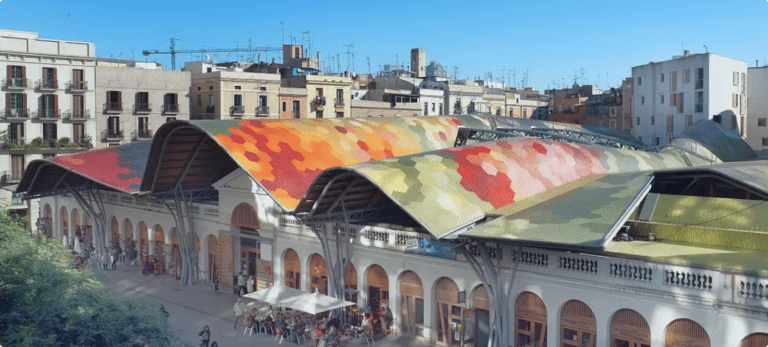
What surprised us most was the park's Cascade: we didn't know Gaudí had worked on it. And the Santa Caterina Market with its ceramic roof is amazing, we would never have visited it on our own.

Pablo G.Madrid, ES · TripAdvisor

Other tours you might also be interested in

More private tours in Barcelona

Montjuïc · Neighborhood

Private tour of Montjuïc with official guide

Tour of Montjuïc, the mountain from which power controlled Barcelona for centuries. From here, they bombarded the city and executed its president; on this very mountain, they staged a major International Exposition under the dictatorship of Primo de Rivera and hosted the Olympic Games that returned Barcelona to the world. Tour with an official tour guide.
First visit · Welcome

Welcome tour to Barcelona

Private welcome itinerary through the central neighborhoods of Barcelona: the Arc de Triomf, Ciutadella Park, El Born, the Gothic Quarter, and El Raval. Tour with an official tour guide.
Dark · History

Tour of mysterious and forbidden Barcelona

Walking itinerary through El Raval, the Gothic Quarter, Las Ramblas, and Plaza Cataluña: secret passages, public execution sites, famous crimes, and the stories that the official version of the city would prefer to forget. Tour with an official tour guide.

Contact

Do you have questions about the tour? We reply within 24h

If you have any questions or special needs before booking, write to us — we reply in less than 24 hours.


Write to us

This site is protected by reCAPTCHA and the Google Privacy Policy and Terms of Service apply.

Great! We have received your information.

You can also find us on

Book your tour
From €84.70 / person (groups of 6+) Book now