Rod listened to my previous tours and catered a day that was perfect. He was knowledgeable (sharing a binder with old maps and pictures) and very kind.
Home / Private Tours in Barcelona / Welcome tour to Barcelona
Private welcome itinerary through the central neighborhoods of Barcelona: the Arc de Triomf, Ciutadella Park, El Born, the Gothic Quarter, and El Raval. Tour with an official tour guide.


The welcome tour is the perfect way to start getting to know Barcelona. It doesn’t start at the Sagrada Família or Passeig de Gràcia: it starts at the Arc de Triomf, so the route follows the logic of the city rather than a checklist of monuments.
Over three hours on foot with an official tour guide, the tour gives you the keys to keep exploring Barcelona on your own: the Born neighborhood and its connection to the defeat of 1714; the Gothic Quarter, where two thousand years of Roman and medieval history are layered street by street; and El Raval, the neighborhood the city always tried to hide and the one that best tells the story of its contradictions. By the end of the tour, every street you walk down will have a meaning you would otherwise have missed.
The walk starts under the Arc de Triomphe and goes through the central neighborhoods of Barcelona on foot. The order of the itinerary has a logic: from the bourgeois city of the 19th century to the medieval core, and from there to the neighborhood that the city always tried to control.
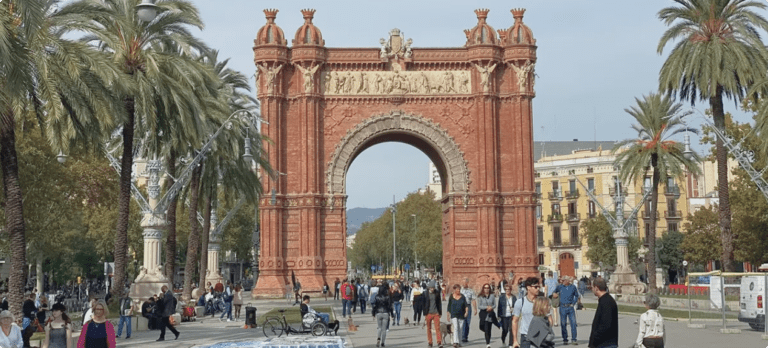
The arch does not commemorate any military victory. It was built by Josep Vilaseca in 1888 as a gateway to the Barcelona Universal Exposition, the event that transformed the city’s coastline and put Barcelona on the international map. The guide explains the political context of the Bourbon Restoration, the rivalry between Barcelona and Madrid, and why an industrial city wanted to present itself to the world with a triumphal arch of exposed brick in the midst of the effervescence of Modernisme.
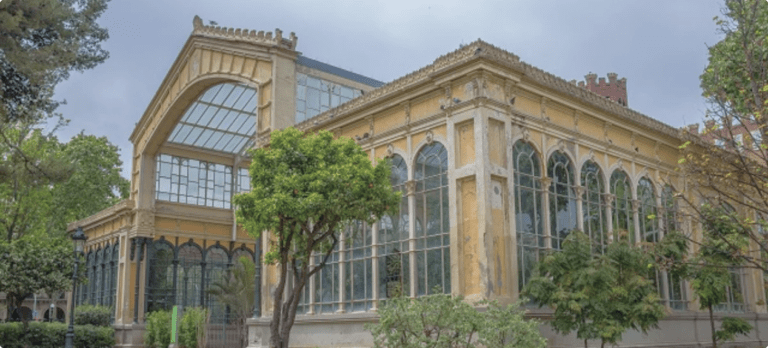
The park stands on the site of the military citadel that Philip V ordered built in 1716 after Barcelona’s defeat in the War of the Spanish Succession. For 150 years it was the symbol of Bourbon occupation: to build it, a large part of the La Ribera neighborhood was torn down, more than a thousand houses, and its residents were evicted by decree. The current park, designed by Josep Fontserè from 1872 onward, literally gave that space back to the city. The guide points out the monumental waterfall, which the young Antoni Gaudí helped build while still an architecture student, and explains the link between the park, the 1888 Universal Exposition and the Parliament of Catalonia, which today occupies the citadel’s former arsenal.
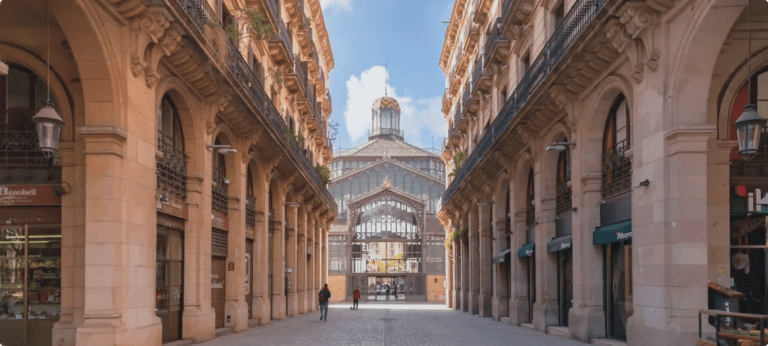
The neighborhood of merchants and artisans that during the Middle Ages concentrated the economic activity of the Crown of Aragon. The Mercat del Born (visible from the outside) is one of the best examples of 19th century iron architecture in Spain, and its subsoil holds the remains of the neighborhood razed to the ground in 1714. The guide walks through the streets of Carrer del Rec and around the Basilica of Santa Maria del Mar (built by the neighborhood’s own inhabitants between 1329 and 1383, without royal or episcopal commission) and explains why its construction was a political as well as an architectural act.
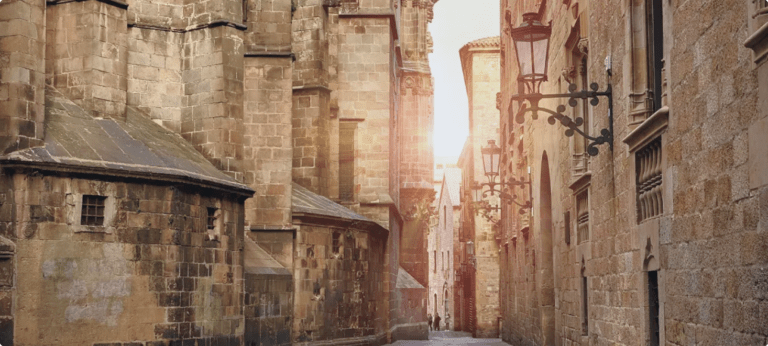
The heart of Roman, medieval and Renaissance Barcelona. Your guide shows you how the layout of the Roman city’s two main streets, the cardo and the decumanus, can still be traced in today’s street plan, and where the walls of Barcino come into view, with towers still standing among the neighborhood’s buildings. You’ll walk under the Pont del Bisbe, the neo-Gothic bridge linking the Palau de la Generalitat with the Casa dels Canonges: it looks medieval, but it was built by Joan Rubió i Bellver in 1928. One of the stops is Plaça de Sant Felip Neri, with shrapnel marks from the bombing by Franco’s air force in January 1938.
Historically outside the medieval walls, the Raval was for centuries the space where everything that the city did not want inside was installed: convents, hospitals, slaughterhouses, factories and, from the nineteenth century, the working population that came to work in them. The guide explains the transformation of the neighborhood since the 1990s (the MACBA, the CCCB, the Rambla del Raval) and what remains of the historic Raval: the Hospital de la Santa Creu, founded in 1401 and today home to the Library of Catalonia, and the streets of the southern sector that official urban planning never finished intervening. The walking tour allows you to read the Raval for what it is: the neighborhood that best tells the contradictions of Barcelona.
At the end of the walk, your guide will suggest what to do with the rest of your time in Barcelona based on what you’ve seen and what caught your interest.
INCLUDED
NOT INCLUDED
The price is per group, not per person: the total is split among everyone, so the more people in your group, the less each person pays.
| People | Total | Per person |
|---|---|---|
| 1 person | €344.85 | €344.85 / person |
| 2 people | €338.80 | €169.40 / person |
| 3 people | €363.00 | €121.00 / person |
| 4 people | €435.60 | €108.90 / person |
| 5 people | €514.25 | €102.85 / person |
| 6 people or more | — | €96.80 / person |
| People | Total | Per person |
|---|---|---|
| 1 person | €344.85 | €344.85 / person |
| 2 people | €338.80 | €169.40 / person |
| 3 people | €363.00 | €121.00 / person |
| 4 people | €435.60 | €108.90 / person |
| 5 people | €514.25 | €102.85 / person |
| 6 people or more | — | €96.80 / person |
* Children (from 0 to 11 years old): free. No hidden charges or reservation fees.
The Welcome Tour is the most popular during the first days of your stay: book early if you are arriving in high season. The tour runs in two daily time slots:
* We recommend booking at least 7 days in advance to guarantee guide assignment. In high season (May-September) the guides work at full capacity: the earlier you book, the more scheduling options you will have available.
Your guide will be waiting for you at the foot of the Arc de Triomphe. After booking, we will provide you with the guide’s telephone number so that you can be reached without any complications.
Under the Arc de Triomphe
Free cancellation available
You can cancel free of charge up to 48 hours before the tour start time. Cancellations made less than 48 hours in advance or no-shows will not be refunded.
Monument tours assume that you already have the general context of the city. The Welcome Tour provides that context: who founded Barcelona, how it grew, why certain neighborhoods have the character they do, and what the relationship is between them. With that mental map, a subsequent visit to the Sagrada Familia, the Gothic Quarter or any other part of the city takes on a completely different dimension.
If this is your first time in Barcelona and you want a tour to start getting to know the city, we recommend you to book this welcome tour on the second day at the latest. The reason is practical: the earlier you do it, the more you get out of the rest of the trip. Every place you visit afterwards (the Gothic Quarter, the Sagrada Família, the Born) already has a context that you would not have without the previous tour. Doing it on the last day is also possible, but you lose the main advantage: understanding Barcelona while you are still in it.
The standard itinerary covers the Arc de Triomf, Ciutadella Park, El Born, the Gothic Quarter and El Raval: five areas with distinct historical identities that, together, sum up two thousand years of history in the center of Barcelona. Three hours on foot at a comfortable pace, with time to stop and ask questions.
Yes. The walk through the old town has an immediate visual level that works well with children from 5-6 years old: narrow streets, squares with history, the Ciutadella park with lake and waterfall. The guide adjusts the vocabulary and pace to the group. Children under 12 years old are free of charge. Please indicate the age of the children when booking.
It depends on what interested you most during the tour. If the Gothic Quarter has got you hooked, the Private Tour of the Gothic Quarter and Cathedral goes into detail on the two thousand years of history of the medieval core. If Gaudí has come up in conversation, the Sagrada Família Private Tour or the Modernisme Private Tour are the natural next steps. If what has moved you is the political history of the twentieth century, the Private Tour of Barcelona during the Civil War is the most demanded by this profile. The guide will guide you at the end of the tour.
Directly from the booking button on this page. You can also contact us by WhatsApp if you have any doubts before booking: we will advise you on which tours to combine depending on the time you have in Barcelona.
Rod listened to my previous tours and catered a day that was perfect. He was knowledgeable (sharing a binder with old maps and pictures) and very kind.
He demonstrated not only the vertical architecture of the beautiful city but the horizontal and how it is played out.
I highly recommend this tour not only for first time visitors but also if you have been to Barcelona before.
With a charming personality and sense of enthusiasm, and a sensitivity to our preferred walking pace, we had a perfect day.
If you have any questions or special needs before booking, write to us — we reply in less than 24 hours.