


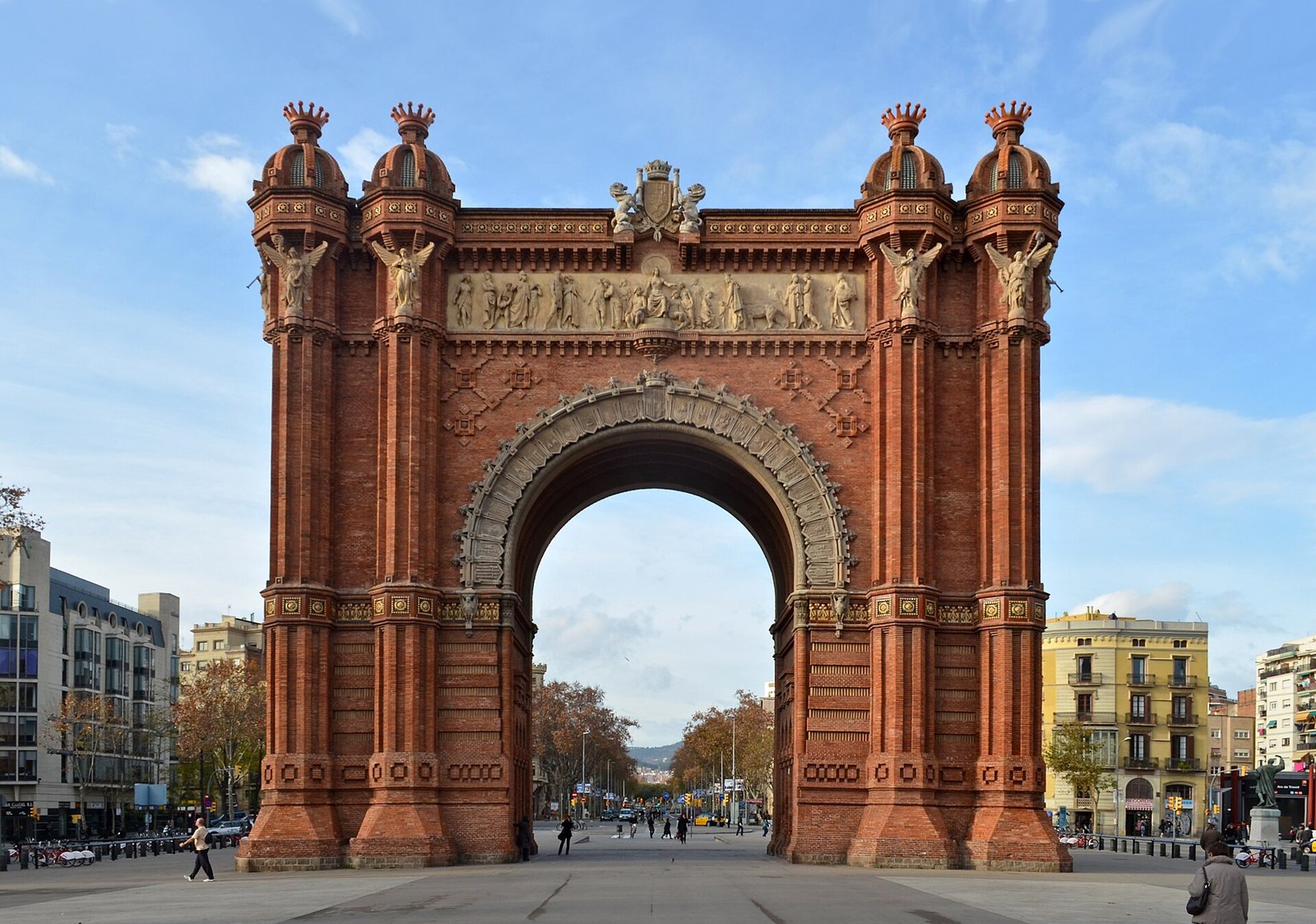
If you have been to Paris, it is easy to arrive with the wrong picture in mind: a white stone arch built for a victorious army. Barcelona's is something else. It is red, made of brick, trimmed with glazed tiles, and it was built to welcome the world to an international fair. That is why it makes sense that it is also where we welcome people who have just arrived in the city.
The arch was built for the 1888 Universal Exposition, the first big international exhibition held in Spain. It was the gateway to the fairgrounds, which took up the Parc de la Ciutadella and its surroundings. Visitors walked through it after buying a ticket, which cost one peseta. The Exposition opened to the public on April 8, 1888. The official opening was on May 20, with the queen regent Maria Cristina and the young Alfonso XIII, who was only two years old. It brought together 22 countries and more than 2 million visitors.
The site was full of symbolism. The Ciutadella had been a military fortress that the people of Barcelona hated, because it was built to keep watch over the city after the siege of 1714. General Prim's government handed it over to Barcelona on one condition: it had to become a public park. The Exposition, driven by mayor Francesc Rius i Taulet, completed the transformation. Barcelona then had just over 500,000 inhabitants and wanted to show the world it was a modern, industrial city.
The Exposition changed the rest of the city too. The waterfront was rebuilt with the Passeig de Colom, whose Columbus Monument was unveiled on June 1, 1888, and access streets such as La Rambla, the Passeig de Colom and Plaça de Sant Jaume got electric street lighting.
Classic triumphal arches, like the ones in Rome or Paris, commemorate military victories. Barcelona's does not. It is a civic arch: its message is the progress of the city and of the countries that came to the Exposition. That is why its reliefs show no battles or generals, only figures representing agriculture, industry, trade, science and the arts.
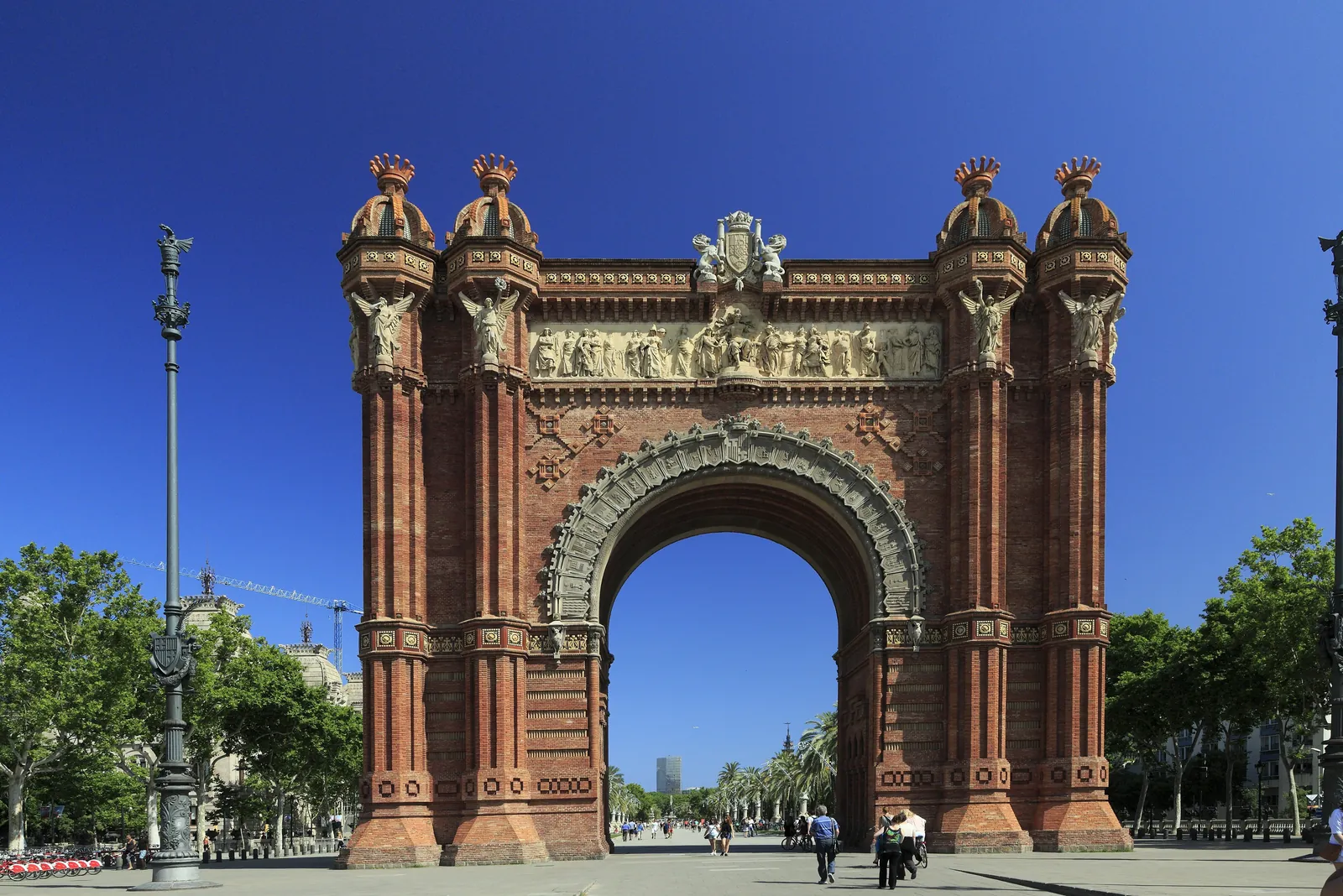
It was designed by architect Josep Vilaseca i Casanovas. Instead of the solid stone of the arches in Paris or Rome, he chose exposed red brick, decorated with glazed ceramics and some stone details. Its shapes recall Mudéjar architecture, which is why it is often described as Neo-Mudéjar. It sits halfway between 19th-century eclecticism and early Catalan Modernisme, the style that was about to fill the city with buildings by Domènech i Montaner and Gaudí. It is about 30 meters tall and was restored in 1989.
Legend
The story goes that when it was time to take down the scaffolding, Vilaseca was afraid the arch would collapse. His friend, the architect Gaietà Buïgas, who designed the Columbus Monument, stood right under the arch and ordered the scaffolding removed to prove it would hold. The arch did not move. It is a much-repeated anecdote, but no documents confirm it.
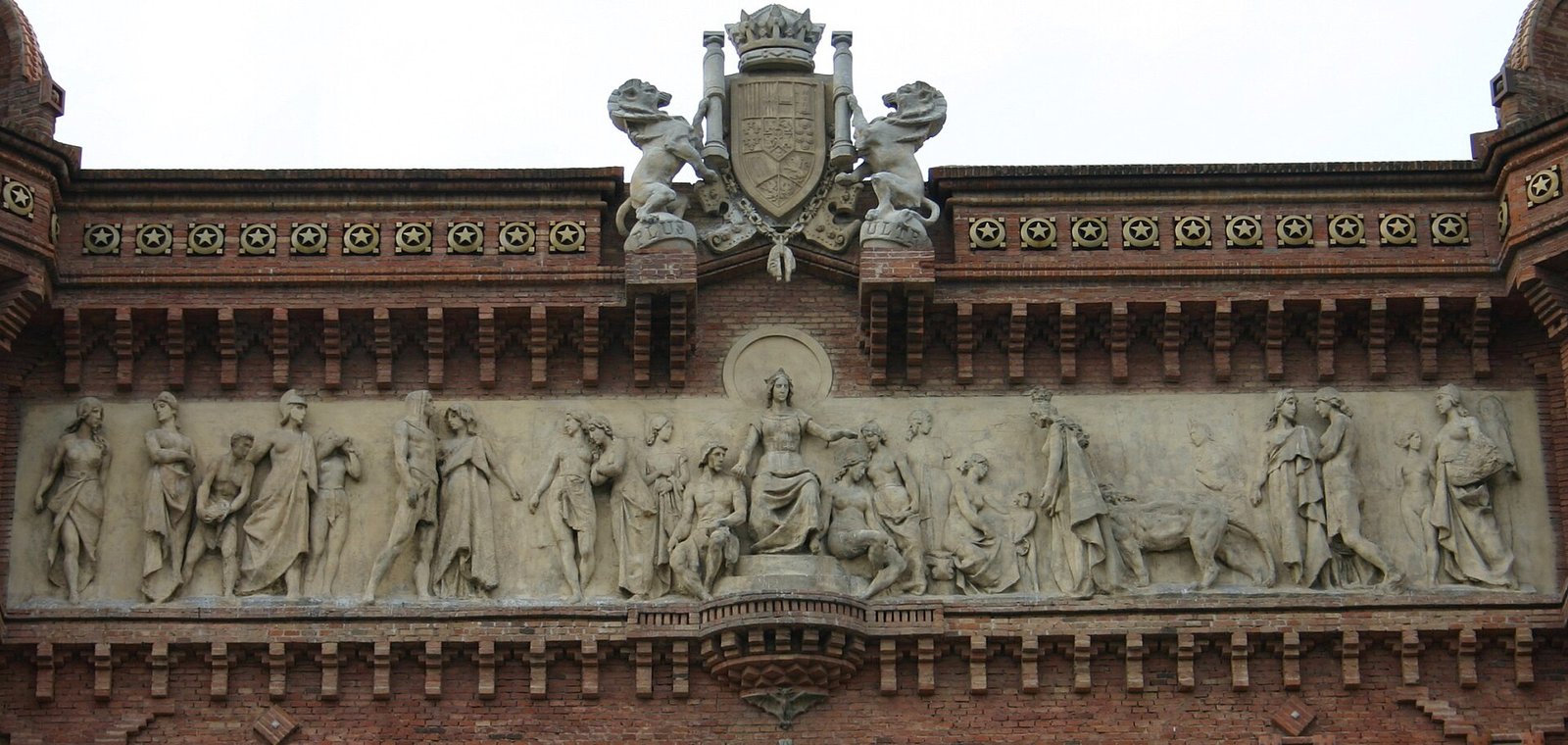
At the top of each of the four faces there is a frieze carved by a different artist. Together they explain what the Exposition was celebrating. These are the artists and themes listed by the Barcelona City Council and by Arquitectura Catalana, from the Architects' Association of Catalonia:
Where to look
Walk around the arch before you go through it. From Passeig de Sant Joan you see Barcelona welcoming the nations. From the park side you see the prize scene. Above the frieze, in the center, is the royal coat of arms flanked by two lions.
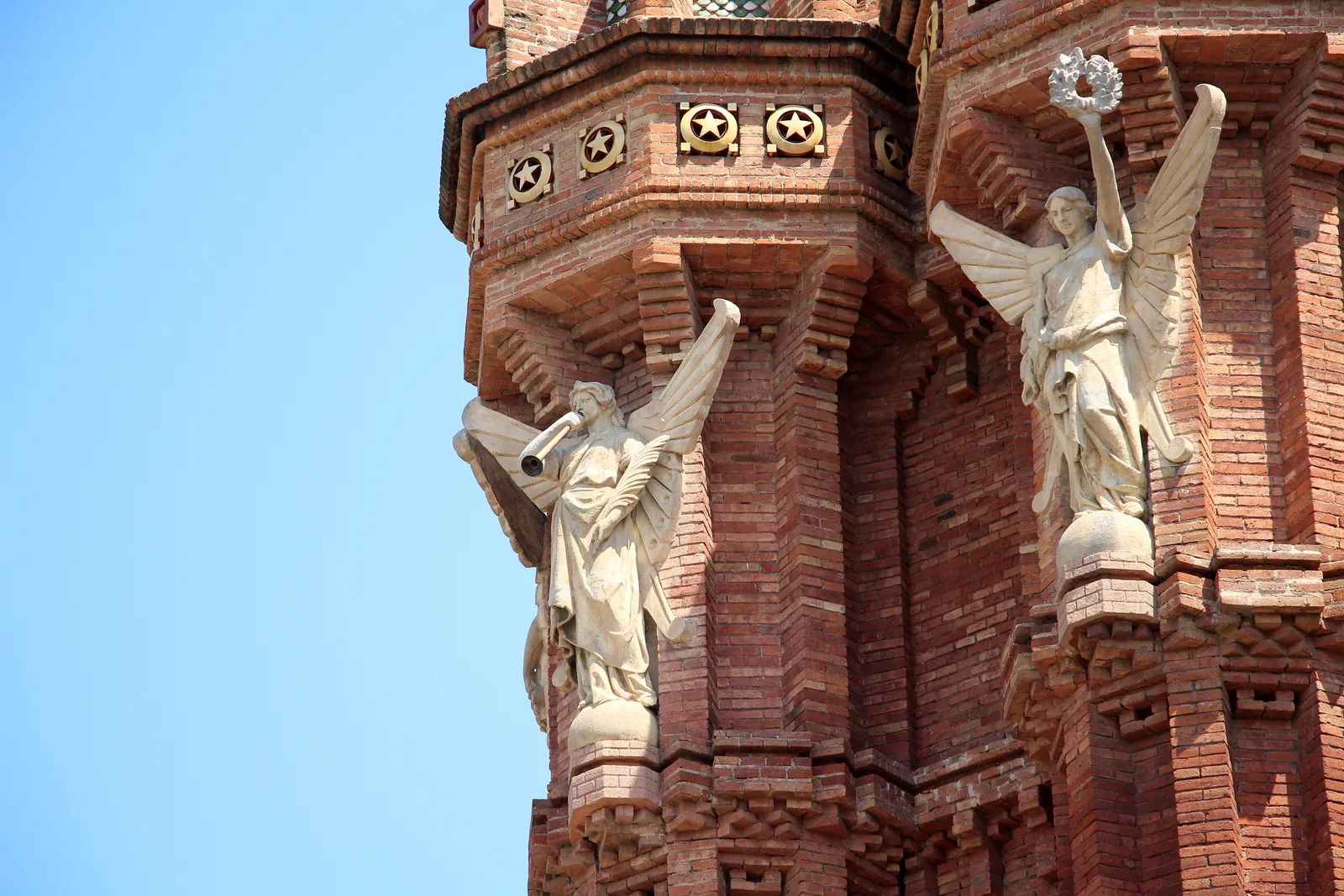
On the corners, above the columns, stand twelve winged figures of Fame by Manel Fuxà and Pere Carbonell. Some blow trumpets and others hold laurel branches, the symbol of glory. Around the curve of the arch, Barcelona's coat of arms takes the center, surrounded by those of the other 48 Spanish provinces of the time, 24 on each face.
Where to look
Among the decoration near the coats of arms, look for some bat-shaped figures. Hardly anyone notices them.
Usually not. The arch is hollow and has stairs inside that lead to the top, but the interior is closed to the public and only opens on occasional open-house days. On some of those days there have been lines of 3 to 4 hours to see Barcelona from the top. What you can always do, for free and at any time, is walk under it and around it.
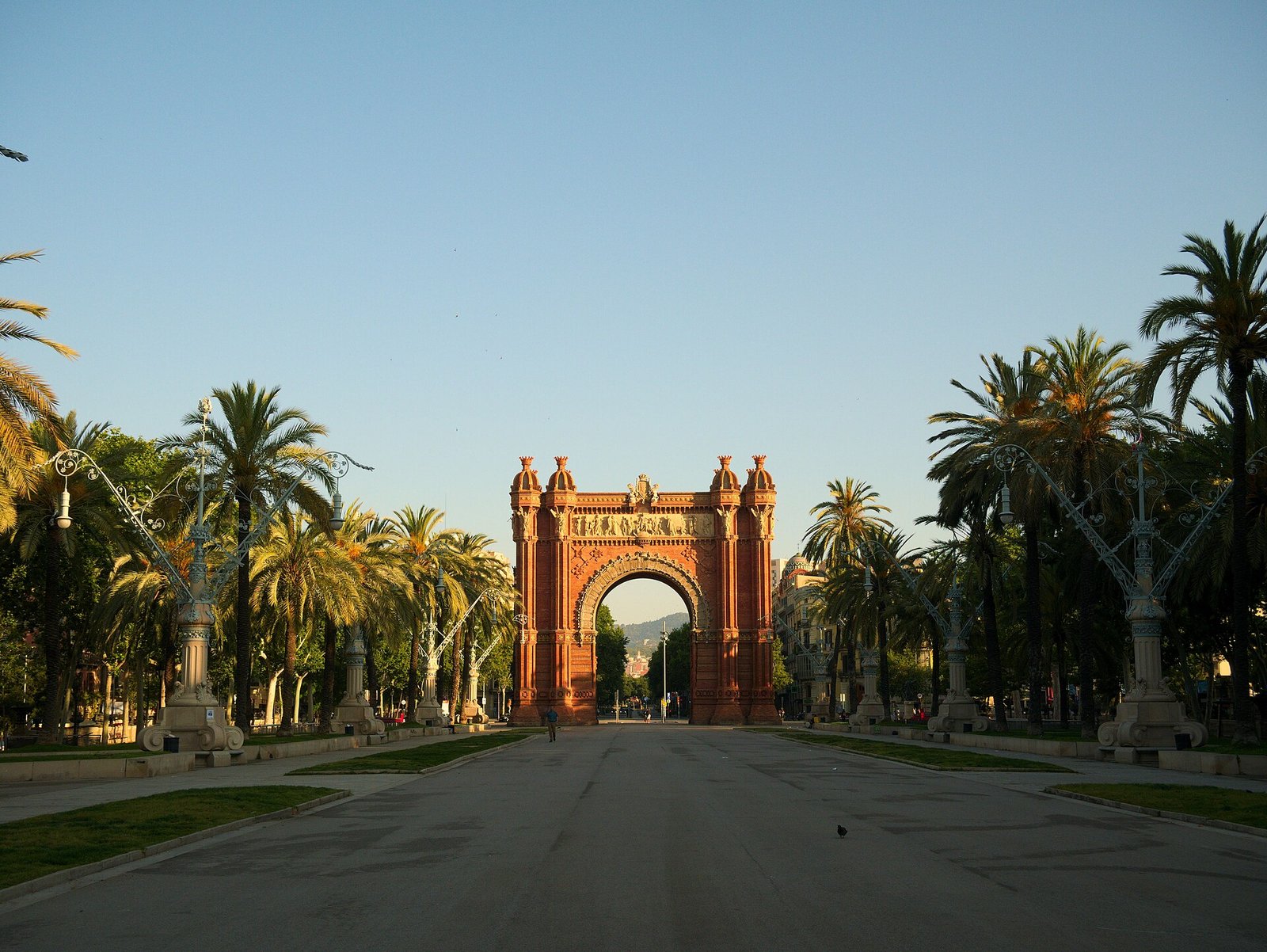
Walk through the arch toward the sea and you are on Passeig de Lluís Companys, a promenade about 50 meters (165 feet) wide that leads to the Parc de la Ciutadella. Look at the large Modernista street lamps: each has a stone bench at its base and two wrought-iron arms. They are replicas, because the originals were badly damaged when the underground parking garage was built.
In 1888 the promenade had eight bronze statues. Only two originals remain: the Baroque painter Antoni Viladomat, palette in hand, and Admiral Roger de Llúria, in armor with his sword. The promenade is named after Lluís Companys, president of the Catalan government executed by the Franco regime at Montjuïc Castle in 1940. At the corner with Ronda de Sant Pere there is a monument to him by Francisco López Hernández: a monolith with his medallion and the figure of Conxita Julià, a young woman who wrote to him while he was in prison.
Where to look
On one side of the promenade stands the Palau de Justícia, by Enric Sagnier and Josep Domènech i Estapà, built between 1887 and 1911, with a facade about 200 meters long made of Montjuïc stone.
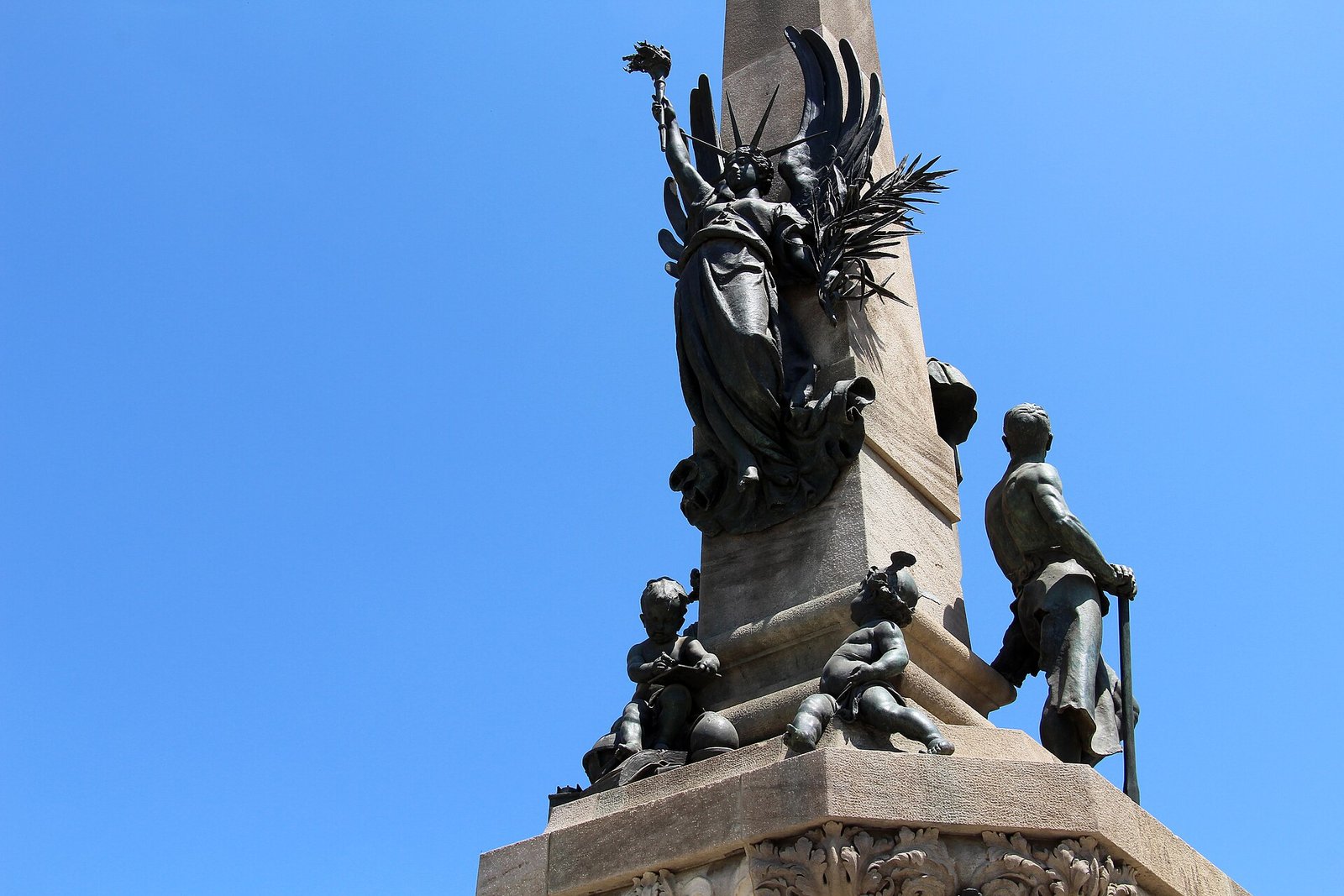
At the end of the promenade, just before the Ciutadella, is the monument to mayor Francesc Rius i Taulet, the driving force behind the Exposition. It is by Manel Fuxà. Its four sides carry bronze shields showing four of the mayor's projects: the Ciutadella park, the 1888 Exposition, the Columbus Monument and the Gran Via de les Corts Catalanes. At the top, Fame holds up a torch.
The park entrance is flanked by two large sculpture groups representing Trade and Industry. Inside, some Exposition buildings still stand, such as the Castell dels Tres Dragons by Lluís Domènech i Montaner, which was the fair's café and restaurant, and the Hivernacle greenhouse. Most of the 1888 palaces were torn down afterward. From the old military compound, the arsenal (now home to the Parliament of Catalonia), the chapel and the Governor's Palace survive.
Tip. Pair the arch with a walk through the Parc de la Ciutadella and the El Born neighborhood next door. Here is what to see in El Born, Barcelona.
The usual advice is to go early in the morning or late in the afternoon, and that the arch looks best framed by the palm trees along the promenade. The morning part is right. Late afternoon, though, is not a great time for the shot from the promenade, as you will see below.
Our advice: for a quiet visit, go early in the morning on a weekday. Passeig de Lluís Companys gets lots of tourists and locals walking through. Early in the morning it is almost empty, but afternoons and weekends are much busier. On top of that, the promenade hosts races, fairs and concerts, and on those days it gets packed and partly closed off. Since July 2025, Barcelona City Council has capped the promenade at 25 events a year, so there are fewer event days, but they still happen.
For the classic photo (the arch seen from the promenade, with palm trees on both sides), our advice depends on the season. The side facing the promenade, with Llimona's frieze, faces south-southeast. Because of that, from fall to spring it gets direct sun from mid-morning to early afternoon, with low, warm light that brings out the brick. In summer the midday sun is almost overhead, the light is harsh and it is hot: go early instead. At sunset the arch is backlit from the promenade, which works for silhouettes but not for details. And for the same reason, the Passeig de Sant Joan side stays in shade most of the time in fall and winter.
Tip. Take the photo from the middle of the promenade, a few yards toward the park, with the lampposts and palm trees on either side. Early in the morning you get a clean shot. If you are going on a weekend, check the City Council's events calendar first. If there is an event on the promenade that day, go another day or very early. In fall and winter, our 10:30 am tour lines up with good light on the side of the arch that faces the promenade.
Lists of cafés near the arch tend to mix very different places, from theme cafés built for visitors to spots that have already closed. Here is our pick, all 5 minutes or less on foot from the arch:
Tip. If you are taking the 10:30 am tour on a Saturday or Sunday, Pipol is the safe bet, because El Café de las 2 is closed on weekends and Lato tends to fill up. If you are taking the 4:30 pm tour, Lato will already be closed. Get coffee at Pipol or, Monday to Friday, at El Café de las 2. At El Café de las 2, order a freshly made Spanish omelet sandwich (bocadillo de tortilla).
People usually say the arch and the promenade are a calm but touristy area, with pickpockets like anywhere downtown. That is accurate: no public data flags it as a particularly dangerous spot, but the risks are the same as in any busy place in Barcelona.
Our advice: around the arch, there are three moments when you should stay alert. Coming out of the Arc de Triomf metro station, wear your backpack or bag in front and zipped, especially on the stairs. At café terraces, keep your phone in your pocket, not on the table. And on the promenade benches, keep your bag where you can see it, not beside you unattended. If someone asks you to sign something, shows you a big map, puts a bracelet or a sprig in your hand or points out a stain on your clothes, do not accept anything and keep walking.
The promenade is pedestrian, but bikes and scooters cut across it, and the Passeig de Sant Joan and Ronda de Sant Pere bike lanes meet around the arch. Look both ways before crossing and do not walk along the curb with your phone in your hand.
Tip. To get your photo taken, ask your guide or someone in your group, not a stranger who offers. In an emergency, call 112. If something is stolen, you can report it at any station of the Mossos d'Esquadra (the Catalan police) or the Guàrdia Urbana (the city police). The Guàrdia Urbana also publishes its tips for crowded places (in Catalan).
The meeting point of our welcome tour of Barcelona is right under the Arc de Triomf. From here your guide walks your group down Passeig de Lluís Companys to the Ciutadella and then through El Born, the Gothic Quarter and El Raval, so you understand the city from day one. It is a 3-hour walking tour, just your group, with an official licensed guide, in English or Spanish, at 10:30 am or 4:30 pm. Kids 0 to 11 go free and you can cancel for free up to 48 hours before.
If you want more time in this area, our private El Born tour in Barcelona focuses on the park and the neighborhood next to it. And if what caught your eye is the jump from the brick of 1888 to Modernisme, our Barcelona Modernism tour follows that story. For the old town, here are the things to do in the Gothic Quarter of Barcelona.
“With a charming personality and sense of enthusiasm, and a sensitivity to our preferred walking pace, we had a perfect day.”
Barbara · Viator, welcome tour with Roberto, 2023
Before you go. The inside of the arch is not usually open: if you want to go up, check Barcelona's open-house event calendar. Main photo: Arc de Triomf, by Selbymay (Wikimedia Commons, CC BY-SA 3.0). Facts about the arch checked against Barcelona City Council and the Architects' Association of Catalonia in November 2026. Event cap on the promenade and safety tips checked against Barcelona City Council and the Guàrdia Urbana in November 2026.
Because it was built as the main gateway to the 1888 Universal Exposition, held in the Parc de la Ciutadella. It does not commemorate a military victory: it is a civic arch that celebrates the progress of the city and of the countries that took part.
It was designed by architect Josep Vilaseca i Casanovas. The friezes are by Josep Reynés, Josep Llimona, Torquat Tasso and Antoni Vilanova, and the twelve figures of Fame are by Manel Fuxà and Pere Carbonell.
About 30 meters (roughly 100 feet). It is made of exposed red brick, with glazed ceramic decoration and stone details.
The Paris arch is made of stone and commemorates military victories. Barcelona's is red brick, Mudéjar-inspired, and was built as the entrance to a world's fair, so its reliefs are about trade, industry, science and the arts.
Not normally. It has stairs inside, but it only opens to the public on occasional open-house days. Seeing it from outside and walking under it is free and possible at any time.
Early in the morning on a weekday, when the promenade is almost empty. For the photo from Passeig de Lluís Companys, our advice from fall to spring is mid-morning, when the sun hits that side head-on. In summer, go early. At sunset the arch is backlit from the promenade.
Yes, it is a calm area, but a very touristy one, so there are pickpockets like anywhere downtown. Wear your backpack in front when you come out of the metro, do not leave your phone on a café table and look carefully before crossing the bike lanes.