


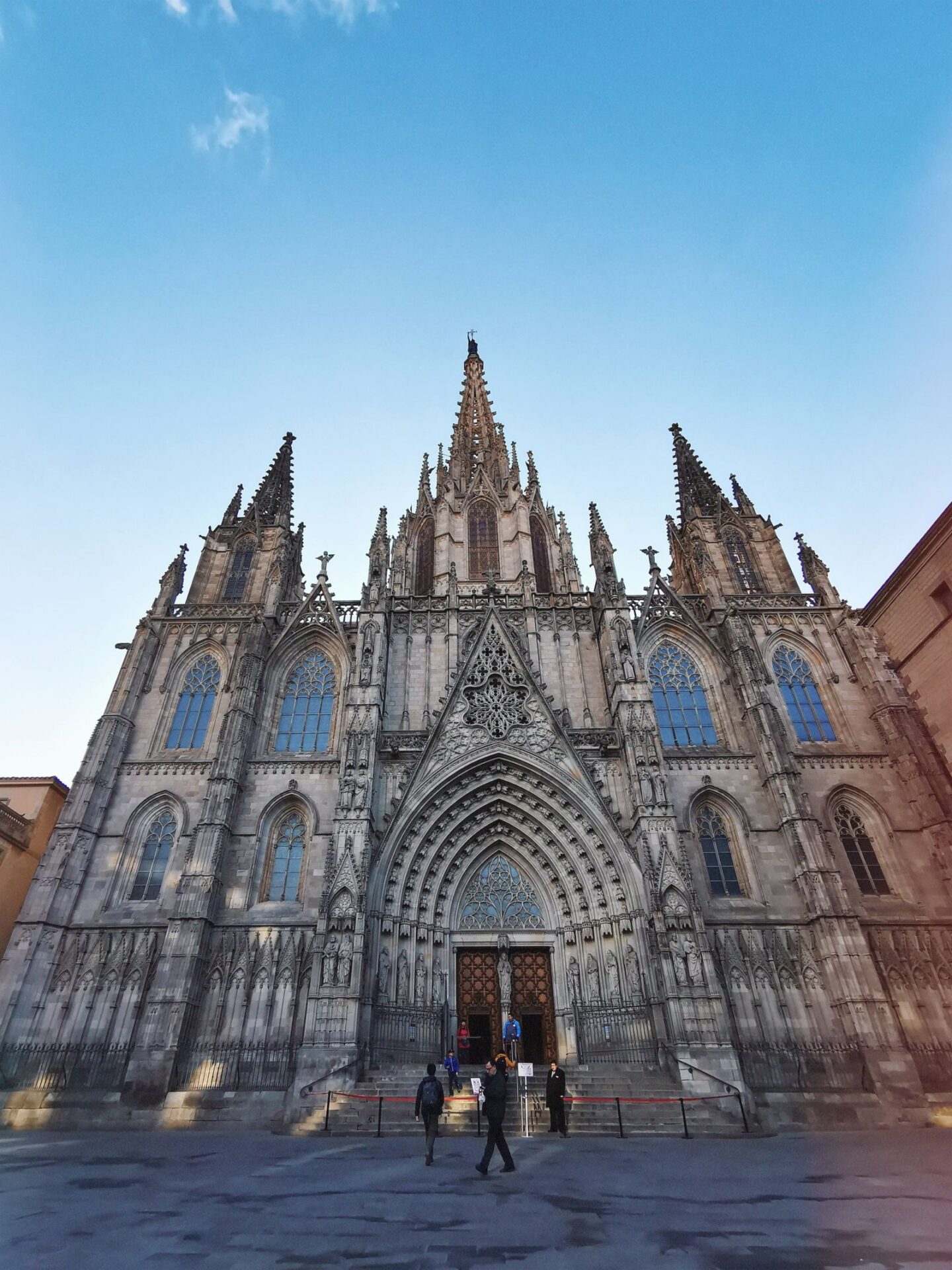
The Cathedral of the Holy Cross and Saint Eulàlia (Santa Creu i Santa Eulàlia) is the most important church in Barcelona, because it is the seat of the bishop. And it holds a surprise for anyone who comes for the photo: the facade that looks the most medieval is actually the newest part of the building. The truly old parts are inside, in the cloister and the crypt. Outside, they're on the apse, at the back, where hardly anyone goes.
On this very spot there was an early Christian church with three naves from the 4th century, with its baptistery and the bishop's palace. The Romanesque cathedral that replaced it was consecrated in 1058, after Almanzor sacked the city in 985. The Gothic cathedral you see today was begun on May 1, 1298, during the reign of Jaume II, and construction lasted until 1463.
The Romanesque church wasn't torn down all at once. It was rebuilt in stages while it was still being used for worship. That's why the Gothic high altar rests on two 6th-century capitals reused from the early Christian church. And it's a cathedral, not a basilica like the Sagrada Família or Santa Maria del Mar, because this is where the cathedra, the bishop's chair, is kept.
For centuries the main facade was a plain, unfinished wall, because the plague and the war of the 15th century left the project without money. The banker Manuel Girona paid for it in the late 19th century, and it was built between 1887 and 1890, based on a medieval design from 1408. When the scaffolding came down, the criticism poured in, and more decoration was added. The central dome, the spire you see in the middle, wasn't finished until 1913, so it's from the same era as the Sagrada Família.
Where to look
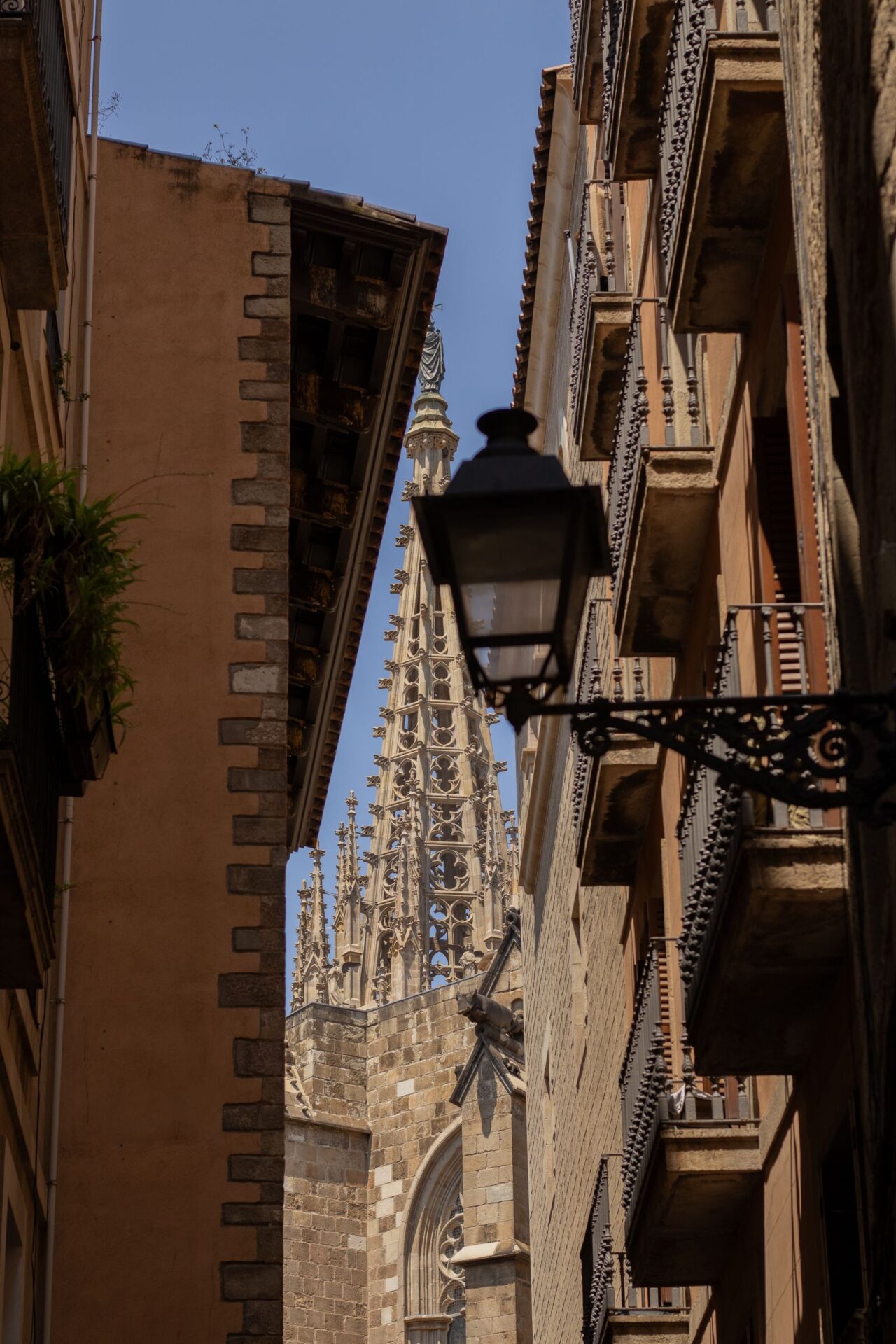
The oldest parts of the Gothic Cathedral are the Sant Iu portal, on the side, and the apse. On each side of the Sant Iu portal there is a Latin inscription commemorating the laying of the first stone on May 1, 1298.
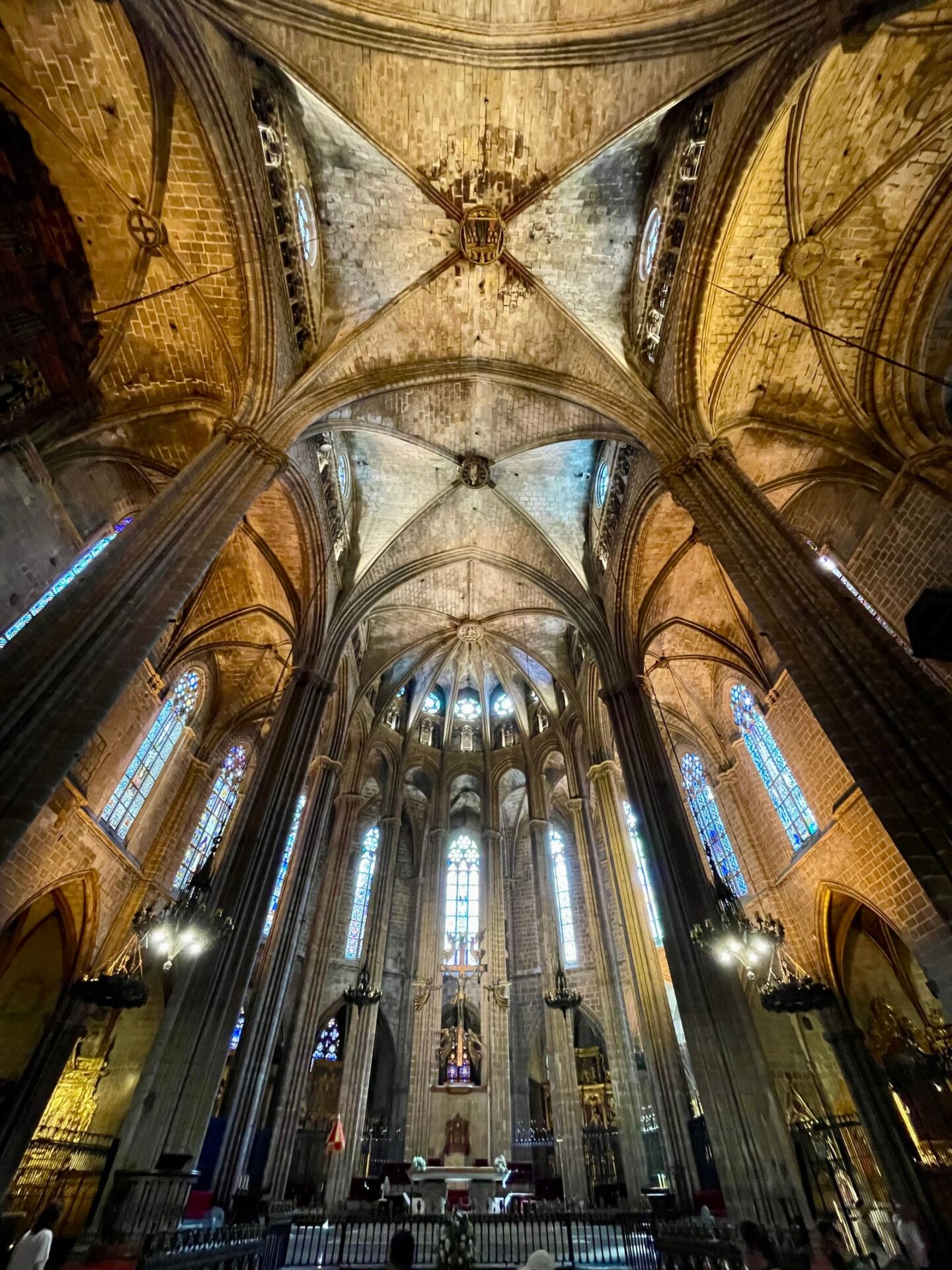
Inside, the Gothic nave soars upward. In the center is the choir, begun in 1390, with choir stalls that are one of the great ensembles of Gothic sculpture in Catalonia. In 1517 and 1518 the coats of arms of the knights of the Order of the Golden Fleece were painted on the backs of the stalls. Emperor Charles V gathered the knights here in March 1519. At the entrance to the choir is the wooden pulpit from 1403. Behind the choir is the choir screen, with scenes from the life of Santa Eulàlia, which Bartolomé Ordóñez began in 1519.
Where to look
Look up. The Cathedral has 215 vault keystones from the 14th and 15th centuries, and when they were restored in 1970, it turned out they had been painted in color.
In the Chapel of the Blessed Sacrament, the old chapter house, you'll find the Christ of Lepanto, the carving that presided over John of Austria's galley at the battle of 1571.
Tip. Photos aren't allowed in this chapel, and you can't go in during Mass. On weekdays there's Mass here at 10:00 a.m., 11:00 a.m. and noon. If you want to see the Christ of Lepanto without a rush, head to this chapel as soon as the Cathedral opens, at 9:30 a.m.
Legend
The Christ of Lepanto leans to one side. The story goes that it moved to dodge a cannonball during the battle. Experts believe the tilt is simply the sculptor's style.
This is the must-see part of the visit. The Gothic cloister was built between the 14th and 15th centuries and has four galleries of pointed arches around a garden with palm trees, magnolias and an orange tree. Thirteen white geese live in the pond. According to tradition, there are 13 because that was the age of Santa Eulàlia, co-patron saint of Barcelona, when she was martyred.
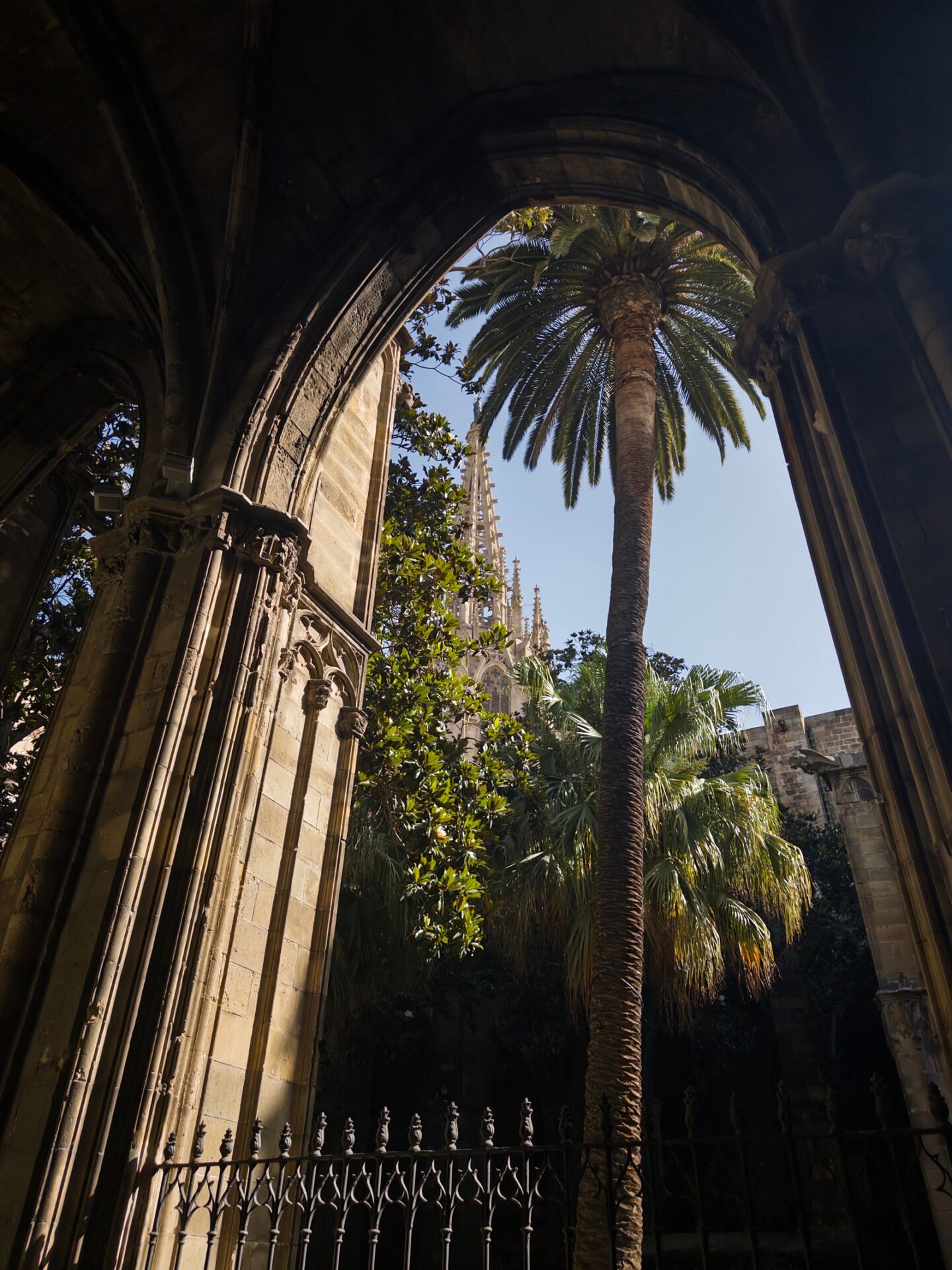
All around are chapels paid for by the medieval guilds, and the floor is covered with tombstones carved with the tools of each trade. The door connecting the cloister to the Cathedral is Romanesque, made of white marble, and is believed to come from the earlier cathedral. On the feast of Corpus Christi, the cloister hosts "l'ou com balla" ("the dancing egg"): an empty eggshell dances on top of the fountain's jet of water. The custom has been recorded in the Cathedral's accounts since 1637.
Where to look
In one of the galleries is the tomb of Mossèn Borra, who died in 1433 and was ambassador and court jester to King Alfonso V. His reclining statue is dressed as a jester. In one corner, under a small pavilion, the fountain of Sant Jordi has a little bronze figure of the saint slaying the dragon.
Legend
There's another version about the geese: since they are noisy and territorial, it's said they were brought in to scare off anyone trying to steal from the Cathedral during construction.
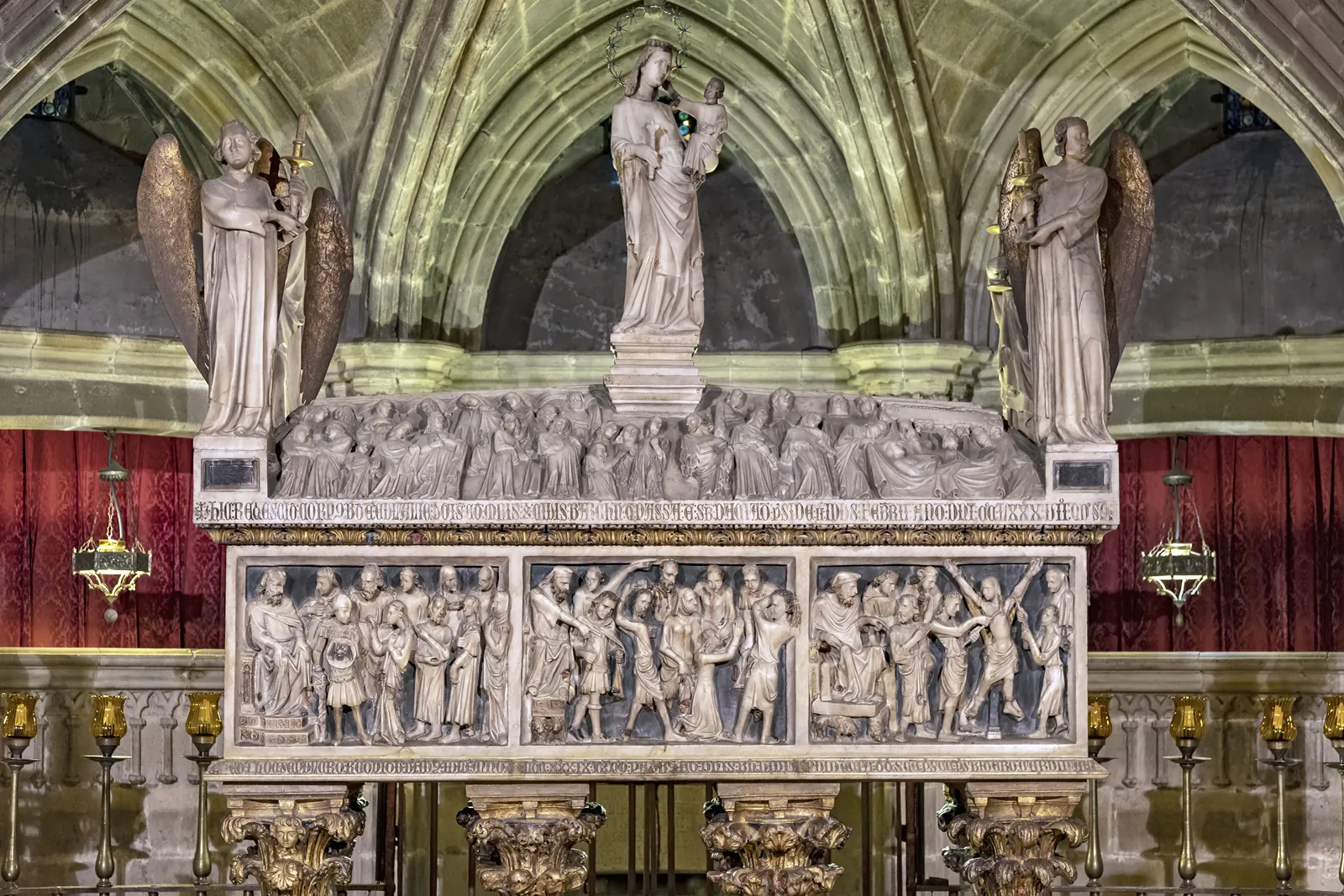
Beneath the high altar, a flight of steps leads down to the 14th-century crypt. There you'll find the Gothic alabaster sarcophagus that holds the remains attributed to Santa Eulàlia. It's the work of Lupo di Francesco and is carved with scenes of her martyrdom. The remains were found around the year 877, and Bishop Frodoí attributed them to the saint. That's why the Cathedral added her name to that of the Holy Cross. You go down a few steps to reach the crypt, and it's closed to visitors during Mass.
Legend
According to tradition, Eulàlia was a 13-year-old girl from Sarrià who endured 13 tortures, one for each year of her life, and when she was crucified, it snowed to cover her body. Many historians believe her story is a version of the story of Saint Eulalia of Mérida, because there are no records of her from before the 9th century.
From the chapel of the Sants Innocents, next to the Sant Iu door, an elevator takes you up to the terraces. Up top you get a close look at the two bell towers, the Gothic spires and the dome, crowned by Saint Helena holding the Holy Cross. You also see the cloister from above and get a great panoramic view of central Barcelona.
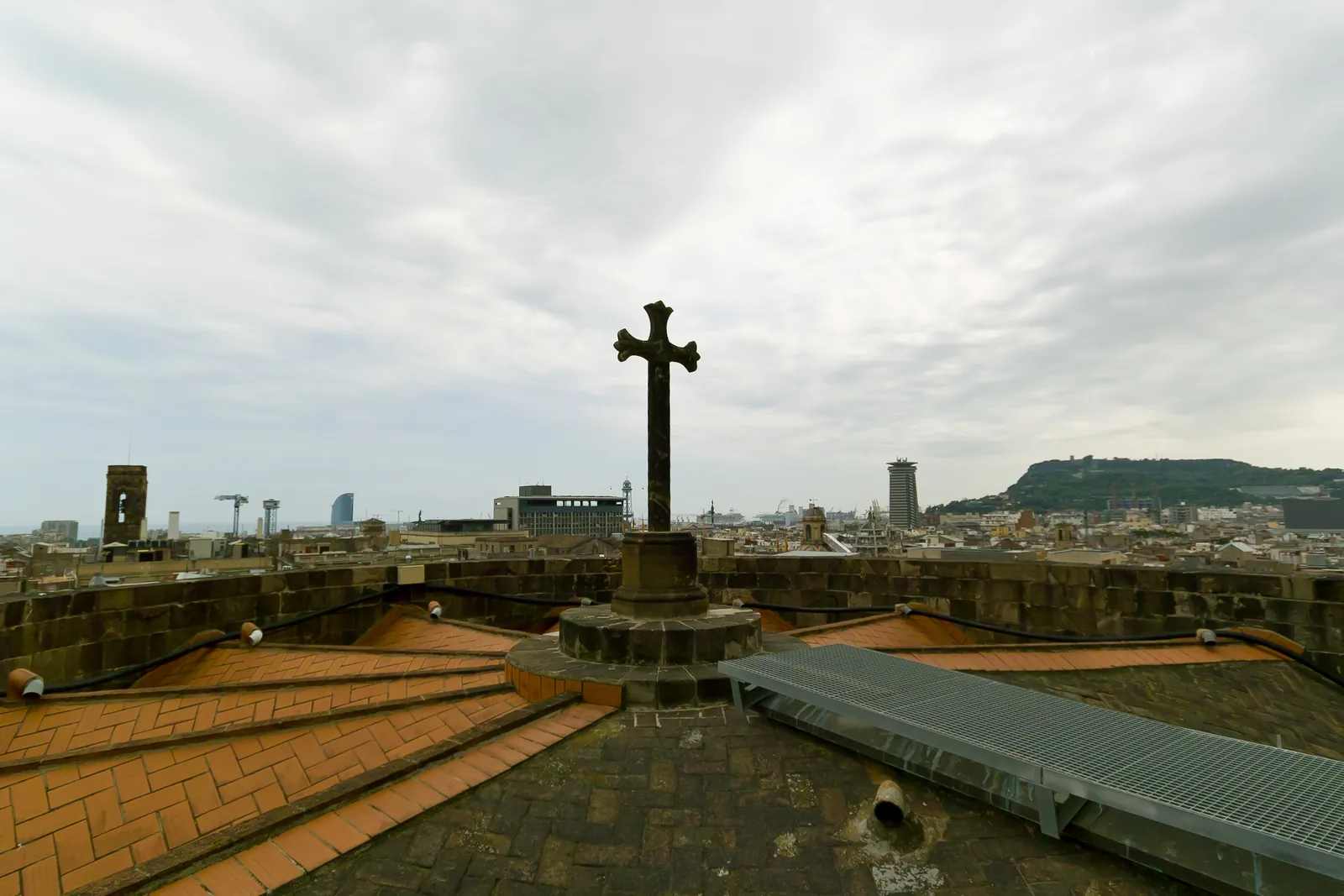
The terraces are included in the €16 general admission, so you don't pay extra for them. The elevator is small and takes only a few people at a time. Up top there are walkways across the roof between towers, pinnacles and gargoyles. The view isn't as sweeping as the one from Montjuïc or Tibidabo. What makes it special is walking on a Gothic roof in the middle of the old town, and that's why our advice is to always go up.
Tip. Allow time for the elevator line. If it's very windy or raining, save the terraces for another day.
The old Chapter House, which you enter from the cloister, is now a small museum. It holds an 11th-century baptismal font shaped like a cloverleaf and the Pietà by Bartolomé Bermejo, from 1490. It's one of the great Gothic paintings of the Iberian Peninsula.
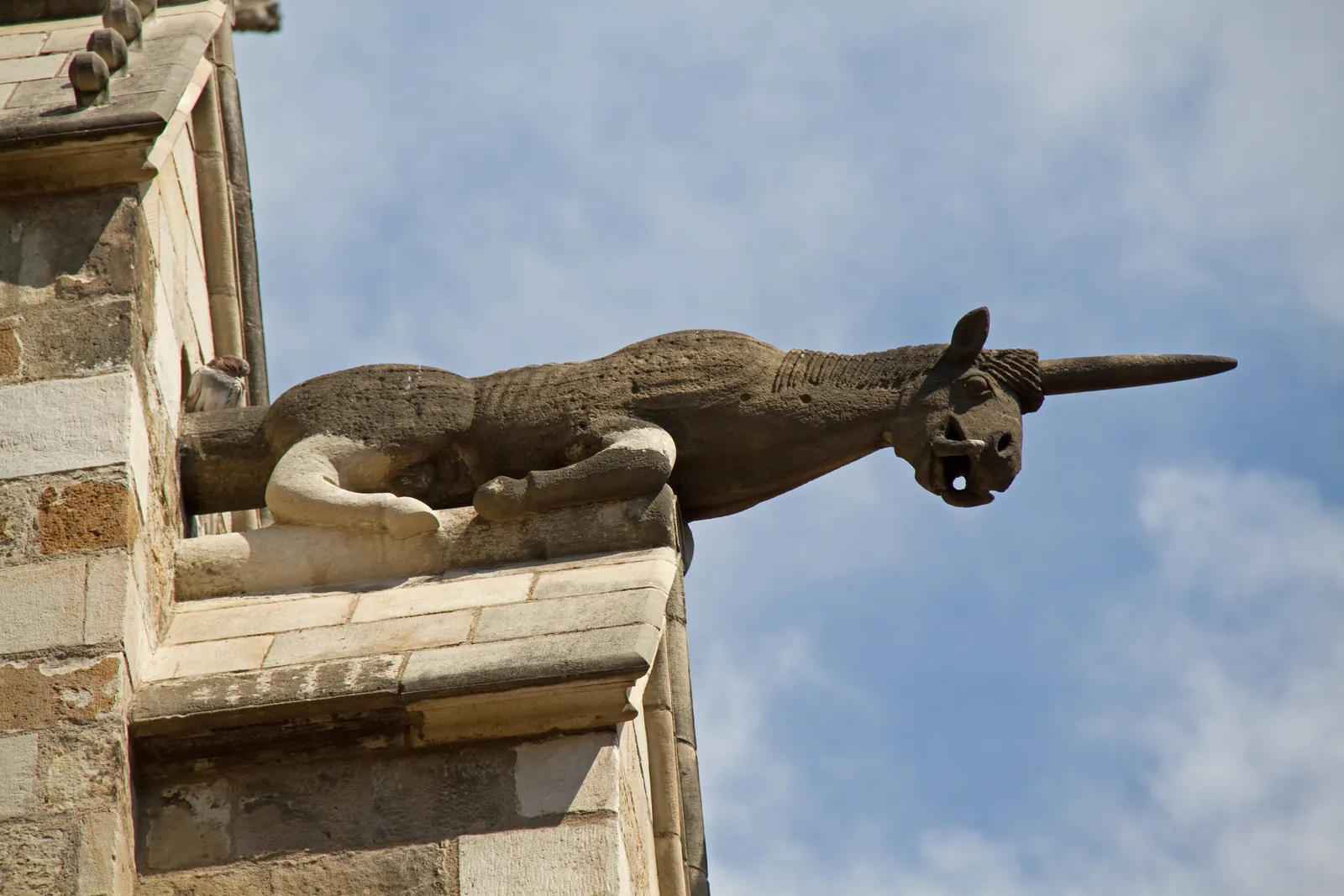
Before or after you go in, walk around the Cathedral. On the apse, at the back, there are more than 150 gargoyles. Among them is a small zoo straight out of the bestiaries, the animal books of the Middle Ages: a bull, a ram, a bee, an elephant and a unicorn, a symbol of purity in the Middle Ages.
Where to look
To the left of the Sant Iu portal you'll see a bricked-up door. It's all that remains of a passage between the palace and the Cathedral, built so King Martí could go to Mass without stepping out into the street. On Carrer dels Comtes, a shoe carved into the wall recalls that the shoemakers' guild gave up part of the land.
These are the hours and prices published on the official Barcelona Cathedral website in November 2026. With our tour you don't have to buy anything: admission, the cloister and the crypt are included.
Many guides and blogs still say the Cathedral is free during "worship hours," early in the morning or late in the afternoon, and that the terraces cost extra. That information is out of date. Today the official website only lists the visiting hours, which require a ticket, and doesn't list any free hours for visitors. The only thing that's free is attending Mass, and Mass isn't a visit. During the service you can't walk around or take photos. Also, the weekday and Saturday morning Masses are held in a chapel, not in the nave.
Our take: yes, it's worth it. The €16 ticket covers the church, the cloister, the choir, the terraces, the Chapter House, the Chapel of the Christ of Lepanto and the "Memòria jueva a la Catedral" exhibit on the city's Jewish heritage. It's a fair price for everything you see. If you come on the Willy's Plan private tour, admission is already included and you skip the ticket line.
Tip. Buy your ticket on the Cathedral's official ticket website or at the ticket office. Resale sites charge more for the same thing, and some have names that look official but aren't. If you'd like to experience the Cathedral as a place of worship, go to the Sunday conventual Mass at 10:30 a.m. It's in Catalan and is held at the high altar in the main nave.
The usual advice is to go first thing in the morning or late in the day, and on a weekday. That's true, but it helps to pin it down with the current hours.
Our take: get there when it opens, at 9:30 a.m., Monday through Friday, before the groups touring the Gothic Quarter arrive. The other good option is a weekday afternoon, around 4:00 p.m. The crowds thin out and you still have time to see everything: last entry is at 5:45 p.m. and a full visit takes 1.5 to 2 hours. Avoid Sundays, because visiting hours are only 2:00 to 5:00 p.m. and everyone crowds into those three hours. Avoid Saturdays too, because it closes earlier and it's busier. From May to September there are more visitors. From November to March it's calmer at any time of day.
Tip. If you go at opening time, start with the elevator to the terraces, because that's where the line builds up when it gets busy. Save the cloister for last, since the exit route goes through it. For photos of the facade, the square is emptier first thing in the morning.
Guides usually suggest between 90 minutes and 2 hours. Our take: 1.5 hours for the essentials, meaning the nave, the crypt, the choir, the cloister with the 13 geese and the terraces. Plan on about 2 hours if you add the Chapter House and the "Memòria jueva a la Catedral" exhibit, or if there's a line for the elevator.
You'll often hear that you need to cover your shoulders and knees and that enforcement depends on the day. Our take: take it seriously, because the rule is official. The Cathedral's website states that shorts, tank tops and caps aren't allowed. Food and drinks, flash photography and suitcases aren't allowed either. And the rule is enforced: over the years, visitors in shorts or tank tops have been turned away at the door. The staff at the entrance make the call, so it's best to show up already dressed for it rather than count on fixing it there.
Tip. In summer, wear pants or a skirt that falls below the knee and keep a scarf or a light shirt in your bag to cover your shoulders. Take off your cap when you go in, and don't bring your suitcase, even if it's your arrival or departure day.
The square in front of the Cathedral is full of places aimed at tourists, and almost everyone agrees it's worth walking a few streets away. These are our favorites, all less than a 6-minute walk:
Tip. At Cafè de l'Acadèmia, ask for the menú del día. It's the best value, and it may not appear on the English menu. At Bodega La Palma, vermouth time is before lunch, from noon to 2:00 p.m.
The Cathedral is the centerpiece of our private Gothic Quarter tour. It's 3 hours on foot with a licensed tour guide, just your group, in English or Spanish. It starts at 10:30 a.m. or 4:30 p.m. Kids ages 0 to 11 go free, and you can cancel free of charge up to 48 hours in advance. If you want to see everything around the Cathedral, here are the things to do in the Gothic Quarter, stop by stop.
"Tour guide was amazing. Personalized the tour and gave us fascinating details. Made us see how wonderful personal tours can be!"
Harold · Viator, 2026
Before you go. The Cathedral is an active church: hours change during religious celebrations and some areas may close during Mass. Check the hours on the official website the same day.
No. Barcelona Cathedral is in the Gothic Quarter, it's Gothic, and it's the seat of the bishop. The Sagrada Família is Gaudí's basilica, in the Eixample, and it's still under construction. They're two different visits, in different neighborhoods.
Yes, and it's included in the €16 general admission: you don't pay extra. You go up by elevator from the chapel of the Sants Innocents, next to the Sant Iu door, and from the top you can see the towers, the dome and the cloister.
Not as a visitor. The official website no longer lists any free hours for visits. General admission costs €16 and includes the cloister, the choir, the Chapter House and the terraces. Attending Mass is free, but during the service you can't walk around or take photos. Admission is free for people with a disability rating of 33% or more and for ICOM card holders.
Yes. Shorts, tank tops and caps aren't allowed, and the rule is enforced at the door. Wear pants or a skirt below the knee and bring something to cover your shoulders.