


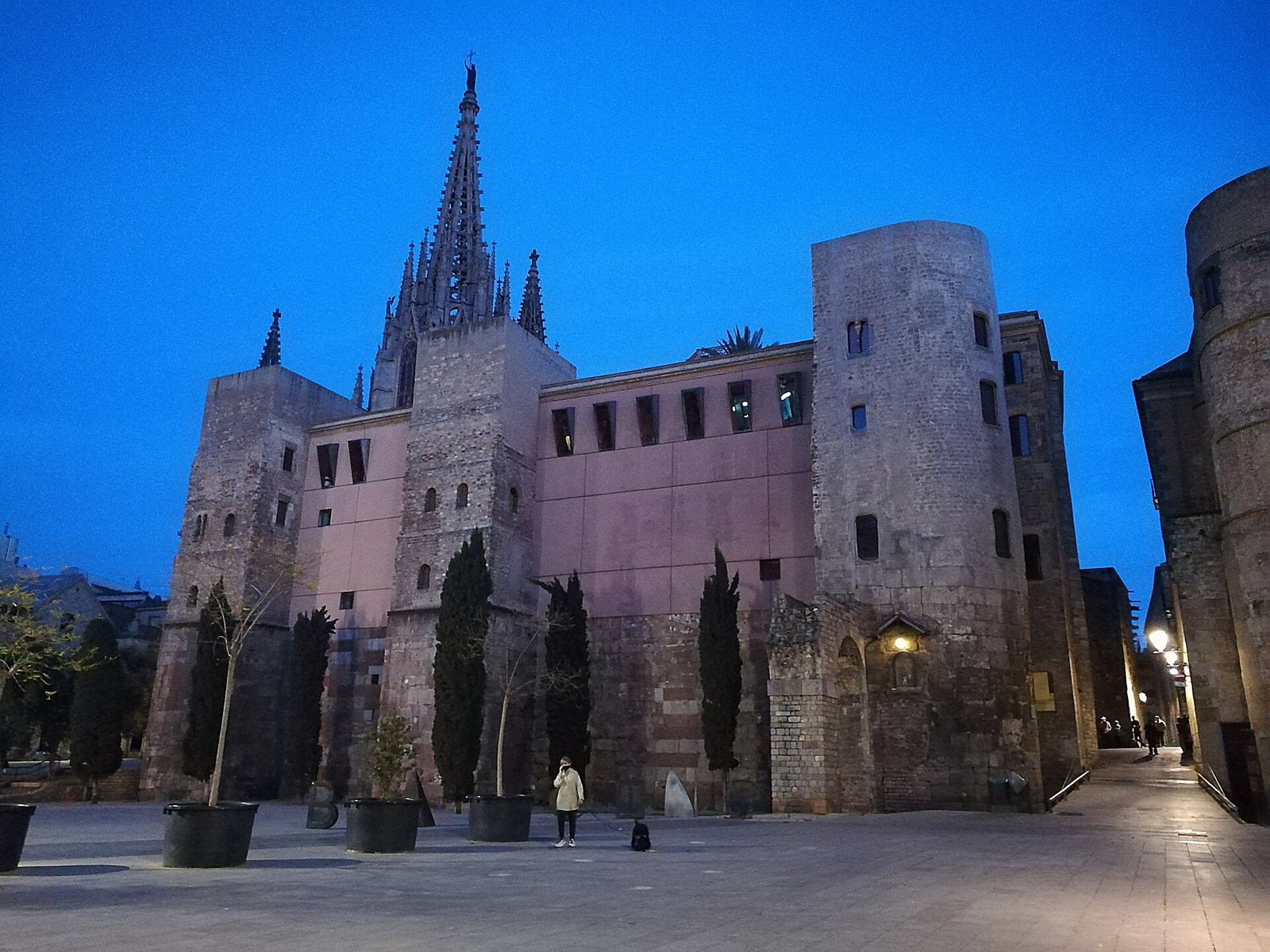
Barcelona wasn't born Gothic: it was born Roman. The streets you walk through today in the Gothic Quarter still largely follow the outline and grid of a colony of war veterans founded more than two thousand years ago. The best part is that this city doesn't live only in books. Its stones are still standing, sometimes hidden inside a courtyard or under a museum. If you know where to look, you can spot them in a walk of just a few hours.
Its full name was Colonia Iulia Augusta Faventia Paterna Barcino. "Iulia" and "Augusta" refer to the family of Augustus, and "Faventia," as historians explain, to the fact that the colony was exempt from taxes. It was founded to give land to veteran soldiers of the Cantabrian Wars, who settled here as farmers. According to archaeologist Marta Prevosti, when the Romans arrived there was no settlement on the plain. The nearest one belonged to the Laietani, an Iberian people, on Montjuïc.
The site wasn't chosen at random. Mont Tàber was a small rise in the middle of the Barcelona plain, between the Besòs and Llobregat rivers, next to the sea and at a crossroads. The colony was small, but it soon had a port, trade and control over the surrounding territory.
Barcino was an octagonal walled enclosure with a grid of streets, crossed by two main roads, the cardo (north-south) and the decumanus (east-west), which divided it into four parts. It had aqueducts to bring water from the Besòs and a sewer system under the streets. At the center was the forum, next to today's Plaça de Sant Jaume. That's where the city government met, the archives were kept and worship took place at the Temple of Augustus.
It was governed by two duumvirs, a kind of mayor that always came in pairs so each could keep an eye on the other. Alongside them was a council (curia) of one hundred decurions. That's one hundred members, just like the Consell de Cent (Council of One Hundred) that would govern medieval Barcelona centuries later.
The economy was based on the land: wine, crops and whatever the plain produced. Inside the walls there were also workshops. Beneath Plaça del Rei, archaeologists have excavated a 2nd-century laundry and dye works and a factory for salted fish and garum (the fish sauce the Romans loved). There's also a 3rd-century winery with its huge storage jars. Barcino's wine was thick and strong, and people drank it mixed with water, often sweetened with honey or candied fruit.
The city had two walls. The first went up when the city was founded, in the time of Augustus. The second, from the late 3rd and early 4th centuries, strengthened the defenses after raids by the Franks and Alemanni, two Germanic peoples. It was a double wall about 2 meters (6.5 feet) thick, with more than 70 towers, and it protected the city for centuries. To build it in a hurry, the funerary monuments outside the city were taken apart, which is why you can find moldings and inscriptions from ancient tombs in its stones.
That wall turned Barcino into a stronghold that others wanted for themselves. In the early 5th century, the Visigothic king Ataulf, married to Galla Placidia, made Barcelona his seat for a time. The Roman city gradually became Visigothic Barchinona, then the Barcelona of the counts and the Middle Ages, and it was never abandoned: people kept living on the same stones.
Across from the Cathedral, in Plaça Nova, stand the two towers of one of the gates in the Roman walls. They came into view in the 1940s and 1950s, when the blocks of houses hiding them were torn down to open up Avinguda de la Catedral. Notice the shape: these gate towers are round, while the rest of the towers along the wall were square.
Where to look
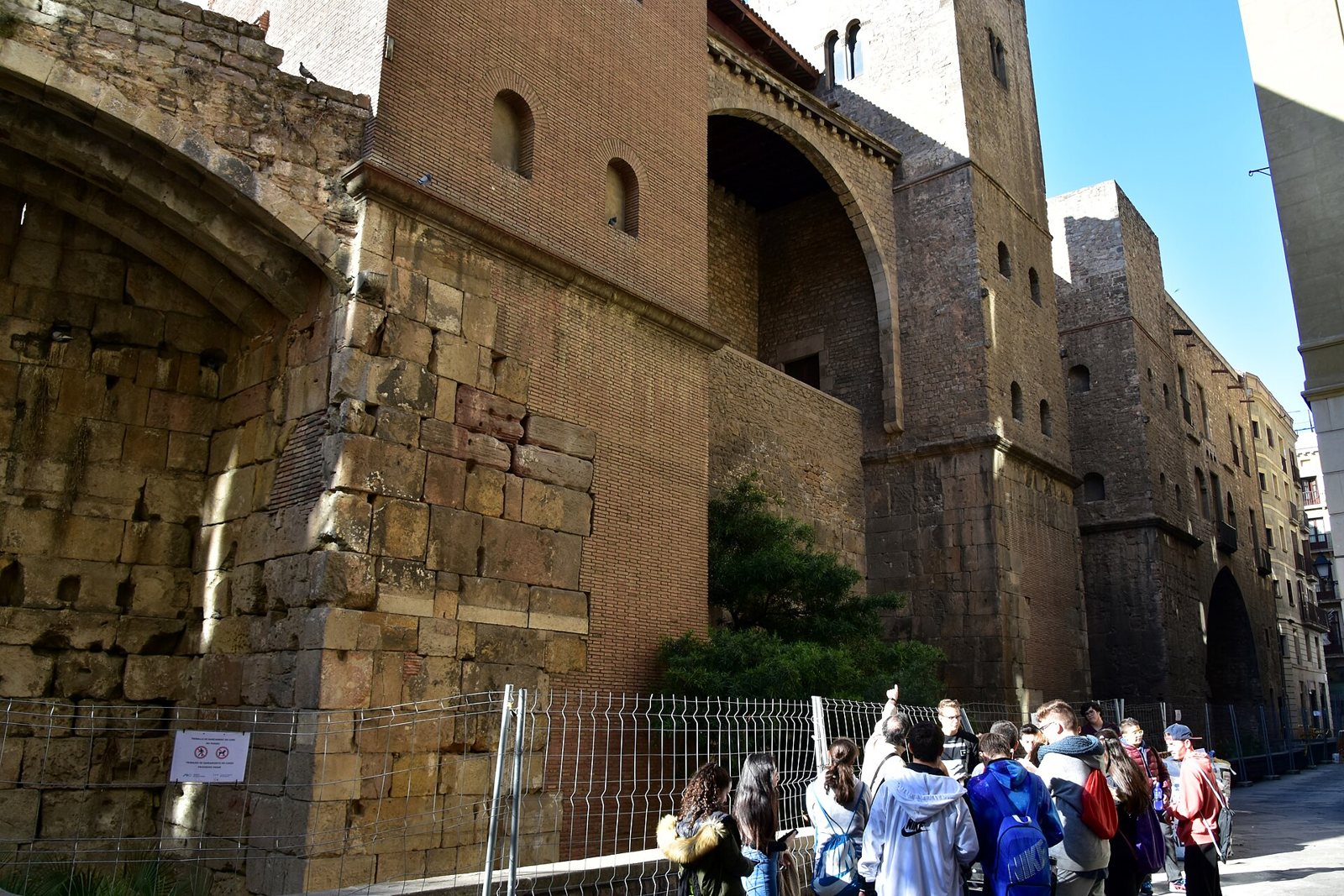
Next to the gate you'll see a few aqueduct arches. They aren't original. They're a 1958 reconstruction by architect Adolf Florensa, although no sign tells you so. The real aqueduct was found inside one of the towers of the wall.
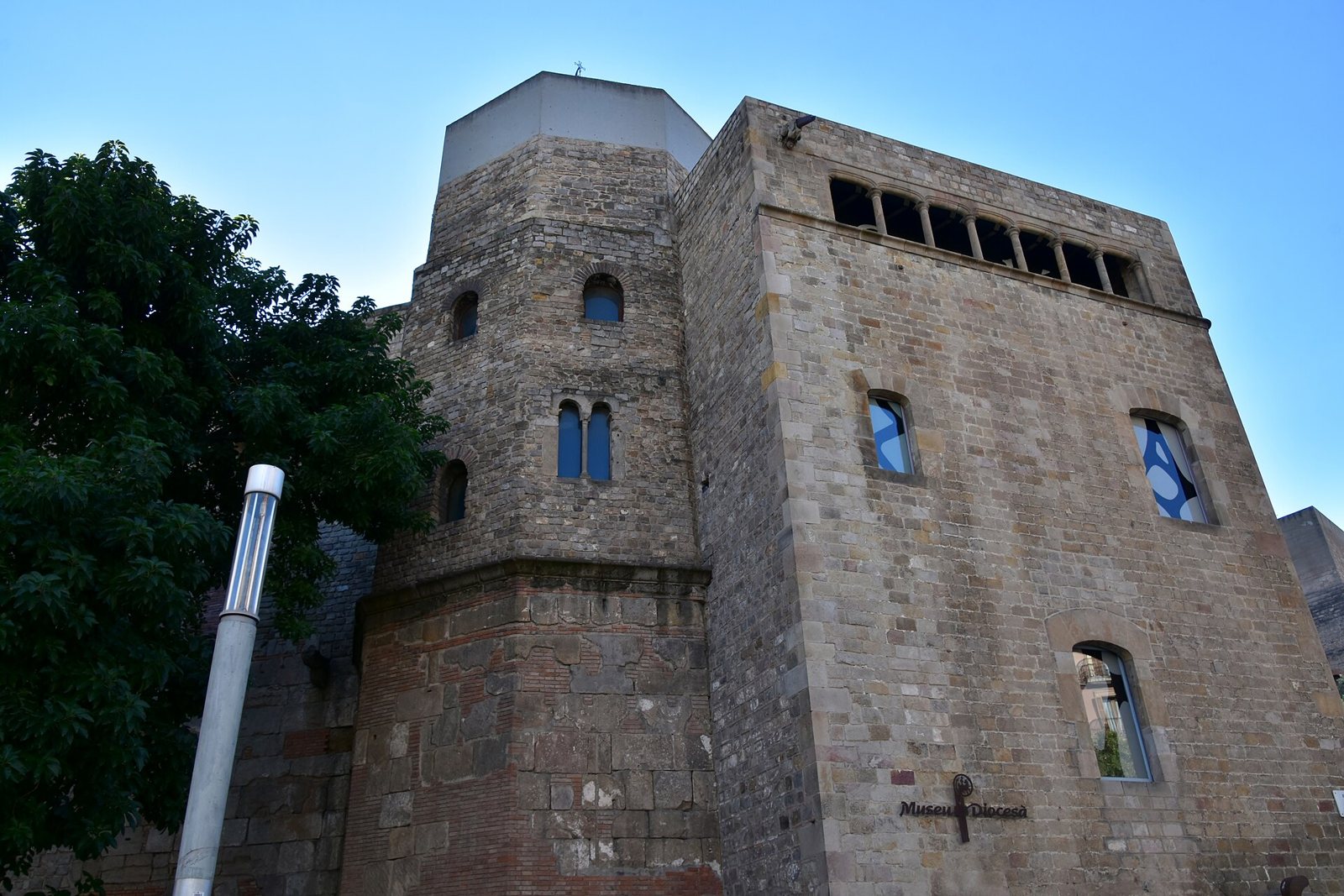
For centuries, people built their houses right up against the wall, and sometimes on top of it. That's why it pops up by surprise in so many spots around the neighborhood. The most impressive stretch is in Plaça de Ramon Berenguer el Gran, next to Via Laietana. Behind the equestrian statue of the count, you'll see a long section of wall with towers. On top of it sits the Gothic chapel of Santa Àgata, whose sacristy is carved into the wall itself. This stretch was hidden behind 19th-century houses until they were torn down between 1959 and 1964.
Another little-known spot is the Palau Requesens, home of the Reial Acadèmia de Bones Lletres. This 15th-century palace sits on towers of the Roman wall, which you can see from the entrance. Visits are by reservation and for groups only.
Where to look
On the wall in Plaça de Ramon Berenguer there's an inscription painted in 1908 by Josep Maria Jujol, commissioned by Gaudí, for the 700th anniversary of King Jaume I: "Al rei Jaume, son poble, 1908" ("To King Jaume, from his people, 1908"). It's all that remains of a Gaudí project for the area.
This is the biggest surprise in Roman Barcelona, because it's hidden inside a building. At Carrer del Paradís 10, in the courtyard of the Centre Excursionista de Catalunya, four Corinthian columns about 9 meters (30 feet) tall rise up. They are what's left of the temple dedicated to the worship of Emperor Augustus, which presided over the forum at the highest point of Mont Tàber.
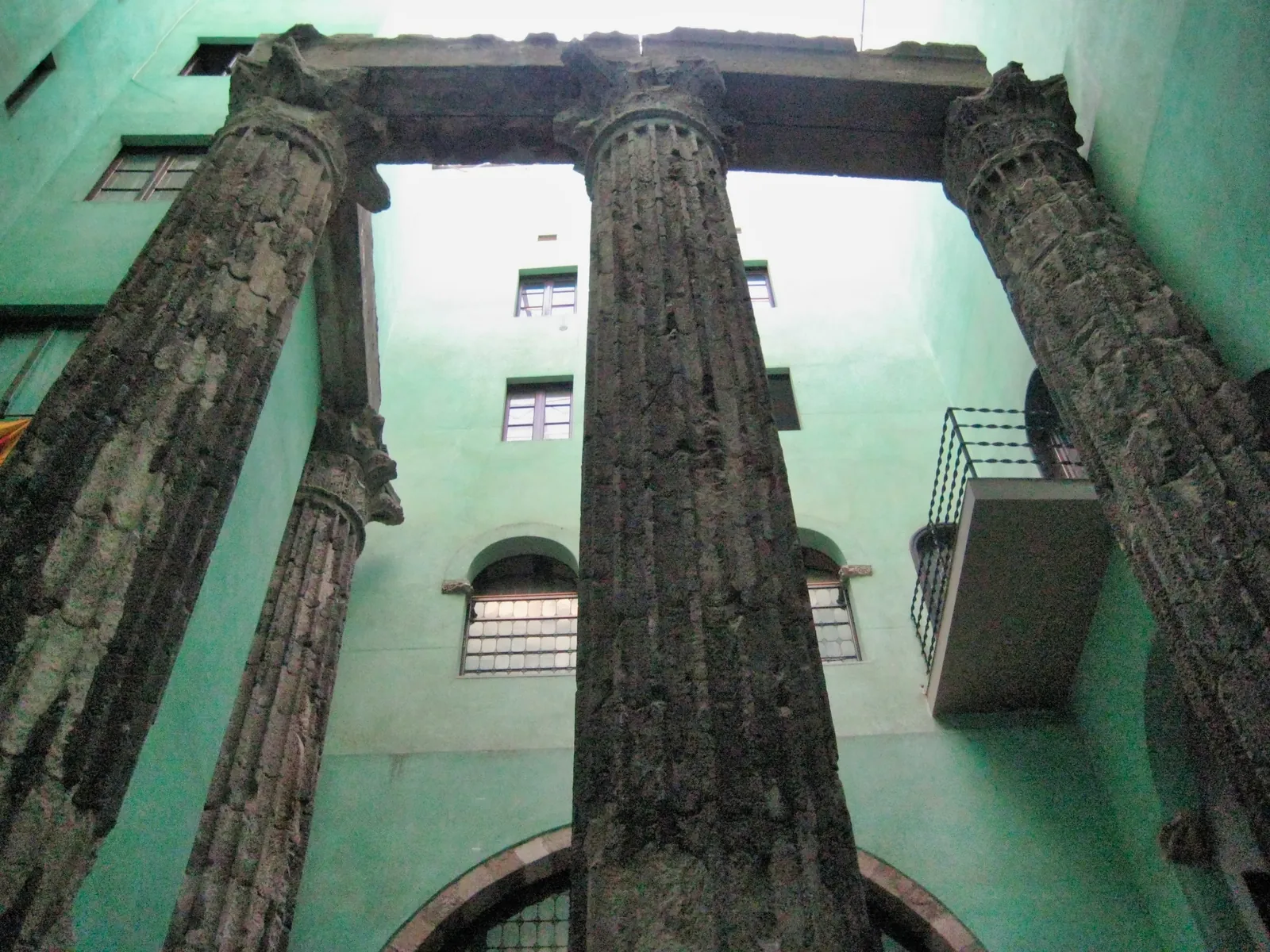
For centuries, the temple was hidden inside the houses of the neighborhood. In late 1876, the founders of the Centre Excursionista rented the space and found three columns holding up the wall and ceiling of a room. The fourth has a story of its own. It was broken and then rebuilt. It spent years in Plaça del Rei as the "traveling column," and in 1956 it was placed next to the other three. According to the Barcelona History Museum, construction of the temple probably began under Tiberius, Augustus's successor. It was Tiberius who established the cult of Augustus.
In front of the facade there was a large altar where offerings were made. The public didn't go inside the temple: only the priests were allowed in.
A lot of people walk out saying "it's just four columns." It's true that this isn't a museum or a complete temple. It's a courtyard with four Corinthian columns almost 9 meters (30 feet) tall, plus part of the architrave (the stone beam on top) and the podium (the base). Our advice: go in anyway, but with the context in mind. This was the religious heart of Barcino, at the highest point of the city and right next to the forum in today's Plaça Sant Jaume. If you know that, the stop is impressive. If you don't, it can disappoint anyone expecting a full temple. It's free, it's a 2-minute walk from Plaça del Rei and 10 minutes is all you need, so there's no reason to skip it.
Where to look
Set into the street in front of the door is a millstone. It marks the summit of Mont Tàber, the highest point of the Roman city, and it's believed to mark the spot of the temple's altar too.
Tip. Admission to the Temple of Augustus is free. It's open Mondays from 10 am to 2 pm, Tuesday to Saturday from 10 am to 7 pm and Sundays from 10 am to 8 pm, with last entry 30 minutes before closing. Lots of people walk right past the door without knowing what's inside. You go in through the doorway of the Centre Excursionista de Catalunya. If the door looks closed, take a closer look: the entrance is inside the lobby. When you leave, walk one minute down to Plaça Sant Jaume. The forum, the heart of Roman Barcino, stood next to it, and that explains why the temple was here. Keep in mind it isn't accessible for people with reduced mobility.
Beneath Plaça del Rei (King's Square) lies one of the largest areas of a Roman city ever excavated under a living city: more than 4,000 square meters (about 43,000 square feet). It was discovered by chance. In 1931, Casa Padellàs was moved stone by stone from Carrer de Mercaders, to save it from the construction of Via Laietana. When its new foundations were dug in the square, Roman streets appeared. The Barcelona History Museum (MUHBA) opened on top of that discovery in 1943.
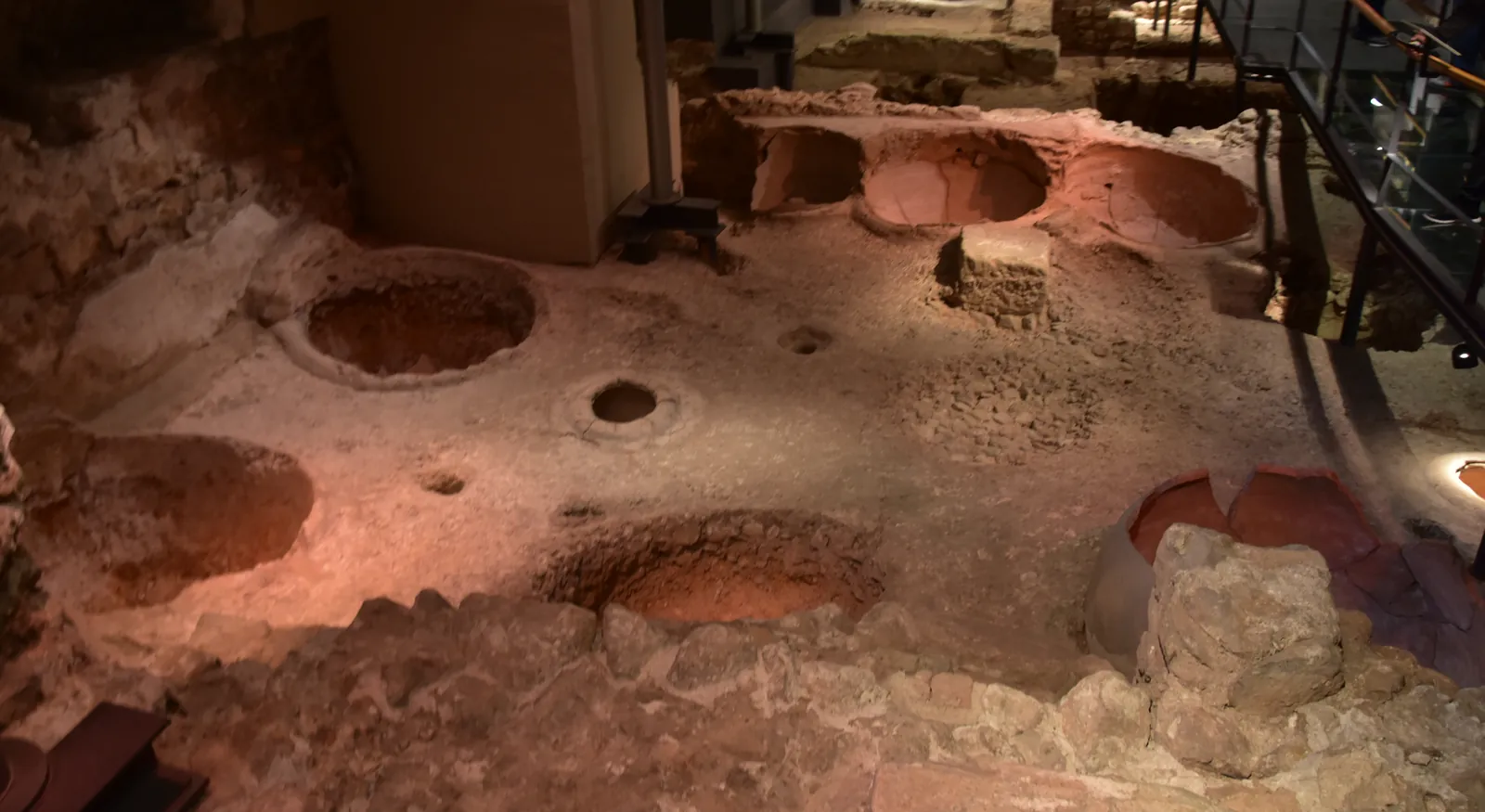
You go in through Casa Padellàs and head down several meters to walk along walkways among the ruins, right where they were found. Down below you'll see the laundry and dye works, where clothes were washed with lime, ash and urine. There are still traces of blue dye on its walls. You'll also see the garum factory, with its tanks for layering fish and salt, and the winery, with the jars where wine was made. Finally, there's a section of the wall and the city's first episcopal complex (the bishop's buildings), with a 5th-century baptistery.
Where to look
In the baptistery, take a look at the baptismal font. A century after it was built, steps in the shape of a cross were carved into it.
Is it worth going in? What you hear most is that the Roman underground is the best part of the museum, that it's hot and fairly dark down there, and that you need to give it some time. We agree, and we'd go further: this is the stop that makes sense of everything else. Outside, you only see pieces of wall and four columns. Here you go down to the level of the Roman city and walk over real remains from the 1st century BC to the 10th century, including what's left of the counts' palace from the Carolingian era. The same ticket also gets you into the Palau Reial Major (the Saló del Tinell and the chapel of Santa Àgata) and Casa Padellàs. Our advice: if you like history, don't miss it. If you only have an hour and archaeology isn't your thing, the outdoor route we suggest below already gives you a good feel for Barcino.
Tip. Plan on 1 to 1.5 hours just for the Roman section, and about 2 hours for the whole museum. That's our rough estimate, not a figure from the museum. Start at the bottom: the elevator takes you down to the Roman level, and then you work your way up to the medieval part, which is the order history happened in. If you want it quiet, go on a weekday right at opening time, 10 am. Admission is free on Sunday afternoons, but it's busier. And in summer, dress light: there's no air conditioning down there and it gets hot.
Roman houses were called domus, and seven have been found in Barcino. They belonged to well-off families with property and businesses. The most spectacular is the Domus de Sant Honorat. It belonged to an important 4th-century patrician, a Roman aristocrat, and it has mosaics from that period and a summer dining room with a water feature. A typical domus had two courtyards. The atrium was more enclosed, with the winter rooms around it. The peristyle was an open garden surrounded by the summer rooms.
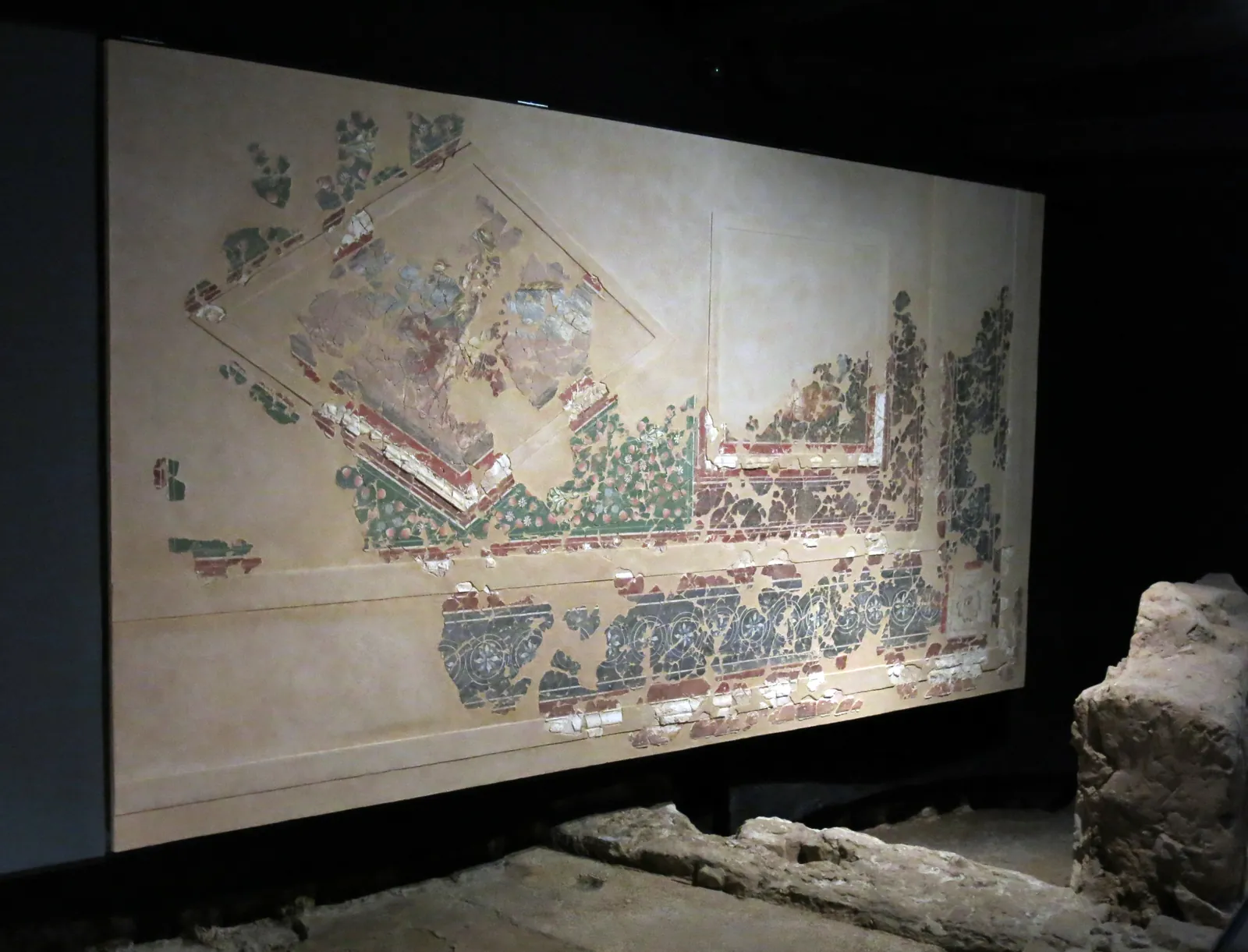
One of Barcino's great patricians was Lucius Minicius Natalis. He paid for public facilities for the city and won the four-horse chariot race at the Olympic Games in the year 129. His family built an aqueduct and a bathhouse.
Tip. The domus are only open on Saturdays and Sundays from 10 am to 2 pm. The Domus de Sant Honorat is at Carrer de la Fruita 2, right next to Plaça Sant Jaume, and the Domus d'Avinyó is at Carrer d'Avinyó 15, where entry is by guided visit only. Each costs €2.10 (€1.60 reduced). They're free with the MUHBA combined ticket, on the first Sunday of every month and for kids under 16. If you're going on a weekend, the combined ticket covers Plaça del Rei and both domus.
The Romans never buried their dead inside the city. They did it outside the walls, for hygiene, and along the sides of the roads, in plain sight. They believed that, as long as someone said your name, you never fully died. In Plaça de la Vila de Madrid, a stretch of one of these roads survives with its tombs, and today it's another MUHBA site.
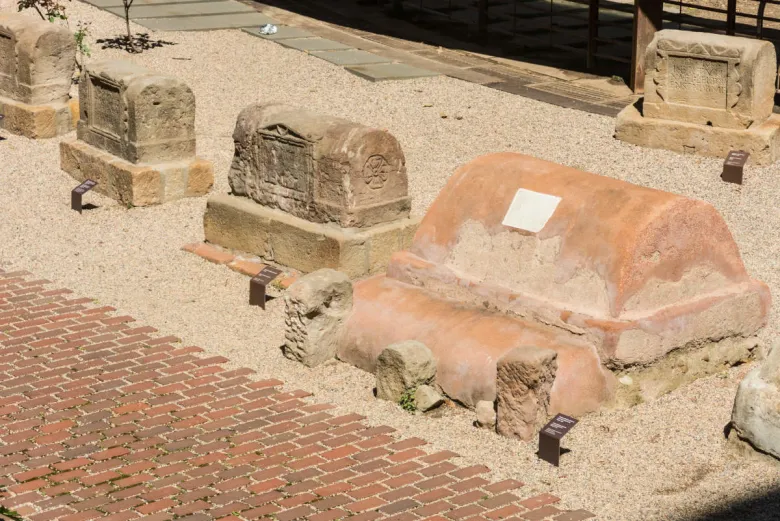
Many tombs have a hole. That's where food was left, because families shared funeral banquets with their dead, the same way we bring flowers to cemeteries today.
Tip. The Roman burial road is closed for improvement works until December 4 (notice posted on the MUHBA website as of November 2026). It's also outside the walls, so it's better to save it for another day than to squeeze it into a short route.
There's no official one-hour route. Barcelona City Council suggests following the wall starting at Plaça Nova, next to the Cathedral, and continuing through Plaça de Ramon Berenguer el Gran, Plaça dels Traginers and the Porta de Mar (Sea Gate). MUHBA, for its part, has a walking itinerary along the wall between Regomir and Plaça Nova. Building on those, this is the order we recommend at Willy's Plan: north to south, using the wall as your thread and never doubling back. In total it's about 1.2 km (0.75 miles) and roughly 20 minutes of walking. The rest of the time is for looking.
Times are approximate: we worked them out on the map. The domus don't fit into this one-hour route, because they're only open on weekend mornings. If you add the Domus de Sant Honorat, right next to Plaça Sant Jaume, the route takes more than an hour.
Tip. If you can, do the route on a Saturday or Sunday between 10 am and 2 pm. That's when you can go inside the Porta de Mar and the harbor baths (Regomir 7-9, free), and both domus are open too. On weekdays, you can only see the Porta de Mar from the street, and the domus are closed.
Tip. This one-hour route doesn't include the MUHBA's Roman underground, because that visit alone takes 1 to 1.5 hours. If you want to see it, go before or after the walk. The route also leaves out the Roman burial road: it's outside the walls and closed for works until December 4.
This part of the Gothic Quarter is full of places aimed only at tourists. These are the ones we recommend, all a few minutes from the route:
Hours and prices checked in November 2026 in Barcelona City Council's official guide and on the official Barcelona History Museum website, on the pages for MUHBA Plaça del Rei and the Temple d'August.
Roman Barcelona is scattered in separate pieces, and the hard part is putting them together: knowing that the tower you see in Plaça Nova and the column hidden in a courtyard were part of the same city. That's exactly what our private Gothic Quarter tour does. It's 3 hours on foot with a licensed tour guide, just your group, in English or Spanish. It starts at 10:30 am or 4:30 pm. Kids ages 0 to 11 go free, and you can cancel free of charge up to 48 hours in advance. If you want to see the rest of the neighborhood, here's what to see in the Gothic Quarter, stop by stop. There's also our guide to visiting Barcelona Cathedral, built on top of the old Roman episcopal complex. And if it's your first day in the city, our Barcelona welcome tour gives you the full map to find your way around.
“Very interesting to walk along streets learning the history. Our tour guide was very funny and accommodating.”
Sue · Viator, 2026
Before you go. MUHBA hours may change on public holidays and during museum events. Check its official website the same day. Main photo: towers of Plaça Nova, by Enric (Wikimedia Commons, CC BY-SA 4.0).
The Romans founded it on the orders of Emperor Augustus, between 15 and 10 BC, as a colony for veteran soldiers of the Cantabrian Wars. That's why it bears his name: Colonia Iulia Augusta Faventia Paterna Barcino.
It's the Roman name for Barcelona. Its official name, Colonia Iulia Augusta Faventia Paterna Barcino, refers to the family of Augustus and, with "Faventia," to the fact that the colony was exempt from taxes. Barcino later became Visigothic Barchinona and, over time, Barcelona.
It sat on Mont Tàber, in what is now the heart of the Gothic Quarter. The wall ran from Plaça Nova to Via Laietana and the Call (the old Jewish quarter). The center of the city was the area around Plaça de Sant Jaume, next to the old forum. Its highest point is marked with a millstone on Carrer del Paradís.
Yes, partly. The Temple of Augustus is free to enter, and you can see the towers in Plaça Nova and the wall in Plaça de Ramon Berenguer el Gran from the street. To go down into the excavated city beneath Plaça del Rei, you need a MUHBA ticket, which is free on the first Sunday of every month, from 3 pm on other Sundays and for kids under 16.
Yes, if you're into history: it's the best way to see Barcino from the inside, walking over Roman streets, workshops and a winery beneath the square. Plan on 1 to 1.5 hours for the Roman section. If you only have an hour and archaeology isn't your thing, the walking route along the wall, the temple and Plaça Sant Jaume already gives you a good feel for it.
One hour is enough to see the essentials from the outside: from Plaça Nova to Plaça dels Traginers, by way of the wall, Plaça del Rei, the Temple of Augustus, Plaça Sant Jaume and the Porta de Mar. If you add the MUHBA underground or the domus (weekend mornings only), plan on half a morning.