


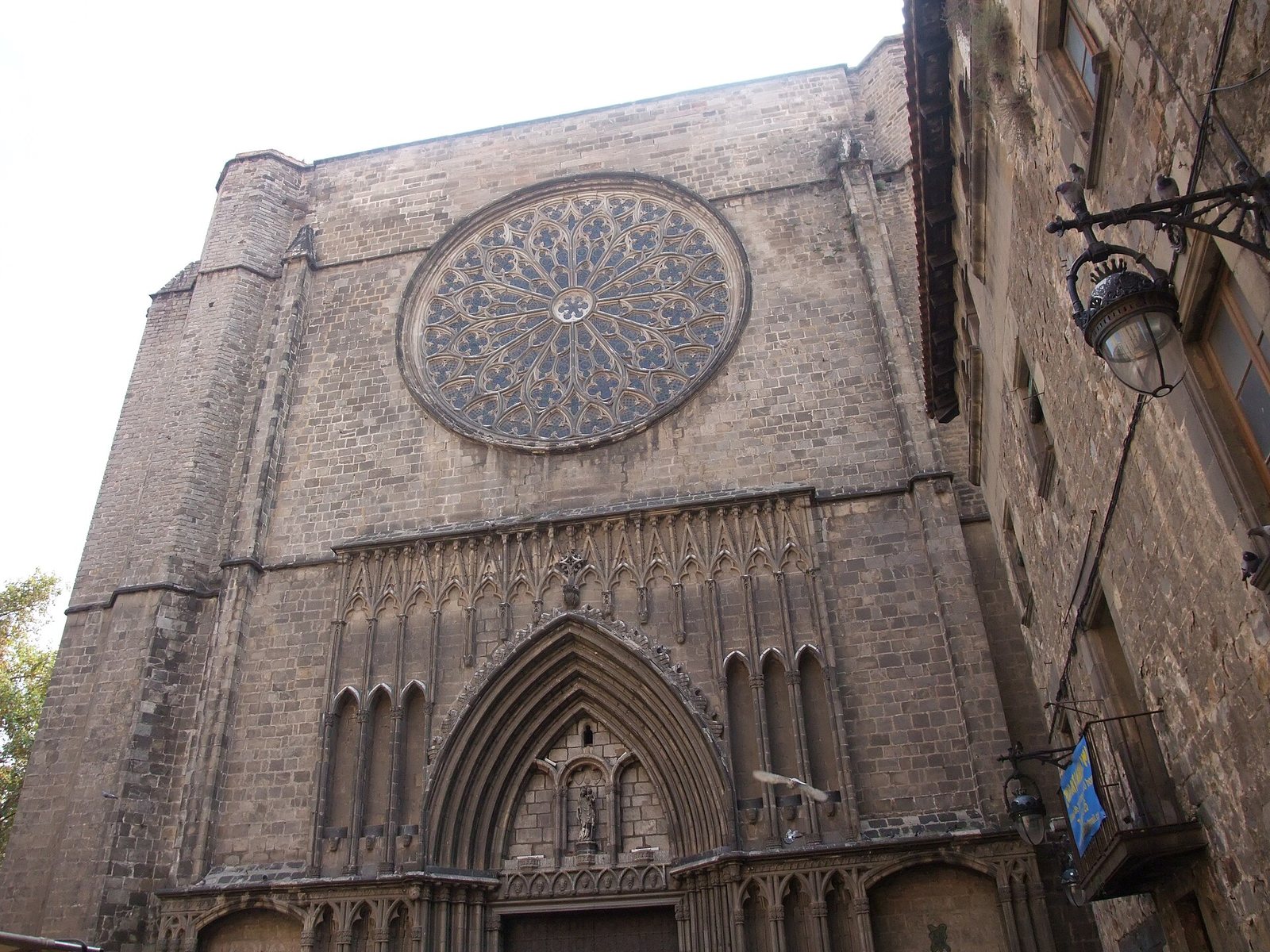
Lots of people come across the Pi almost by accident. You walk down Carrer de Petritxol, a narrow street of art galleries and chocolate shops, and suddenly the square opens up. In front of you is the facade, a huge stone wall with a single round window, the rose window, filled with stone tracery. From the outside it looks like a fortress. Inside, it's one single, soaring nave lit by colored light from the stained glass. And behind it there's more than you can see from the square: a crypt, a treasury with a relic commissioned by a king of Aragon, a hidden garden and a tower that was for centuries one of the tallest points in Barcelona.
It's one of the two great churches of ordinary townspeople in medieval Barcelona. The other is Santa Maria del Mar. The Pi was known as the church of the guilds, the city's trade associations. Its parish was huge and reached into part of the Raval. Today it holds the title of basilica and is still a parish church.
"Pi" means "pine" in Catalan. In front of the main door there's a pine tree that has been replanted over the centuries to keep the name alive. The church was also once called Santa Maria "dels Reis" (of the Kings), probably after an early altarpiece of the Adoration of the Magi that no longer survives. Nobody calls it that today.
Legend
Tradition says that after the Muslim invasion in the 8th century, a sailor found an image of the Virgin in the top of a pine tree that grew here. Another version says the image was inside the trunk. The church's name is said to come from that discovery.
According to tradition, there was already a small chapel here around the year 400, and a new neighborhood grew up around it outside the city, the Vila Nova del Pi. What is documented is a Romanesque church from the 10th century, with three apses. What survives of it are 11th-century capitals and imposts (the stone blocks an arch springs from), carved with plant motifs and reused in the Gothic doorways.
The Gothic church you see today was begun around 1320. Work stopped with the Black Death of 1348, and the last stone of the main body was laid in 1391. Then came another blow, the earthquake of 1428, and the church wasn't consecrated until June 17, 1453. It's a textbook example of Catalan Gothic: massive buttresses set against the walls instead of flying buttresses, horizontal lines, octagonal towers and flat roofs.
On the night of July 19 to 20, 1936, at the start of the Civil War, the church burned. The high altar, the organ, the choir stalls and several chapels went up in flames. The doorways were badly damaged and the rose window shattered. Almost all the stained glass you see today is a replica, because between the 1428 earthquake, the bombings of 1714 and the fire of 1936, very few originals remain. What survived was the 14th-century Gothic statue of the Virgin of the Pi, which now presides over the high altar. The parish archive, with documents dating back to the 11th century, was also saved.
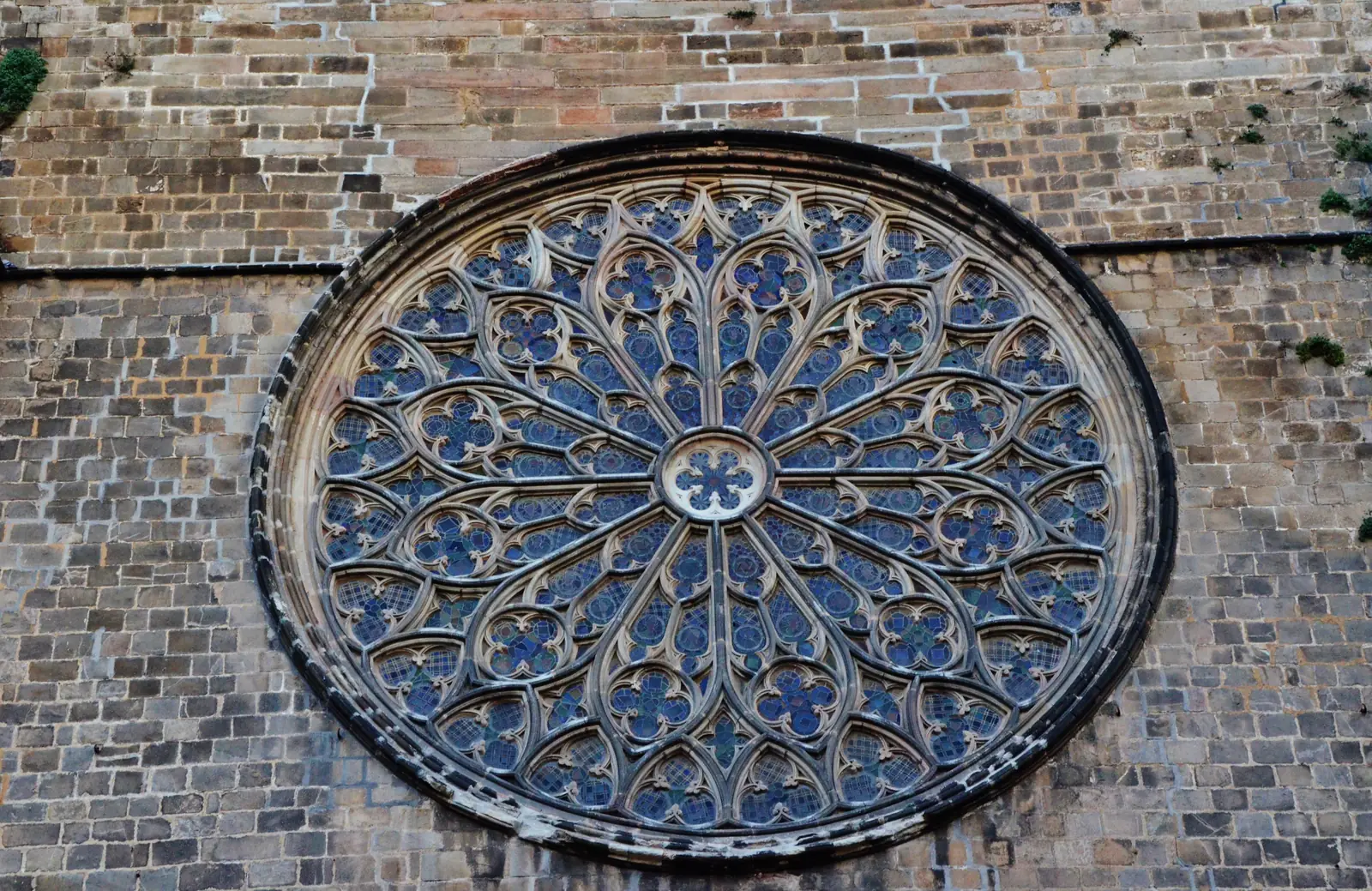
The main facade, the one facing Plaça del Pi, is almost a plain wall between two octagonal towers, with a Gothic doorway below and the rose window above it. It's about 10 meters (33 feet) in diameter: one of the largest in Gothic architecture and the largest in Catalonia. The one you see isn't the original. It shattered in the 1936 fire and was rebuilt thanks to Josep Maria Jujol, the architect who worked with Gaudí. A couple of years before the war, Jujol had asked his students to draw it, and those drawings were used to reconstruct it.
Where to look
Notice the pine tree in front of the main door, the one that gives the church its name. And once you're inside, turn around: from the nave you can see the rose window with its stained glass of biblical scenes.
The most impressive part of the Pi is inside. The church has a single nave, with no side aisles. It's 54 meters (177 feet) long, almost 16 meters (52 feet) wide and more than 28 meters (92 feet) high, with ribbed vaults overhead. Between the buttresses there are 12 chapels, six on each side. The result is a huge, almost open space. That's typical of Catalan Gothic: plain facades, with the most spectacular part saved for the inside.
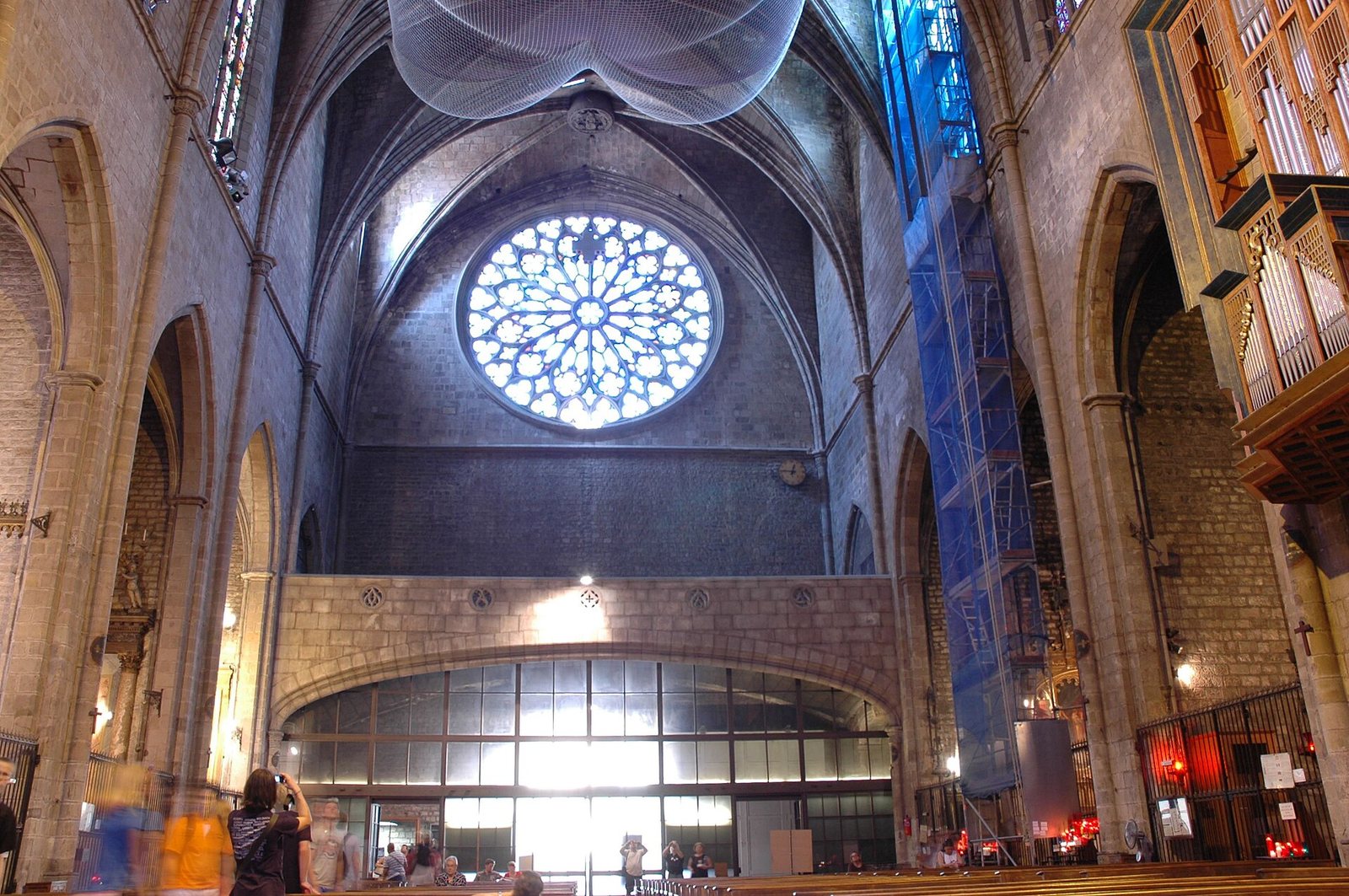
It's worth going through the chapels one by one, because they hide details almost nobody notices. In the chapel of Sant Josep Oriol, the saint the square next door is named after, you'll find his tomb and, on the wall, his original tombstone. One of the chapels is the work of Joan Martorell, one of Gaudí's teachers. There are also two baptismal fonts, one inside the other. The outer one is 14th-century Gothic and cracked. The inner one is Carrara marble and was blessed in 1691.
Where to look
Look on the floor for the "pirate's" tombstone, with a skull and crossbones. It didn't belong to any pirate: it's the tomb of a locksmith who made firearms. To the right of the presbytery, the area around the high altar, is the stone sarcophagus of Arnau Ferrer, a ship's captain who died in 1394. It rests on two lions. And on the door of the chapel of the Puríssima Sang, among capitals carved with monkeys, eagles and griffins, there's a tiny toad carved at the bottom left.
Beneath the presbytery, down a wide staircase to the left of the high altar, you reach the crypt. It was built to hold the relic of the Holy Thorn, a thorn from Christ's crown that arrived from Paris around 1542. Today it's an information space with panels on the history of the church, including photos of what the church looked like after the 1936 fire.
To the right of the presbytery you go through to the museum, where the treasury is kept. The star piece is a lignum crucis, a gilded silver reliquary holding a fragment of the Cross, commissioned by King Martí I. It survived the war because the parishioners hid it. There are also some pavises, 14th-century shields that are unique in Catalonia. From the museum you step out into the inner garden, the old rector's orchard. It's a quiet courtyard with orange trees, cats and one of the best views of the bell tower.
This is the part most people come looking for, and for good reason. According to the basilica's official website, the tower was begun in 1379 and finished in the early 16th century, paid for by the parish and by kings Pere el Cerimoniós and Martí l'Humà. It's octagonal, built of Montjuïc stone, stands 54 meters (177 feet) tall and about 12 meters (39 feet) in diameter, and is divided into five floors. Its walls, about 3.5 meters (11.5 feet) thick, suggest it also served as a defensive tower. For centuries it was one of the tallest points in the city.
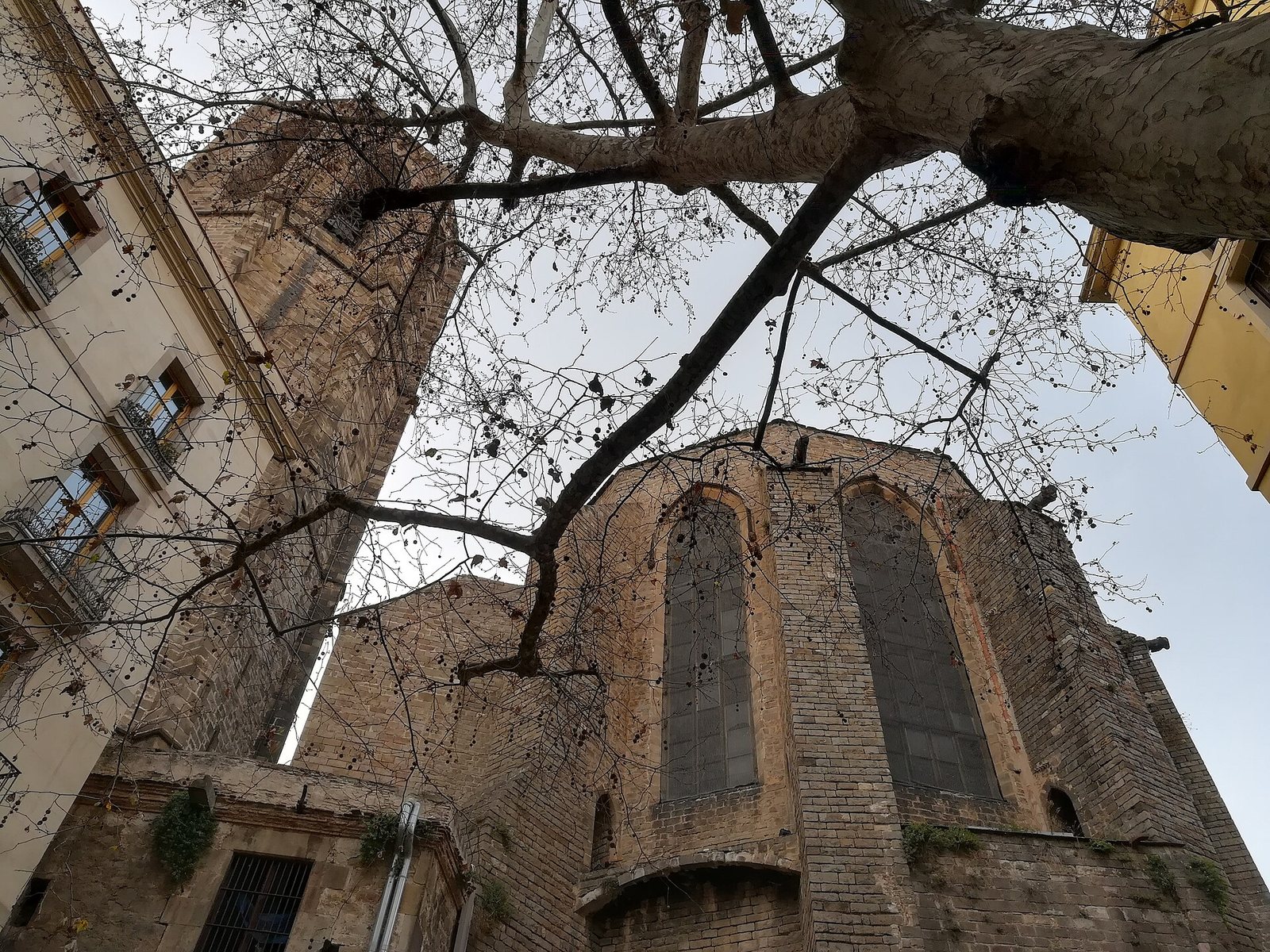
You climb a spiral staircase that starts on the first floor and reach a flat terrace with views over central Barcelona. Six bells hang in the tower's pointed-arch windows, each with its own name. The largest is the Antònia, from 1774, which weighs 1,806 kilos (about 3,980 pounds). The others are l'Andreua, la Maria, la Vicenta, la Josepa and l'Esquirol.
The tower also holds a reminder of the Civil War. During the May Days of 1937, a few days of street fighting in Barcelona, shots were fired from the bell tower at a barricade in front of the church. Up top there's still graffiti dated May 3, 1937, along with bullet marks. The basilica's archivist, Jordi Sacasas, believes it's the tower George Orwell mentions in "Homage to Catalonia."
Legend
They say the bell tower kept collapsing, and its architect made a pact with the devil: he would hand over his soul when the staircase reached step 100. The architect never went past step 99 and died of old age without finishing the tower. Someone else finished it, and the devil, cheated out of his deal, struck step 100 with his hoof. According to the archivist, the broken step exists: it's the only broken one on the whole staircase. It's an oral tradition that doesn't appear in the archive's documents, and almost the same story is told about Munich's cathedral.
People often say it's one of the best viewpoints in the Gothic Quarter and that the staircase is narrow and a bit claustrophobic. Both are true. Our take: it's worth it if stairs aren't a problem for you. It's 54 meters (177 feet), more than twenty stories, up a spiral staircase. Halfway up you pass through the bell chamber, where some of the bells date from before 1700. At the top there's a flat rooftop with a 360-degree view: the Rambla, Montjuïc, the cathedral, Tibidabo, the Sagrada Família, the port and the sea. On clear days, according to the official website, you can also see the Collserola hills and even the Montseny mountains. It's one of the few viewpoints right in the Gothic Quarter, and it's included in general admission.
We don't recommend it if you're claustrophobic, afraid of heights or have limited mobility: the staircase is narrow and you come down the same way you went up.
Tip. Bell tower climbs run in small groups at set times, so you can't just show up. Pick your climb time first and get to the basilica a little early. You can see the nave, the crypt, the treasury and the garden before or after your climb. On Sundays the visit opens at 1 pm and the first climb is at 1:45 pm, so you can't climb on a Sunday morning. Go on a clear day, because in fog or rain it isn't worth it, and climb times may change due to weather. Tickets are sold on the official ticket site linked from the basilica's website. Children under 8 can't go up, and children under 12 must be accompanied by an adult. Wear comfortable shoes and leave large backpacks behind.
The basilica is surrounded by squares: Plaça del Pi, in front of the main facade, and Placeta del Pi and Plaça de Sant Josep Oriol along its side. That's unusual. Old churches usually had a single square in front, the sagrera, where the dead were buried. The Pi needed more space because so many people wanted to be buried next to the church. These squares, now full of café terraces, were the parish cemeteries.
Part of that fame goes back to 1587. That year the plague killed more than 10,000 people in a Barcelona of about 30,000 inhabitants, according to letters from the Consell de Cent to the viceroy. Every parish had deaths except the Pi. There, none of the parish members fell ill. They were about fifteen people. They celebrated with a Te Deum, a solemn hymn of thanksgiving, which went down badly in the other parishes. From then on, everyone wanted to be baptized, married and buried at the Pi. The archivist documents the same thing happening in the great plague of 1651.
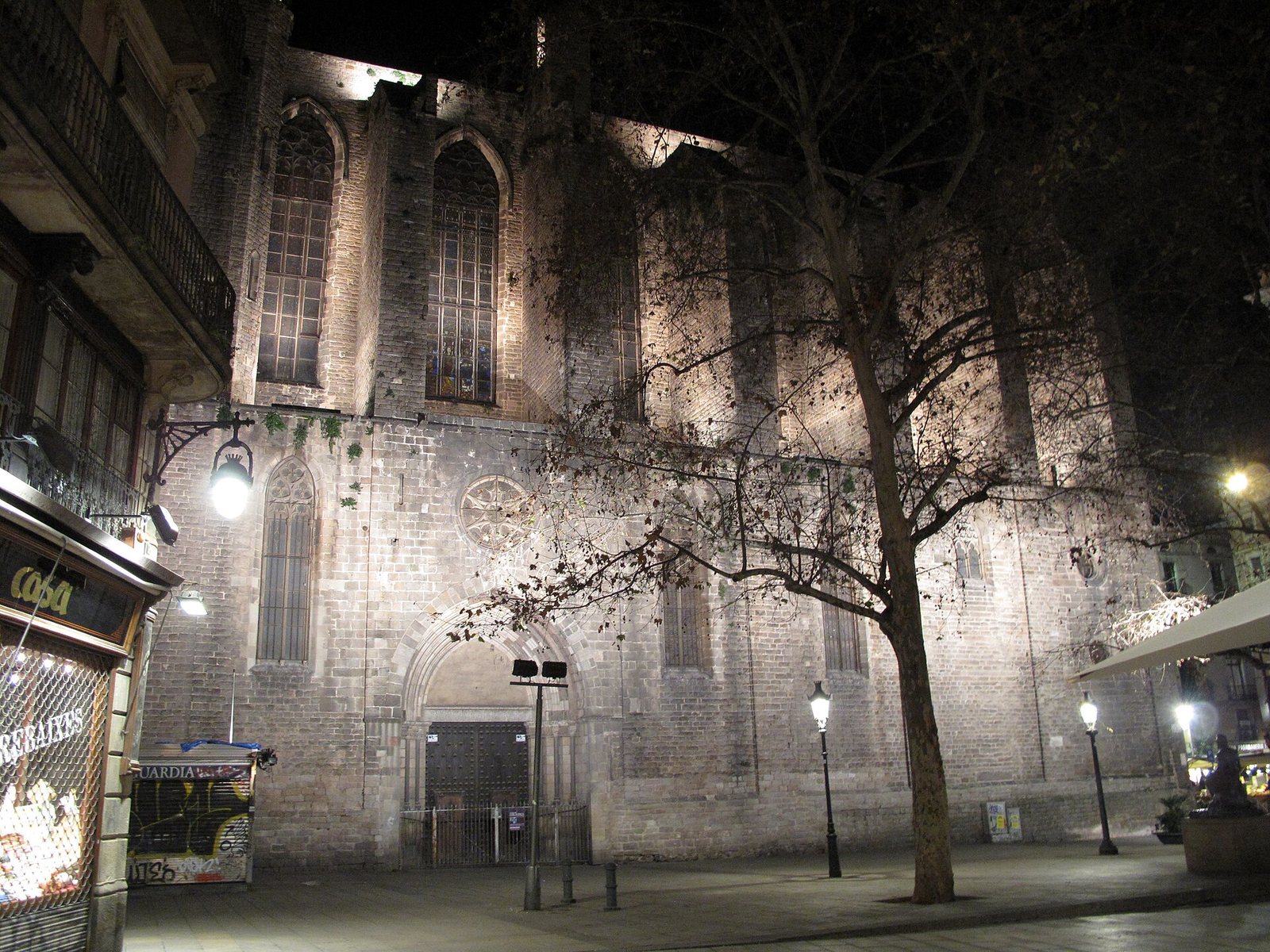
On Plaça de Sant Josep Oriol is the Ave Maria side door. It's Gothic, but it keeps a Romanesque impost, a stone band of carved capitals from the earlier church. Next to it is the monument to the writer Àngel Guimerà. The painters' association of Plaça del Pi and Plaça de Sant Josep Oriol holds its art fair in these squares. The artists sell their work directly, with no middlemen, from oils and watercolors to newer techniques.
At number 1 on the same square, across from the basilica, is the Bar del Pi. A young couple, Pepita and Enric, opened it in 1927 in an old coaching inn where the stagecoaches used to stop. They threw the keys into the sea, a ritual meant to keep the bar from ever closing. And it stayed open for ten years straight, until the first bombings of the war. When they tried to pull down the shutter to run to the air-raid shelter, it had rotted. It keeps its marble, the woodwork at the entrance and Modernista (Catalan Art Nouveau) details on the bar, and the same family still runs it.
You'll often read that there's a cheese and honey market on Plaça del Pi every weekend and painters on Plaça de Sant Josep Oriol every Saturday and Sunday. The painters part is true, but the market part isn't. According to Barcelona City Council's official listings, there are three separate events:
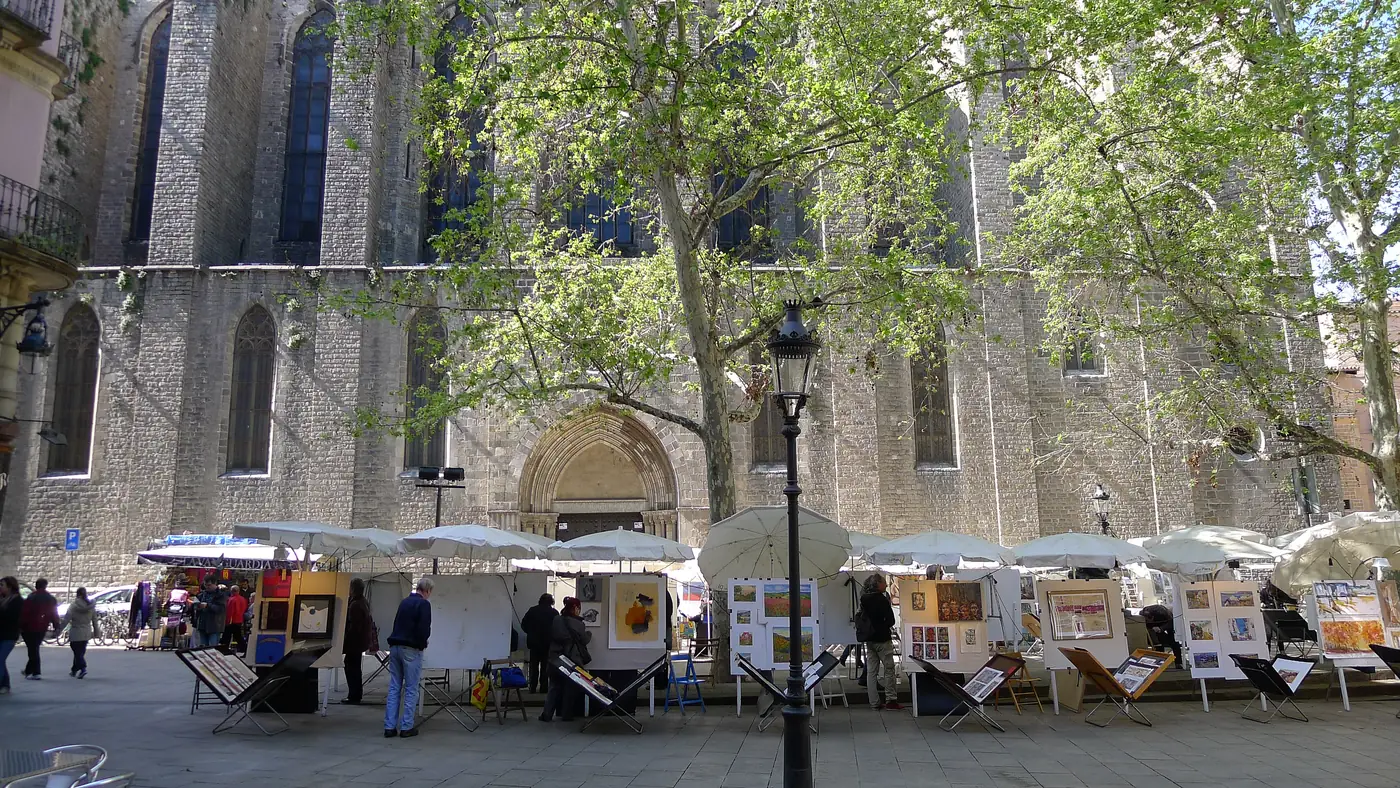
Our take: the best time is a Saturday between 11 am and 2 pm on the first or third weekend of the month. The food producers' fair and the painters overlap, and both squares are at their best. By Sunday afternoon the painters are gone. Monday to Thursday there are no fairs and no painters, but the squares are quiet and you can enjoy the facade and the rose window more. You can check the days in the City Council's official guide: food producers' fair, traditional products fair and painters.
Tip. If you want photos, go before 11 am. The squares are almost empty and the light falls nicely on the Pi's facade. On Sundays, see the painters before 1 pm, because they pack up at 2 pm. At the food fair you can taste before you buy, and it's a good place to pick up Catalan cheese or cured meats from small producers.
People often say the café terraces on these squares are pricey tourist traps and that the good stuff is on the side streets. That's only half true. These three places are local businesses with decades of history and quality Catalan or Spanish food, and they're all within a couple of minutes of the basilica's door:
Tip. All three are well known and fill up. For vermouth, go to La Pineda around midday. At the Bar del Pi, it's easier to get a table on the terrace before noon or in mid-afternoon. At the busiest times the terrace gives priority to people eating, so order something to snack on, not just drinks. Go to La Pallaresa on a weekday, first thing in the morning or mid-afternoon, because on winter weekends there's a line.
These are the hours and prices published in November 2026 on the basilica's official website, on its hours and prices and bell tower pages. The details about the bells come from its page on the bells.
You can see the Pi on your own, but it makes much more sense when you know what to look for: the Romanesque capital hidden in a Gothic doorway, the locksmith's tombstone or why one church has three squares. With our private Gothic Quarter tour, you arrive here at the end of a 3-hour walk. It's just your group and a licensed tour guide, in English or Spanish, starting at 10:30 am or 4:30 pm. Kids ages 0 to 11 go free, and you can cancel free of charge up to 48 hours in advance. If you love stories like the devil's step, our private Barcelona legends tour is all about them. And if you're interested in what happened on these streets in 1936 and 1937, there's our private Civil War tour in Barcelona.
To round out the neighborhood, here are the things to do in the Gothic Quarter, stop by stop, our guide to visiting Barcelona Cathedral and the story of Barcino, the Roman city the Pi sat just outside of.
“Robert, a magnificent guide, shows and documents every single place perfectly.”
Jorge · TripAdvisor, Gothic Quarter tour
Before you go. Hours for the basilica and the bell tower may change because of religious celebrations and weather: check its official website the same day. Main photo: facade of Santa Maria del Pi, by Javi Guerra Hernando (Wikimedia Commons, CC BY-SA 4.0).
General admission costs €8 and includes the basilica, the crypt, the museum, the garden and the bell tower climb. There's a reduced €6 ticket for students up to age 25 and large families. Children under 6 get in free.
Yes. Climbs run at set times: Monday to Saturday at 11 am, 12:30 pm, 2 pm, 3:30 pm and 4:45 pm, and Sundays and public holidays at 1:45 pm, 3:30 pm and 4:45 pm. You go up a spiral staircase to a terrace with views, and children under 8 can't go up.
Yes, if stairs aren't a problem for you. It's 54 meters (177 feet) up a narrow spiral staircase to a rooftop with a 360-degree view over the old city, the port and Montjuïc, and it's included in general admission. We don't recommend it if you're claustrophobic, afraid of heights or have limited mobility, and it's best on a clear day.
Not every weekend. The artisan food producers' fair sets up on the first and third weekend of every month, Friday to Sunday. On the last weekend there's a traditional Catalan products fair. Both run from 10 am to 9 pm. The painters are on Plaça de Sant Josep Oriol every Saturday from 11 am to 8 pm and every Sunday from 11 am to 2 pm.
Yes. Outside cultural visit hours, you can enter the church freely whenever it's open, although at those times you can't visit the crypt, museum, garden or bell tower. Barcelona residents get in free by showing their DNI, and children under 6 don't pay.
They're two different Catalan Gothic churches, and they were the two great churches of ordinary townspeople in medieval Barcelona. Santa Maria del Pi is in the Gothic Quarter, near the Rambla, and was the church of the guilds. Santa Maria del Mar is in the Born neighborhood.