


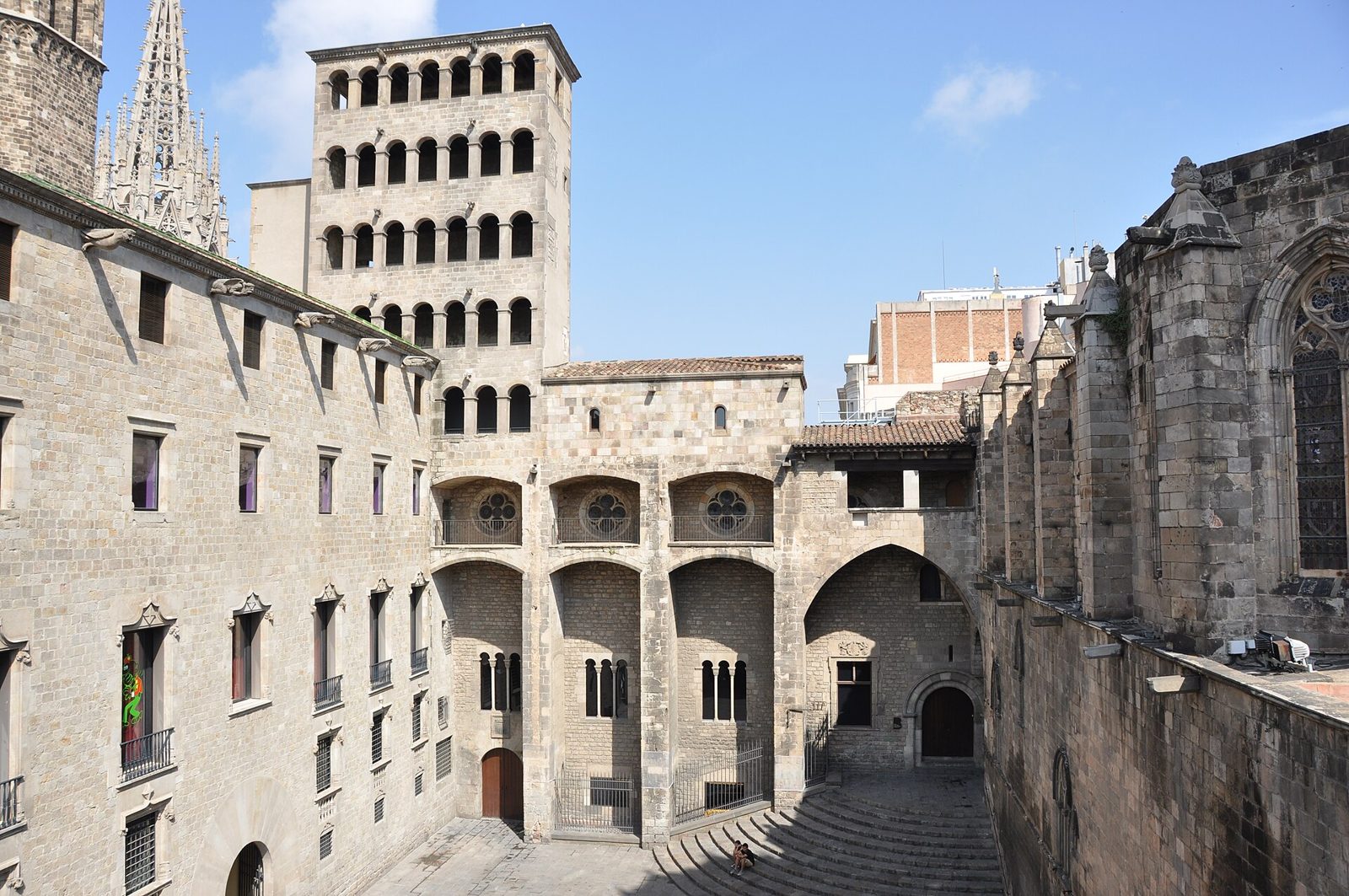
Some squares you walk through, and some make you stop. Plaça del Rei is one of the second kind. You arrive along a narrow street and suddenly you're surrounded by seven-hundred-year-old stone walls, a huge flight of steps, a five-story tower of arches and a Gothic chapel built right on top of the Roman wall. Tournaments were held here, the Inquisition moved in here, a king was stabbed here and, according to tradition, Columbus was received here. Here's what to look at and the stories behind every stone.
The square takes its name from the palace around it, the Palau Reial Major. It was the home of the Counts of Barcelona, who in time also became kings of the Crown of Aragon. The square began in the Middle Ages as the palace courtyard. It's an almost enclosed rectangle, and you enter it from Carrer del Veguer or Baixada de Santa Clara.
In the late 14th century, King Martí I gave the complex a grander, more palatial feel. He also remodeled the square to hold jousts and tournaments, giving it the rectangular shape it has today. Over the following centuries the square filled up with other things: offices, archives, a convent and the Inquisition's court. What you see today is the sum of all those eras, plus a major 20th-century restoration.
According to the Barcelona History Museum, this same spot held one seat of power after another. First came the residence of the Visigothic civil governor, later enlarged by the Carolingian counts. Then, in the 12th century, came a new count's residence, which is the origin of the Palau Reial Major. In the 14th and 15th centuries that Romanesque building was transformed into a much larger Gothic royal palace. It became the most important and symbolic one of the Catalan-Aragonese monarchy.
The word "Major" has an explanation. King Pere the Ceremonious built a second palace in Barcelona, the Palau Reial Menor or Queen's Palace, and from then on this one became the "major" (greater) palace.
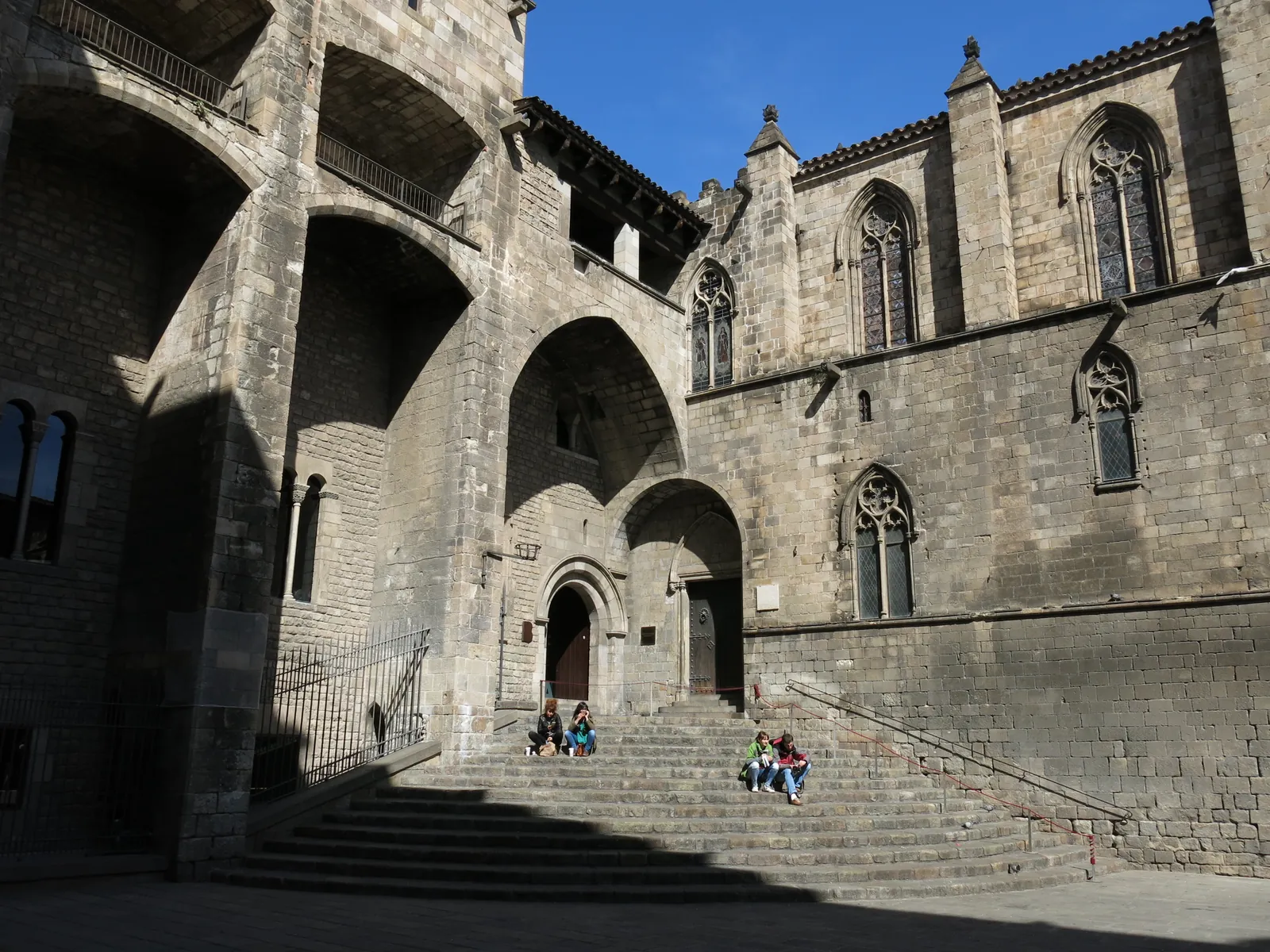
At the far end of the square, a wide flight of steps leads up to the palace door. Behind that façade is the Saló del Tinell. It's the classic photo of the square. It was also the setting for one of the most famous episodes in Barcelona's history, the attack on King Ferdinand the Catholic in 1492, which we tell you about below.
Where to look
There's a steel sculpture in the square that doesn't look medieval, because it isn't: "Topos V" by Eduardo Chillida, installed in 1986. The sculptor chose the spot himself.
Behind the façade is the Saló del Tinell, the palace's great ceremonial hall. In its day it was known as the Hall of Hangings (Saló dels Paraments). It was commissioned by King Pere the Ceremonious and designed by master builder Guillem Carbonell. According to the MUHBA, it was built between 1359 and 1370. It was the throne room, where royal receptions, celebrations and assemblies were held.
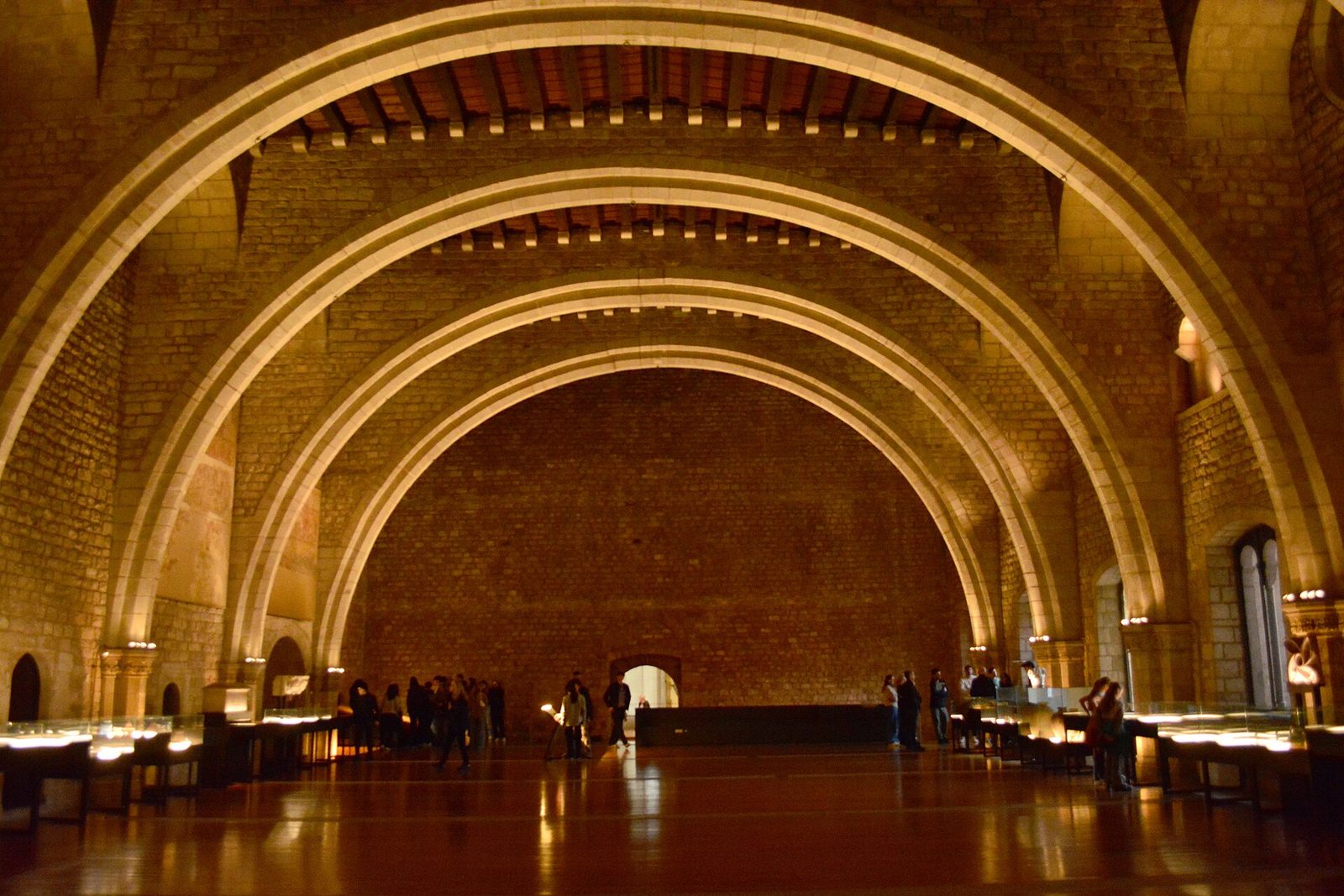
What strikes you when you walk in is the space. The hall is about 33 meters (108 feet) long and 17 meters (56 feet) wide. Six enormous round arches span it, called diaphragm arches, which hold up a flat timber ceiling. Thanks to them, there isn't a single column in the middle. It's one of the finest examples of Catalan civil Gothic, the Gothic of buildings that weren't churches, with lower and much wider spaces.
What happened to it later is just as interesting. In the 16th century it became the clerks' hall of the Royal Court (Reial Audiència), and part of it went to the Inquisition. From 1722 until 1936 it was the church of the Santa Clara convent, and the great hall was hidden inside a Baroque church. In 1937, when that church was demolished, the Tinell came back to light and was restored.
To the right of the steps stands the royal chapel, known today as the Chapel of Santa Àgata (Saint Agatha). King Jaume II had it built for his private use. According to the MUHBA, it went up between 1302 and 1318, on top of the Roman wall. It's all that's left of the palace's first Gothic building. It has a single nave. It was consecrated to the Virgin Mary and, as historians explain, changed its name in the 17th century, when relics of Saint Agatha arrived.
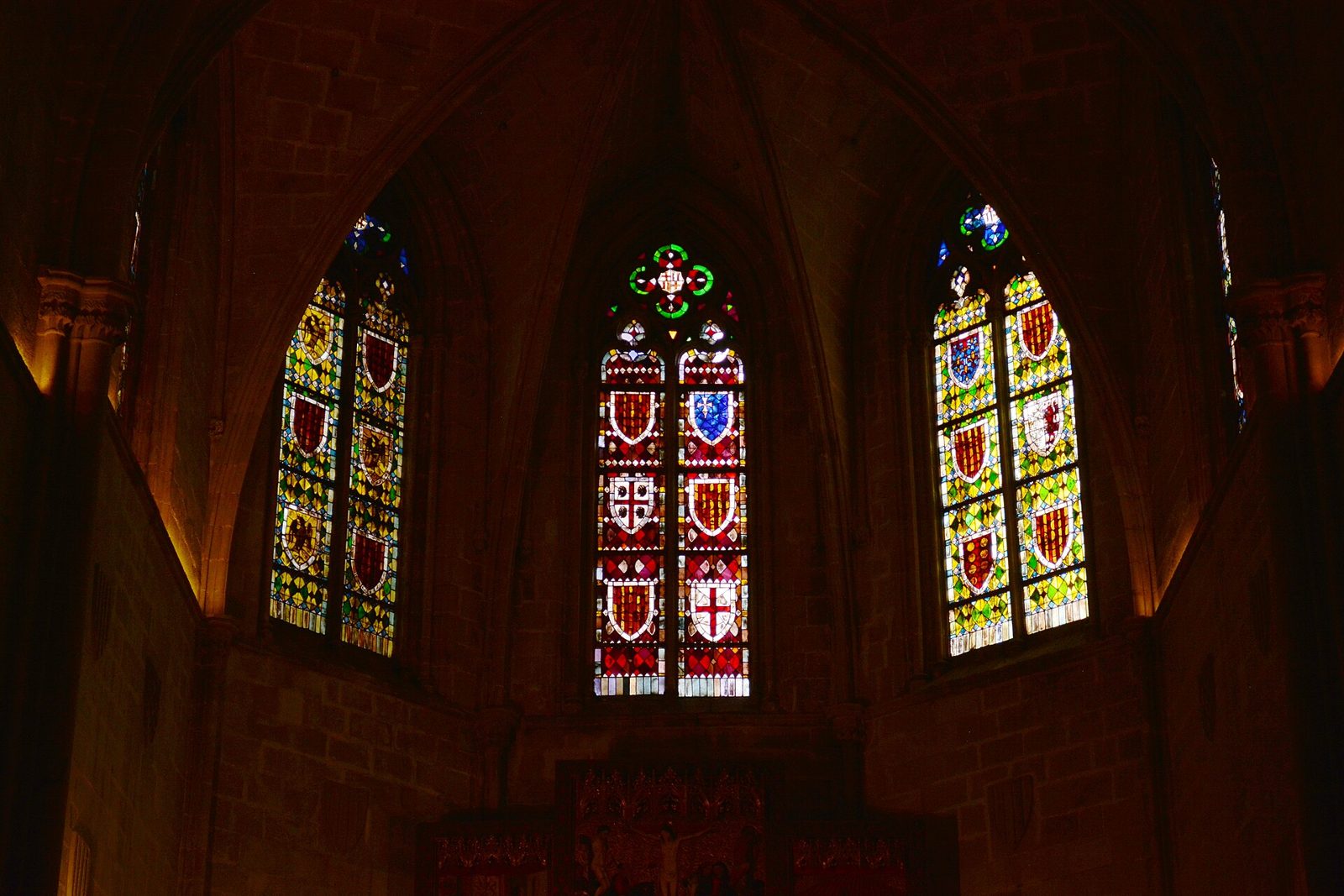
Inside, two works from the 1460s stand out, both commissioned by King Peter of Portugal, known as the Constable. One is the painted wooden ceiling, by Alfonso de Córdoba. The other is the Epiphany or Constable's Altarpiece by Jaume Huguet, with the Adoration of the Magi at its center. The chapel stopped being used for worship in 1835. In 1866 it became the first building declared a National Monument, and from 1877 to 1932 housed the Provincial Museum of Antiquities.
Where to look
Check out the bell tower. It's octagonal and its top looks like a royal crown, in honor of Jaume II. To see the chapel perched on the Roman wall, walk around the block to Plaça de Ramon Berenguer el Gran, by Via Laietana. From there you can see that the sacristy is carved into the wall itself.
The five-story tower of arched galleries that towers over the square is the Mirador del Rei Martí, or King Martí's watchtower. The name is misleading. King Martí I died in 1410, and the tower was built more than a century later, in the mid-16th century, under Emperor Charles V. It sits on top of the Tinell's buttresses. You can spot it peeking above the rooftops from many streets in the neighborhood.
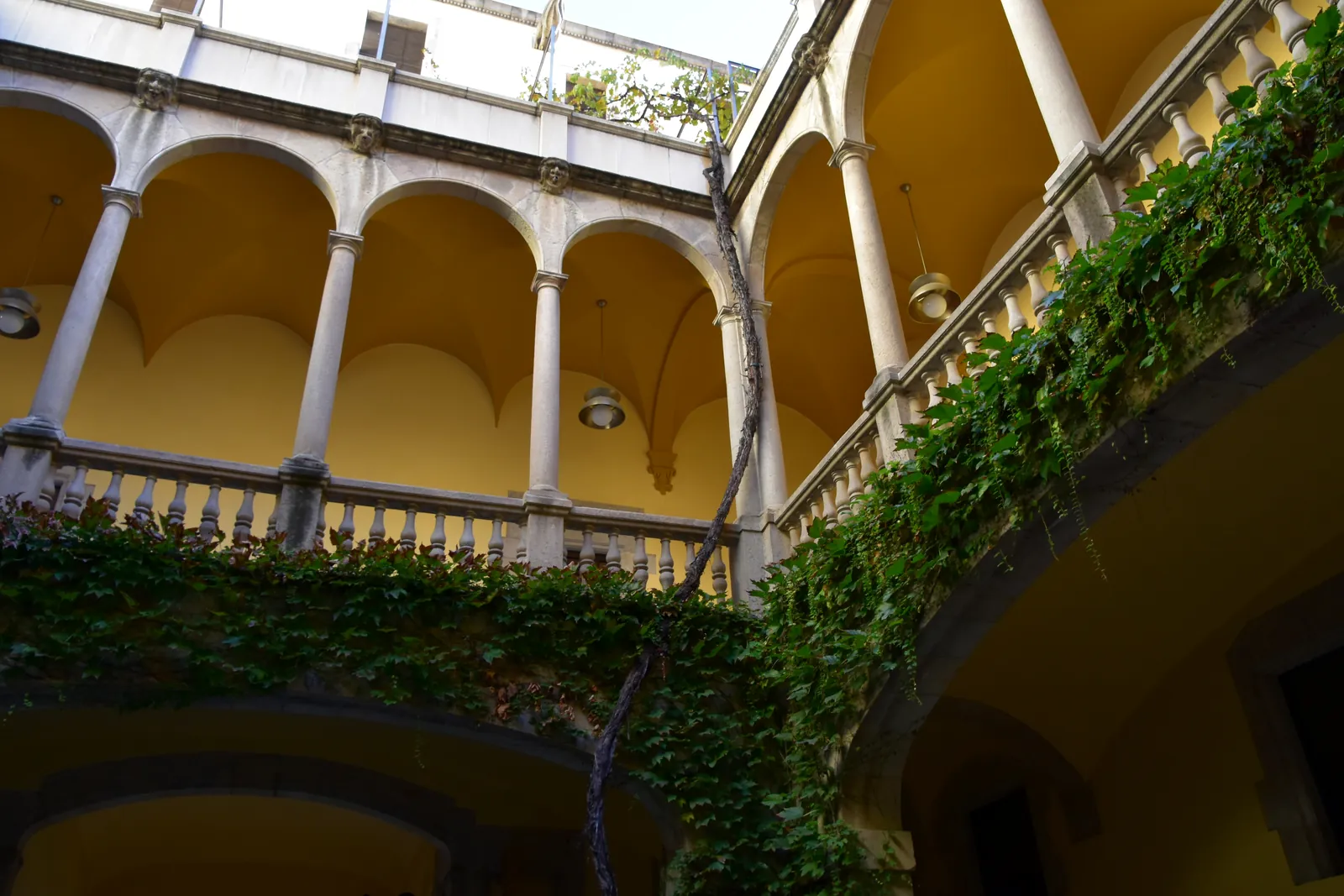
On the left side of the square stands the Palau del Lloctinent, built between 1549 and 1557 for the lieutenant, the king's representative in Catalonia. Today it houses the Archive of the Crown of Aragon.
Plaça del Rei's biggest secret is right under your feet. In 1931 the Casa Padellàs, a Gothic mansion on Carrer de Mercaders that stood in the way of the new Via Laietana, was moved stone by stone. When workers dug its new foundations in the square, they found remains of Roman Barcino. Excavations went on until the Spanish Civil War, and in 1943 the Barcelona History Museum opened here.
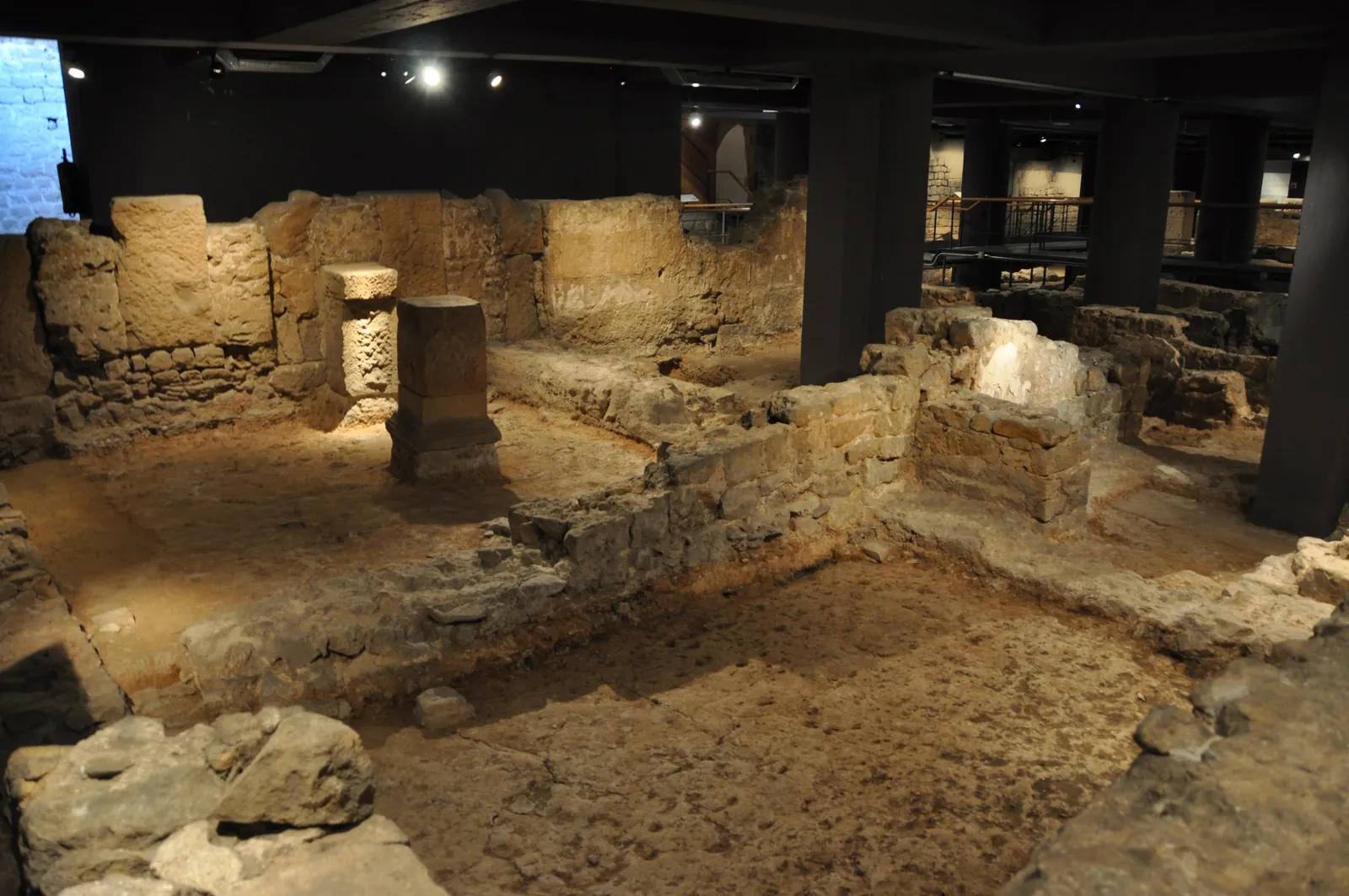
Today you enter through the Casa Padellàs and go down to a walk of about 4,000 square meters (43,000 sq ft) beneath the city. You'll see Roman streets, a 2nd-century laundry and dye works, and a 3rd-century fish-salting and garum (fish sauce) factory and winery. There are also sections of both city walls and the episcopal complex of Visigothic Barcino, with its baptistery. For the full story of that city, see our guide to Barcino, Roman Barcelona.
Then the visit climbs into the Middle Ages. First you pass through a hall of the 12th-century count's palace, with an exhibition on early medieval Barcelona. One level up are the Saló del Tinell and the Chapel of Santa Àgata, which the museum also uses for its temporary exhibitions.
A lot of people think the Tinell and the chapel cost extra, or skip them without realizing it. There's no separate ticket: they're included in the regular MUHBA ticket, and you see them at the end of the visit. And if you came for the square, they're the best part, because they're the two Gothic pieces of the palace you've already seen from outside. The same ticket also covers the Casa Padellàs, with the exhibition "Barcelona flashback."
Tip. For the whole MUHBA visit, plan on 1 hour 15 minutes to 1 hour 30 minutes. That's about 45 minutes for the Roman city underground and 15 to 20 for the Tinell and Santa Àgata. When they come up from underground, many people miss the turn and walk out through the gift shop without seeing the best part. Head up to the Tinell and the chapel instead. In the chapel, take your time with Jaume Huguet's Constable's Altarpiece, which is the highlight.
After the crowns of Aragon and Castile were united, the palace lost its kings and gained a feared new tenant. In the late 1480s, Ferdinand the Catholic extended the Inquisition's court to Catalonia, and it moved into the Palau Reial Major. According to betevé, Barcelona's public TV channel, the court sat upstairs and there were 13 cells in the basements.
The square was one of the places where autos-da-fé, the public reading of sentences, were held. The day before, a white cross and a green cross were set up in the square to announce it. The next day, the condemned walked in procession from the palace. The Inquisition's first executions in Barcelona took place in this very square. A secret passage connected the court to the Royal Court of Justice (Reial Audiència). When the deputies of the Generalitat objected, the inquisitors jailed two of them for more than two years. Much of the court's archive was lost in 1820, when the people of the city burned it.
Where to look
On Carrer dels Comtes, along the side of the Museu Frederic Marès, there's a coat of arms of the Inquisition: a cross in the center, a sword on one side (punishment) and an olive branch on the other (reconciliation).
On December 7, 1492, King Ferdinand the Catholic was at the palace negotiating with French ambassadors. As he came out, on the palace steps, a man named Joan de Canyamars stabbed him in the neck. The king survived and ordered that his attacker not be killed on the spot, so he could be questioned about whether there was a conspiracy behind the attack. A few days later Canyamars was sentenced to a gruesome death: he was paraded in a cart from Plaça del Rei and burned.
Legend
According to tradition, the Catholic Monarchs received Christopher Columbus in the Saló del Tinell when he returned from his first voyage to the Americas in 1493. It's the story you'll hear most often in the square, but not every historian accepts it. Historian César Alcalá argues that after the attack the court recovered at the monastery of Sant Jeroni de la Murtra, in Badalona, and that Columbus was received there.
The square is a public space and you can walk in at any time. To go down to the Roman city and see inside the Saló del Tinell and the Chapel of Santa Àgata, you need a MUHBA ticket.
Many websites still say "about €7" or "free on Sundays" with no fine print. That information is out of date. Today, on Sundays it's only free from 3 pm, except on the first Sunday of the month, when it's free all day.
These are the hours and prices published in November 2026 on the official website of the Barcelona History Museum, on the MUHBA Plaça del Rei page and the prices page.
Tip. Pair Plaça del Rei with the Cathedral, just a few minutes' walk away. Here's our guide to visiting Barcelona Cathedral, with opening hours and tickets.
Tip. If you want to get in for free, go on the first Sunday of the month or on a Sunday from 3 pm, but expect bigger crowds. And if you're in Barcelona on February 5, Saint Agatha's Day, the MUHBA usually opens the chapel for free, with a sung Mass at noon. Check the program on its website.
Almost every guide will tell you to "go early or late in the day." It's good advice, and here's why. From mid-morning, roughly 10:30 am to 1:30 pm, almost every Gothic Quarter tour group passes through the square, and that's when it's least enjoyable. If you want it quiet and a shot of the steps with nobody in it, go before 10 am, before the MUHBA opens, or after dark, when the square empties out.
If you hear music, it's almost certainly coming from Plaça de Ramon Berenguer el Gran, right next door. Street musicians aren't allowed to play in Plaça del Rei, because it isn't one of the spots approved by the city on its street music list for November and December 2026.
The real local plan is "Els divendres a la Plaça del Rei" (Fridays at Plaça del Rei), a live folk music and dance series that has been running for more than 30 years. In fall 2026 it takes place every Friday from October 2 to December 25. There's a dance workshop at 8 pm and a concert with dancing at 9 pm. It's free and open to everyone. You'll find it in the Barcelona City Council's official guide.
Tip. Grab a seat on the steps on a Friday from 8 pm and join the workshop, which is for everyone, even if you can't dance. And if you'd like to see the square with a licensed guide, our tour starts at 10:30 am and 4:30 pm, and you can ask us for another time on WhatsApp.
Online lists tend to send you to the big tapas bars on the surrounding streets, with menus designed for visitors. We prefer two old-school spots, each with its own history and no more than a 5-minute walk from the square:
You can see Plaça del Rei in five minutes or understand it in half an hour. The difference is who's telling you about it: where the cells were, which steps the king came down that December 7, or why King Martí's tower isn't King Martí's at all. That's what our private Gothic Quarter tour does. It's 3 hours on foot with a licensed tour guide, just your group, in English or Spanish, starting at 10:30 am or 4:30 pm. Cathedral admission is included. Kids aged 0 to 11 go free and you can cancel for free up to 48 hours before.
To plan the rest of the neighborhood, here are the things to do in the Gothic Quarter, stop by stop. And if you like the darker side of the city's history, take a look at our mysterious and forbidden Barcelona tour.
“Tour guide was amazing. Personalized the tour and gave us fascinating details. Made us see how wonderful personal tours can be!”
Harold · Viator, 2026
Before you go. MUHBA hours may change on public holidays and during museum events: check its official website the same day. The Saló del Tinell sometimes hosts city events and may close now and then. Main photo: Plaça del Rei, by JosepBC (Wikimedia Commons, CC BY-SA 3.0).
It's the courtyard of the Palau Reial Major. You'll see the palace steps, the Saló del Tinell, the Chapel of Santa Àgata, the King Martí watchtower and the Palau del Lloctinent. Underground lies the Roman city, which you can visit at the Barcelona History Museum (MUHBA).
Yes, usually, with a MUHBA Plaça del Rei ticket. The visit starts in the Roman city underground and ends upstairs, in the Tinell and the Chapel of Santa Àgata, which the museum also uses for temporary exhibitions. Since it sometimes hosts city council events, it may be closed on the odd day. Check the MUHBA website.
No. There's no separate ticket. Both are included in the regular MUHBA Plaça del Rei ticket (€7.30 general as of November 2026), and you see them at the end of the visit, after the Roman city underground. Plan on 1 hour 15 minutes to 1 hour 30 minutes for the whole thing.
As of November 2026, €7.30 general and €5.20 reduced. It's free for under-16s, and for everyone on the first Sunday of the month and on Sundays from 3 pm.
That's what tradition says. According to it, the Catholic Monarchs received him in the Saló del Tinell in 1493, after his return from the Americas. Some historians, such as César Alcalá, believe the reception took place at the monastery of Sant Jeroni de la Murtra, in Badalona.
Plaça del Rei means "King's Square" in Catalan. It was the courtyard of the Palau Reial Major, the residence of the Counts of Barcelona and kings of the Crown of Aragon.
Before 10 am or after dark, when there are no tour groups. From 10:30 am to 1:30 pm it's usually packed with guided tours. And on Fridays until December 25, 2026, from 8 pm, there's free live folk music and dancing in the square.