


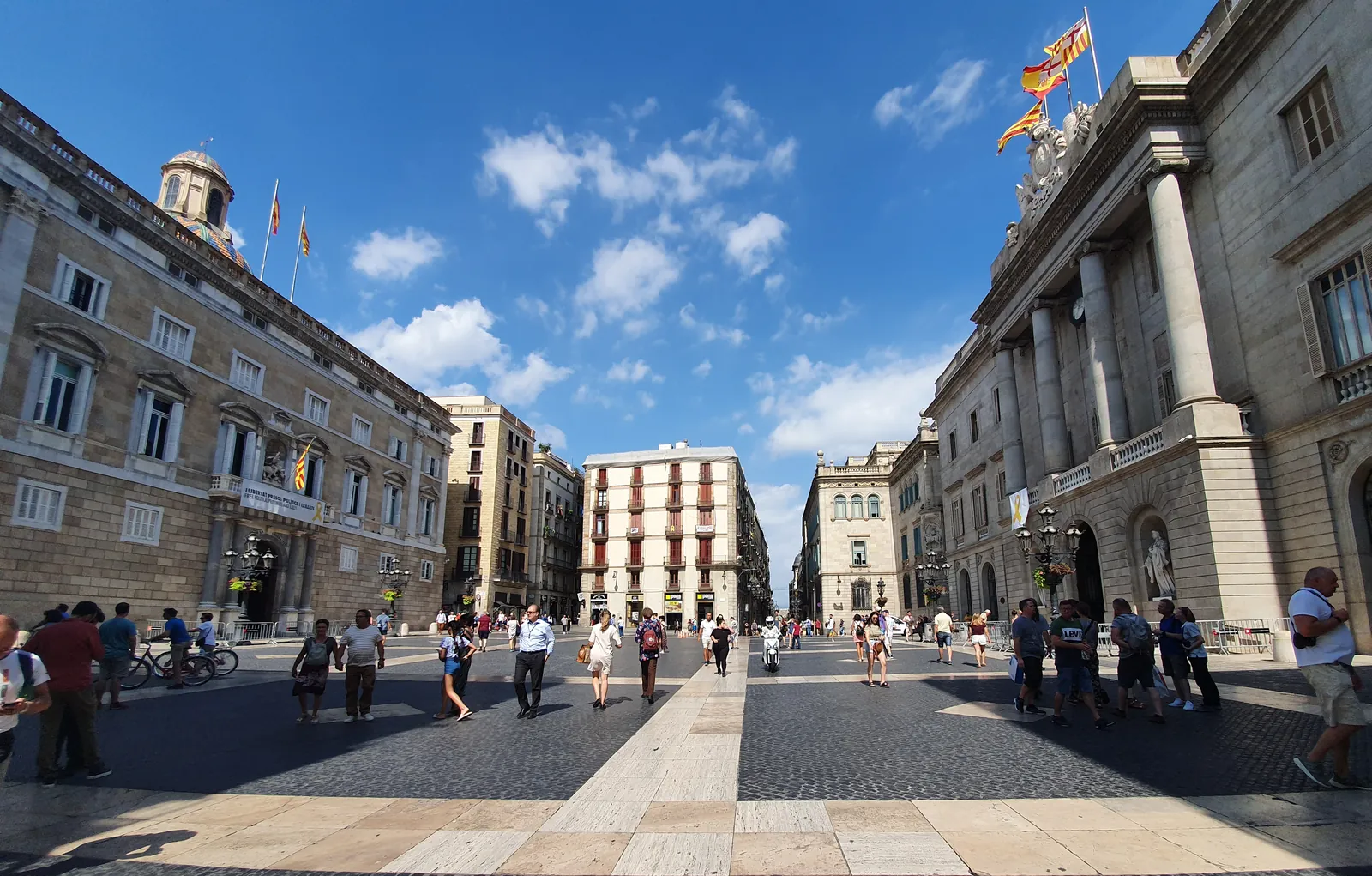
Few squares pack so much power into so little space. This is where the city is run and where Catalonia is run, and the Generalitat balcony has witnessed some of the best-remembered moments in Catalan history. Yet the square you see today is much younger than the buildings around it. And the center of the Roman city still lies under the surrounding streets. Here is what to look for on each facade, what is inside and how to get in.
Plaça de Sant Jaume sits on the highest point of ancient Barcino, next to the top of Mont Tàber, the small hill where the Romans founded the colony. The square lies next to the ancient forum, the center of Roman public life, where trials, business, official announcements and the worship of the emperor took place. Back then the city was run by two magistrates, the duumvirs, and a council of one hundred decurions. That's one hundred members, just like the Consell de Cent (Council of One Hundred) that would govern medieval Barcelona from this very spot.
Two thousand years later, the square is still the seat of power. On one side is the Palau de la Generalitat, and across from it is the Ajuntament, which locals also call the Casa de la Ciutat. The square itself, as we know it, dates from the 19th century. After the state seized and sold off church property in 1835, the City Council enlarged the square and connected it to La Rambla by opening Carrer de Ferran.
For more than a century, guidebooks and maps have placed Barcino's forum around the square, even though nobody had ever seen a single paving stone. What does survive in plain sight is its temple: the columns of the Temple of Augustus still stand a few steps away, on Carrer del Paradís. We tell the whole story in our post on Roman Barcelona.
Our take: the careful way to put it is that the square is the center of Roman Barcino, next to the ancient forum, without pointing to an exact spot. Since the 2026 find described below, archaeologists have been debating exactly where the forum stood and how it was oriented, and there is no conclusion yet.
In February 2026, Barcelona City Council announced an important find for Roman Barcelona. It came to light during expansion work at the Gran Hotel Barcino, at Carrer d'Hèrcules 3, just a few steps from the square. Beneath the Casa Requesens, a monumental pavement of Montjuïc stone appeared: 42 square meters (about 450 square feet) of slabs from the founding years of the colony, between 15 and 10 BC. The Barcelona Archaeology Service (Servei d'Arqueologia de Barcelona) interprets it as part of Barcino's forum.
What stands out is the orientation. The slabs run parallel to the decumanus, the other main street, which crossed the cardo at a right angle. They are not aligned with the cardo, the main north-south street, which is how the forum had always been drawn. According to the Archaeology Service, this calls for rethinking how the center of the colony was laid out. It is a hypothesis. The find has opened a debate among archaeologists about the forum's location and orientation, and it is not settled yet. The remains have been restored and will be integrated into the building's basement, which will be open to public visits. You can read it in the official Barcelona City Council press release.
The palace started out as a house. On December 3, 1400, the deputies of the General de Catalunya, the institution that became the Generalitat, bought a noble townhouse on Carrer de Sant Honorat. From there, the building kept growing through the 16th and 17th centuries until it reached its current shape. Today it is the seat of the Presidency and the Government of Catalonia. It is not the Catalan Parliament, which meets in Parc de la Ciutadella.
The facade facing the square is the newest part of the palace. It is Renaissance, inspired by Roman palaces, and Pere Blay designed it in 1596, commissioned by the deputies. When construction began, the entrance hall looked so massive that many people thought a fortress was going up, and King Philip II had the works halted for a while.

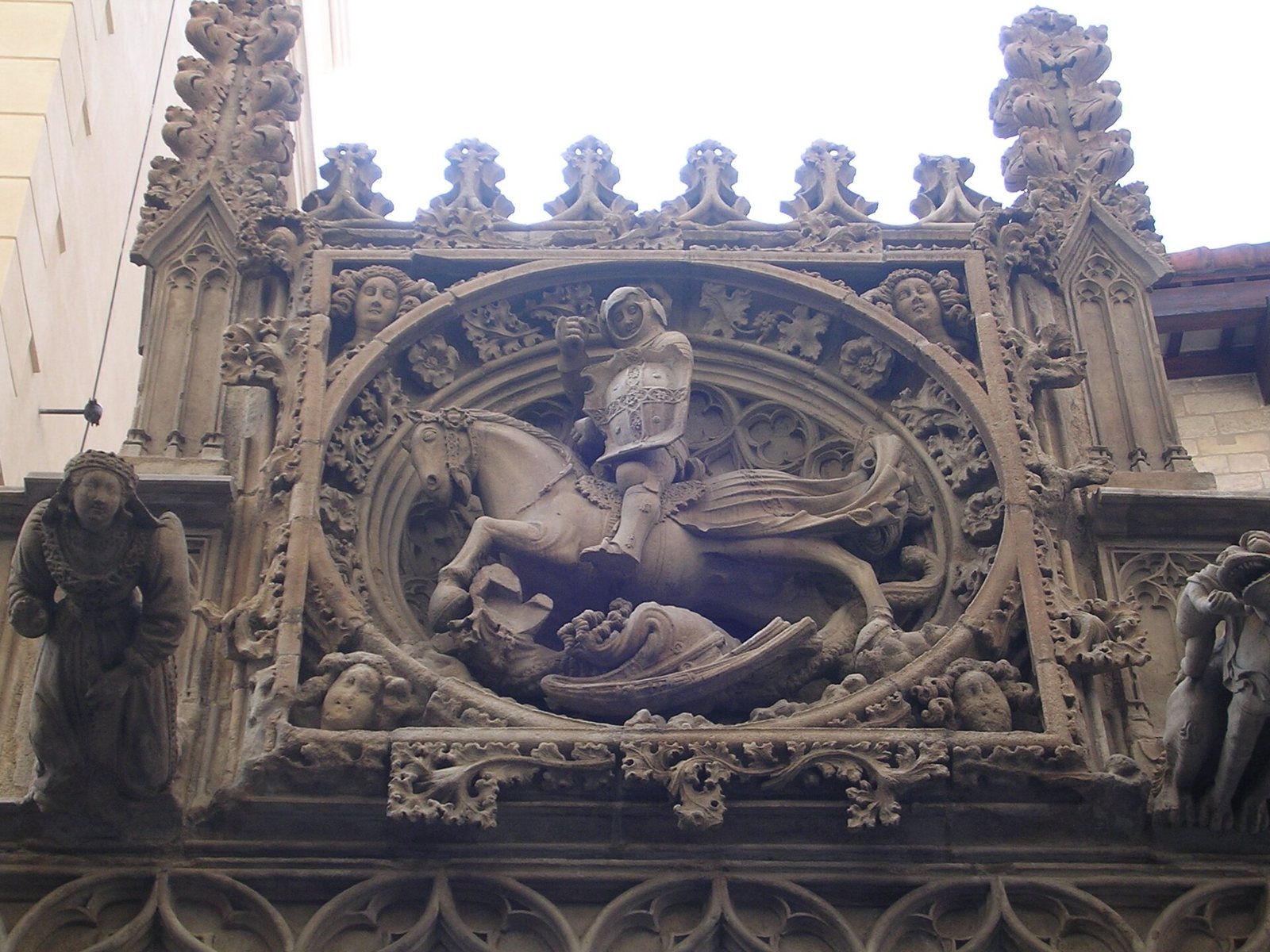
The original facade had no Saint George (Sant Jordi). In 1861, the Diputació de Barcelona, which occupied the palace at the time, held a competition to add one. Sculptor Andreu Aleu won it, and his Sant Jordi was placed above the balcony a few years later. That balcony has been a stage for history. The Republic was proclaimed from it in 1931, with Francesc Macià, and both Franco and Eva Perón appeared on it. In 1977, president Josep Tarradellas delivered his famous "Ciutadans de Catalunya, ja sóc aquí!" ("Citizens of Catalonia, I am here!") there, and European Cup soccer titles have been celebrated on it too.
Where to look
Check the column orders. Up to the main floor, the plainer Doric order dominates. Above it, the Corinthian takes over. At the top of the balcony, a marble quarter sphere holds portraits of the three deputies who commissioned Pere Blay.
Legend
It is said that the granite shafts of the door columns came from a temple in Constantinople, as war booty in the Middle Ages. No document confirms it.
To see the palace's oldest face, leave the square along Carrer del Bisbe. There you will find the 15th-century noble entrance, the only one that leads into the courtyard without steps. That's why horses come in through it during the Tres Tombs, a traditional parade of horses and carriages. Above the doorway is a medallion of Saint George slaying the dragon. The deputies commissioned it from sculptor Pere Joan around 1416, and they liked it so much they paid him double the agreed price.
Where to look
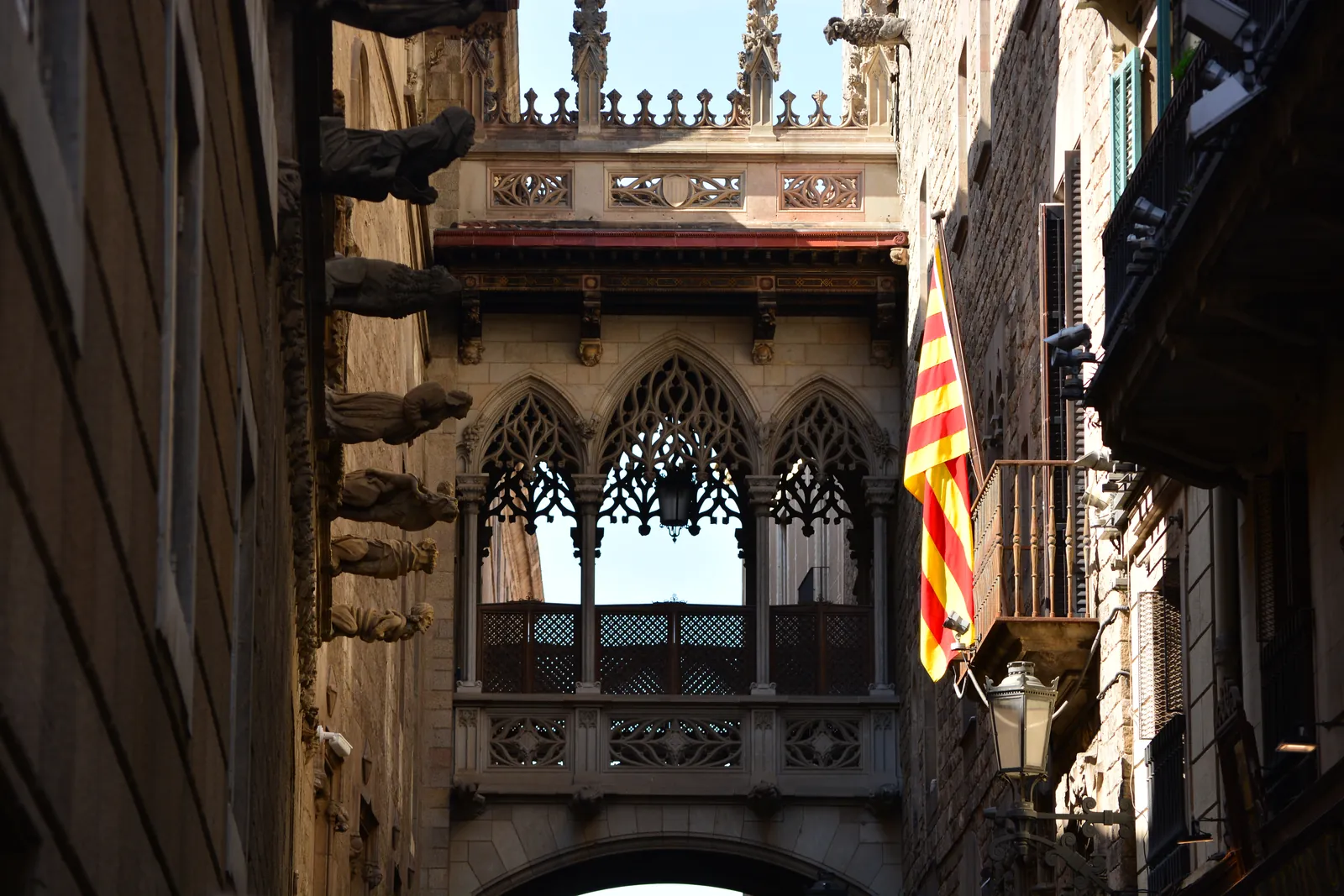
A few yards further on, the bridge over Carrer del Bisbe linking the Generalitat with the Casa dels Canonges looks medieval, but it was designed by Joan Rubió i Bellver and built in 1928.
The whole palace is dedicated to Saint George, patron saint of Catalonia, with more than 50 images of the knight spread around the building. If you join a visit, the route takes in three gems:
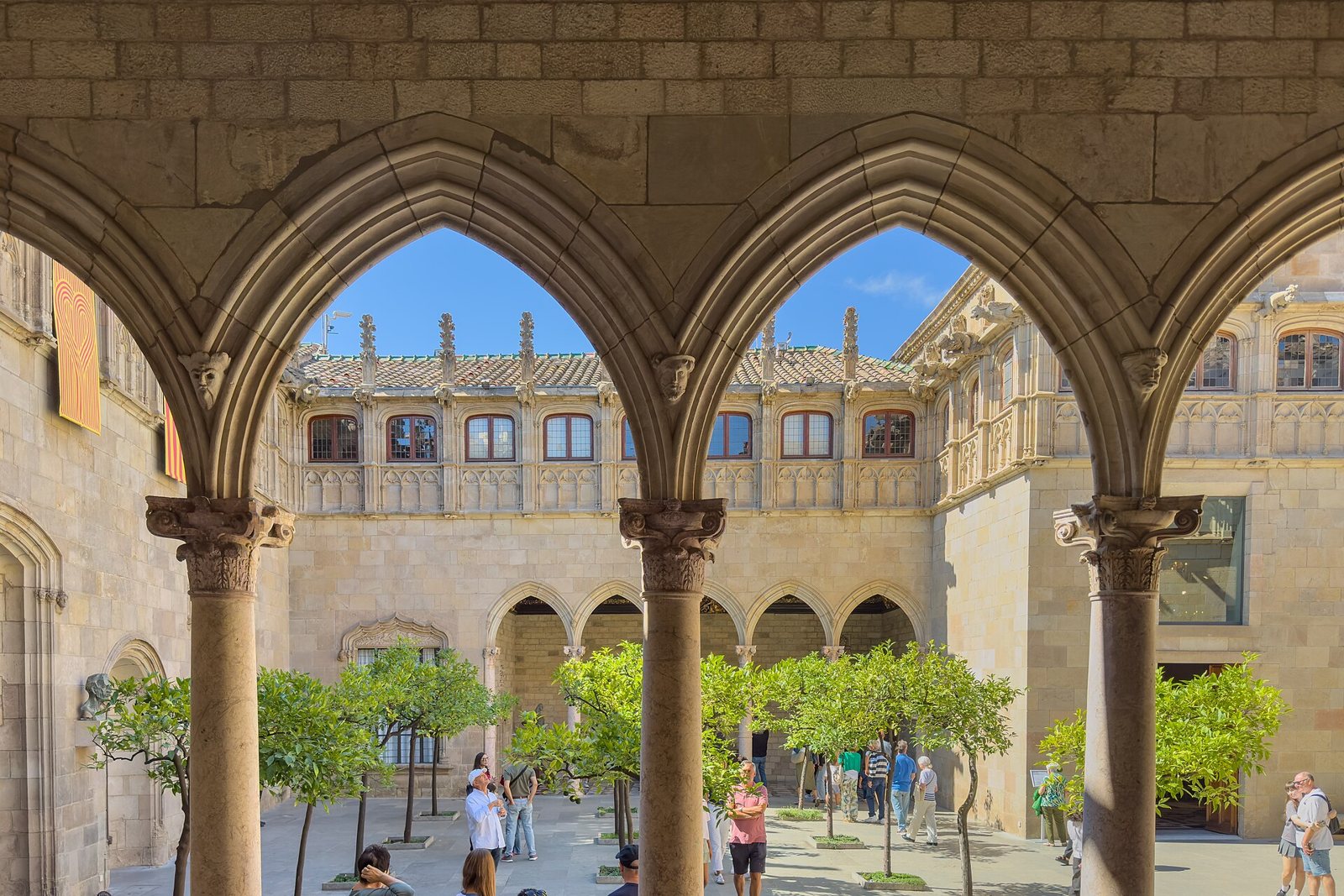
Tip. The oranges in the courtyard are ornamental and not for eating. Palace staff keep an eye out so nobody, especially kids, tries one.
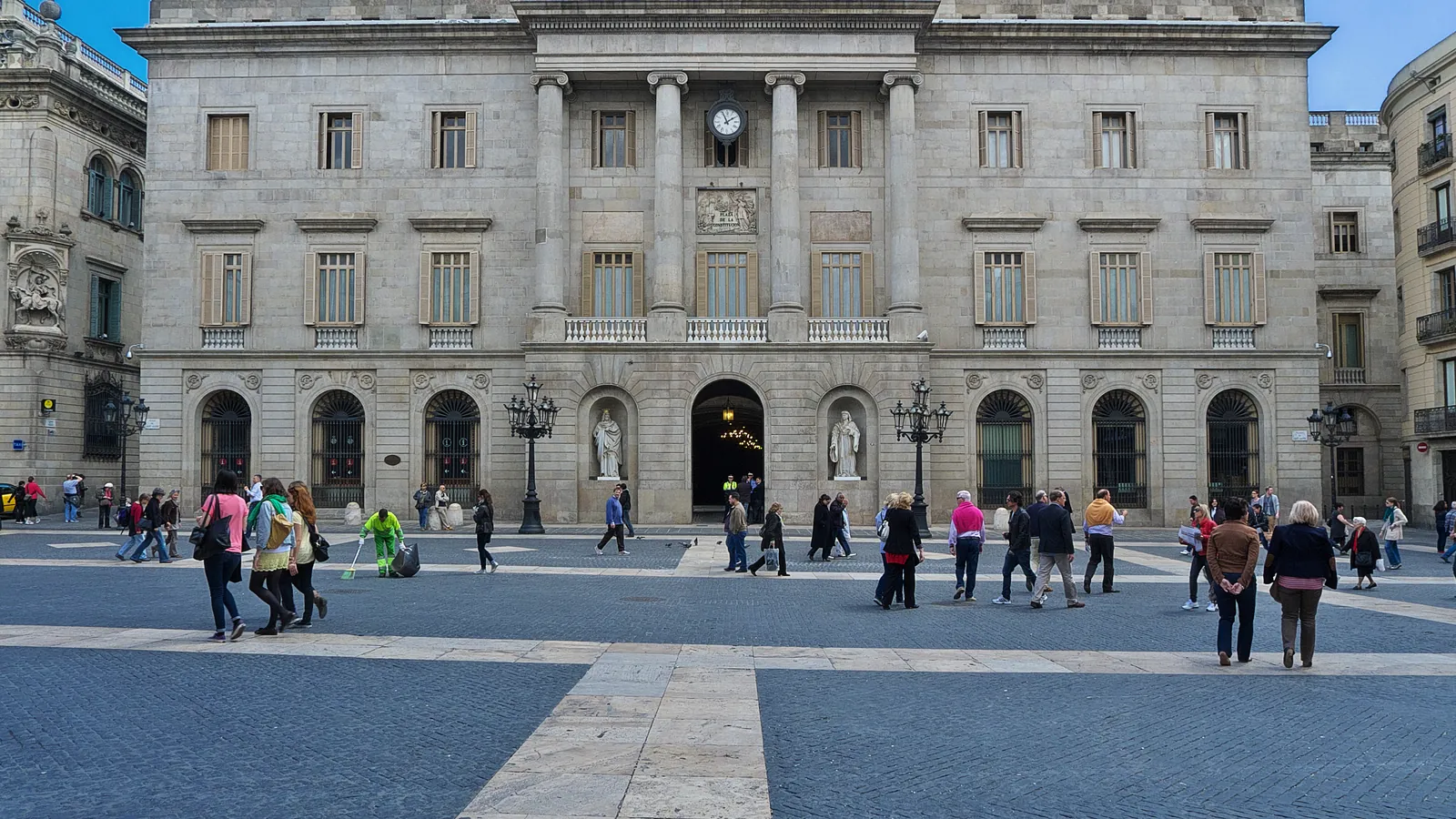
Across from the Generalitat stands the Ajuntament de Barcelona. Construction began in the 14th century as the seat of the Consell de Cent, the council of citizens that ran the city in the Middle Ages. What you see from the square is the neoclassical facade added in the 19th century. The Gothic core survives behind it, so the building mixes styles, from Gothic to neoclassical.
Where to look
Next to the main door is the statue of Joan Fivaller, the city's chief councilor in the 15th century. Inside, on the staircase, there are works by Josep Maria Subirachs, the sculptor of the Passion facade of the Sagrada Família. And the Saló de Cròniques (Hall of Chronicles) is decorated with 1929 murals by Josep Maria Sert.
This is the jewel of City Hall. It was inaugurated in 1373 as the meeting hall of the Consell de Cent and is one of the oldest surviving assembly halls in Europe. Look for its great stone arches and the wooden coffered ceiling. It was enlarged in the 19th century. It has hosted almost every major ceremony in Catalan political life, and today it is used for civil weddings.
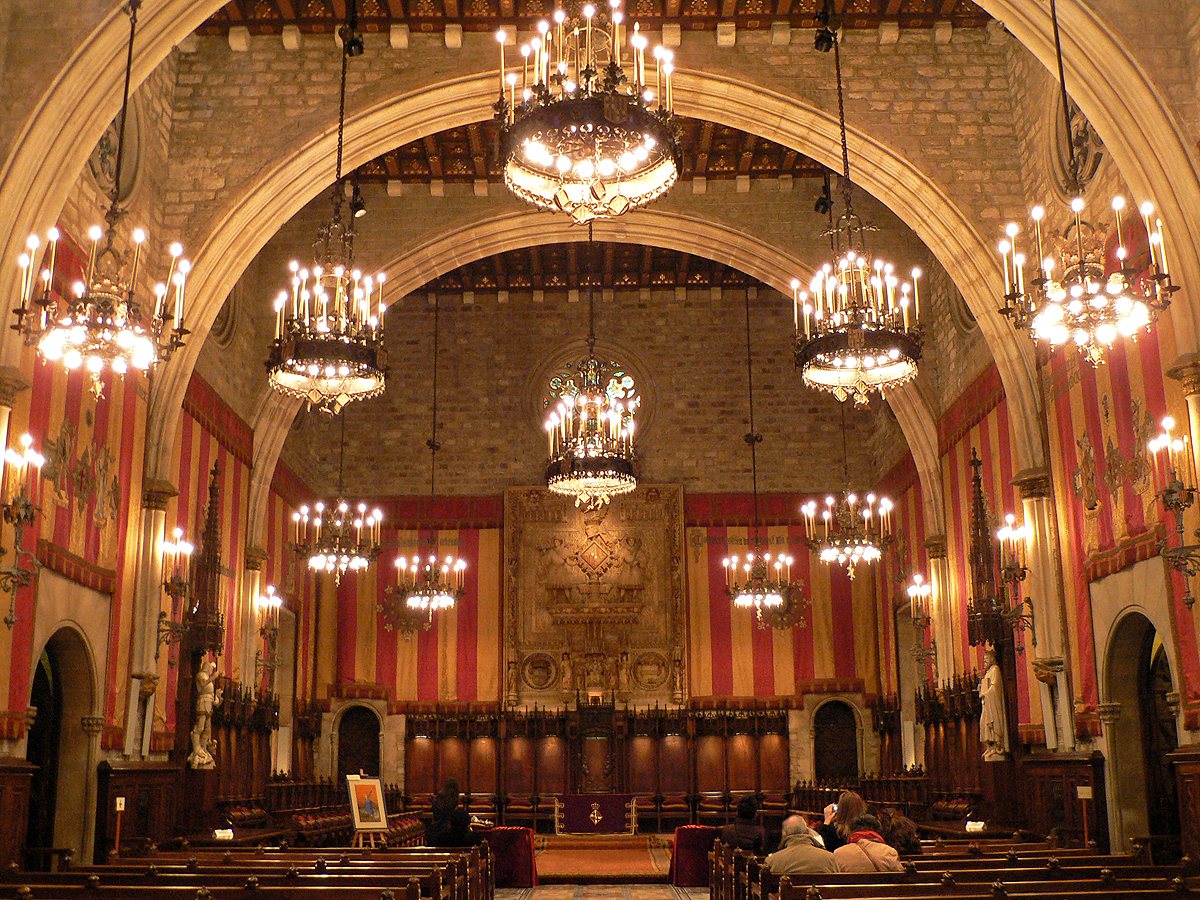
What gives the hall its personality are the domassos, silk hangings in the red and yellow of the Catalan flag. They were meant to be temporary until tapestries showing scenes of Barcelona's history were woven, but those were never made. In 1934, when the Generalitat was suspended, they were taken down because they were seen as a Catalan nationalist symbol. The walls stayed bare through the Civil War and the whole Franco era. They came back in 1974.
Where to look
Find the "fake domàs". Of the fifteen or so hangings, several carry the coats of arms of the old towns annexed by Barcelona, such as Gràcia, Sarrià and Sant Andreu. One, however, shows a sky-blue shield with a white band that belongs to nowhere, and letters that say nothing. It was put up because nobody knew what to hang in that spot.
About two minutes away on foot is the Basilica of Sants Just i Pastor, another stop on our tour, with the Font de Fivaller fountain in front. And on Carrer de Sant Honorat, which leaves the square beside the Generalitat, stood one of the two gates of the Call, the medieval Jewish quarter. The small synagogue of the Call probably stood where the palace's Chapel of Saint George is today.
You will often read that City Hall and the Generalitat are two "hidden gems" that hardly any tourist visits, and that spots for the Generalitat go fast. Both are true. You can tour the inside of both buildings for free, but each has its own rules:
This information was published in November 2026 on the official websites of Barcelona City Council and of the Palau de la Generalitat visits.
Our take: both are worth it if you like history, but they are not the same. City Hall is the easy one: any Sunday morning, free and hassle-free. The Generalitat is the more special of the two, with its Gothic gallery, the Chapel of Saint George and the Pati dels Tarongers, but you have to plan ahead. It only opens on the second and fourth weekends of the month, with a reservation, so check the dates on the Generalitat website before you make plans. If you are in Barcelona for just a few days and your trip does not overlap with those weekends, do not count on it. If the dates do not work for you, you can still hear the Palau carillon from the street (more on that below).
Tip. At City Hall, if you are joining the guided tour, get to the Carrer de la Font de Sant Miquel entrance 15 minutes before it starts. If you are going on your own, it is less crowded at 10:00 am.
Tip. For the Generalitat, check the visits website several times, because spots are released in batches. Type your email carefully, because that is where your QR code arrives. The reservation is free and personal. The Generalitat does not allow agencies or guides to charge for booking it or for the visit itself, and it can cancel bookings that break this rule. If you take our tour and want to see the palace inside, book the palace visit yourself as an add-on.
People often say the square is the stage for Barcelona's big festivals, and it is true: this is where human towers (castells) go up, the giants arrive and the city's main festival kicks off. These are the dates we think are worth it:
Our take: La Mercè is the big moment, but if crowds are not your thing, Santa Eulàlia or the carillon are easier plans. The carillon is the simplest thing for any visitor to fit in, and almost nobody knows about it. If you take our 10:30 am Gothic Quarter tour on the first Sunday of the month, it may coincide with the noon concert. And July 25? Because of the name, many people assume Sant Jaume's day is the square's big festival, but the square has no events of its own that day, so do not plan around it as a special date.
Tip. For the castells at La Mercè, arrive at least an hour early and stand toward Carrer de Ferran or Carrer del Bisbe, because the center fills up first. Skip it if you hate crowds or are pushing a stroller.
Tip. If you are in Barcelona on the first Sunday of the month, you can hear the noon carillon concert from inside the Palau. To do that, register by the Friday before, using the Generalitat form or by calling 012. The next ones are on December 6, 2026 (carillon and tenor) and the special Sant Esteve concert on December 26 at noon. Without registering, the safe bet is to listen to the weekday performances from the street.
Information from the official websites of Nadal a Sant Jaume, the Palau de la Generalitat carillon and La Mercè, checked in November 2026.
What people say is true. Around the square and on Carrer de Ferran there are plenty of places aimed at tourists, with paella and sangria at any hour. To eat like a local, head into the back streets. These are the ones we recommend, all less than a 10-minute walk away:
Our take: none of them has anyone at the door pulling customers in or menus with photos, and the food is local. What we would avoid are the terraces on Carrer de Ferran and in Plaça Reial with photo menus in several languages and someone at the door inviting you in.
Tip. The lunch set menu is served from 1:00 to 3:30 pm. At Can Culleretes, lunch runs until 3:45 pm. Arrive before 2:00 pm or book, especially at Ca l'Agut and Can Culleretes. On a Monday, go to Bodega La Palma or La Plata. For Sunday lunch, try Ca l'Agut or Can Culleretes. After our 10:30 am tour, Ca l'Agut (on weekdays) or Bodega La Palma are just steps away.
From the square you only see two facades. The interesting part is what you cannot see: the ancient Roman forum next to the square, the palace that began as a house, or the Saint George hidden on Carrer del Bisbe. That is what our private Gothic Quarter tour brings to life. It's 3 hours on foot with a licensed tour guide, just your group, in English or Spanish, starting at 10:30 am or 4:30 pm. Kids aged 0 to 11 go free, and you can cancel for free up to 48 hours before. To plan the rest of your walk, here is what to see in the Gothic Quarter, stop by stop, and our guide to visiting Barcelona Cathedral, very close to the square. And if it is your first day in the city, our Barcelona welcome tour gives you the full picture to find your way around.
“Stephen was our tour guide. He gave us a very informative tour about the history of Spain… He explained great details on each site.”
Cindy · TripAdvisor, 2026 (Gothic Quarter tour on Sant Jordi Day)
Before you go. Visiting hours at City Hall and the Generalitat may change because of official events: check their websites the same day. Main photo: the Generalitat (left) and City Hall (right), facing each other across Plaça de Sant Jaume, by exilexi (Wikimedia Commons, CC BY 4.0, cropped).
The two government buildings of Barcelona and Catalonia, facing each other: the Palau de la Generalitat, seat of the Catalan Government, and Barcelona City Hall. Nearby are the Temple of Augustus, the Basilica of Sants Just i Pastor and Carrer del Bisbe.
Yes, for free with an advance reservation on the Generalitat website. Visits run on the second and fourth weekends of each month, except in August, last about 50 minutes and are offered in Catalan, Spanish or English.
Yes, for free, on Sundays that are not public holidays. You can join a guided tour (in English at 10:00 am) or go on your own from 10 am to 1 pm. The entrance is on Carrer de la Font de Sant Miquel.
The square sits at the center of Roman Barcino, next to the ancient forum, but the forum's exact location and orientation are debated among archaeologists. In 2026 a monumental pavement turned up at Carrer d'Hèrcules 3, a few steps from the square. The Barcelona Archaeology Service interprets it as part of the forum, and the find has opened a debate that has not reached a conclusion yet.
Mainly during La Mercè: on September 24, around noon. There is also a castell performance during the Santa Eulàlia festival in February, with smaller crowds. On July 25, Sant Jaume's day, there is no event of its own in the square.
In the back streets: Ca l'Agut (Carrer d'en Gignàs, 16) for the weekday lunch set menu, Can Culleretes (Carrer d'en Quintana, 5) for classic Catalan cooking, or Bodega La Palma (Carrer de la Palma de Sant Just, 7) for vermouth and tapas. Skip the terraces with photo menus on Carrer de Ferran.
No. The Palau de la Generalitat, on Plaça de Sant Jaume, is the seat of the Government and the Presidency of Catalonia. The Parliament, where the elected members meet, is in Parc de la Ciutadella.