Tour guide was amazing. Personalized the tour and gave us fascinating details. Made us see how wonderful personal tours can be!
Home / Private Tours in Barcelona / Tour of the Gothic Quarter of Barcelona
Walking itinerary from Plaça de l'Àngel, a former gate in the Roman wall, to the Basilica of Santa Maria del Pi: Plaça del Rei, Plaça de Sant Jaume with the City Hall and the Generalitat, Basilica of the Saints Martyrs Just and Pastor, Barcelona Cathedral (admission included), Plaça de Sant Felip Neri and the Call, the medieval Jewish quarter. Tour with an official tour guide.
The Gothic Quarter packs two thousand years of history into less than a square kilometer. Beneath its medieval streets lies Barcino, the Roman colony founded under Augustus in the 1st century BC, with its forum, temple and walls. The forum lies buried under Plaça de Sant Jaume, and four columns of the temple dedicated to Augustus still stand in the courtyard of a building on Carrer del Paradís: three in their original position and a fourth, rebuilt from fragments of the temple, which stood in Plaça del Rei until 1956. Towers and stretches of the Roman wall peek out between buildings and shops, and hardly anyone notices them.
On top of that Roman layer, medieval Barcelona was built: the Call, the Jewish quarter, one of the most active in the Crown of Aragon until the attack of 1391; the palaces of the Counts of Barcelona; the Gothic Cathedral, begun in 1298; the Basilica of the Saints Martyrs Just and Pastor, by tradition the oldest parish in the city; and Plaça del Rei, where, according to tradition, the Catholic Monarchs received Columbus in 1493 on his return from the Americas.
On this 3-hour private walk, your official tour guide takes you through those layers of history in order, with concrete details and no filler. Admission to the Cathedral is included in the tour price.
The tour starts in Plaça de l’Àngel, next to the Jaume I metro station (L4), where one of the gates of the Roman wall once stood, and continues through the historic core of Barcino to Santa Maria del Pi.
Visiting the Gothic Quarter means reading Barcelona in layers: each era built on top of the one before without wiping it out completely, and Plaça de l’Àngel is the best place to see it from the very first minute.
Why it has this name. According to tradition, in the year 878 Bishop Frodoí moved the remains of Saint Eulàlia from Santa Maria de les Arenes (today’s Santa Maria del Mar) to the cathedral. When the procession reached this city gate, the coffin became so heavy that no one could lift it. An angel appeared and pointed at one of the canons, who had stolen one of the saint’s fingers. Once he gave it back, the procession could move on. In 1618 a statue of the angel by silversmith Felip Ros was placed on top of an obelisk erected in 1606; the one you see today in the niche above number 2 is a 1966 copy. For centuries the spot was also known as Plaça del Blat (Wheat Square), because the city’s grain was sold here.
The Roman layer. This was the site of the Porta Principalis Sinistra, one of the four gates of Barcino. Around the square stand the best-preserved stretches of the Roman wall, with towers on Carrer del Sotstinent Navarro reaching about 46 feet (14 meters).
The medieval layer. After Almanzor sacked the city in 985, the gate was reinforced with the Castell Vell, one of the castles guarding the entrances to the medieval city of the Counts of Barcelona. It stood until the mid-19th century.
The modern layer. The opening of Via Laietana in the early 20th century cut through the old town and exposed sections of the wall that had been hidden inside houses for centuries. Right under your feet, metro line 4 has its Jaume I station.
With these three layers in mind, your guide leads you into the heart of the Roman city.
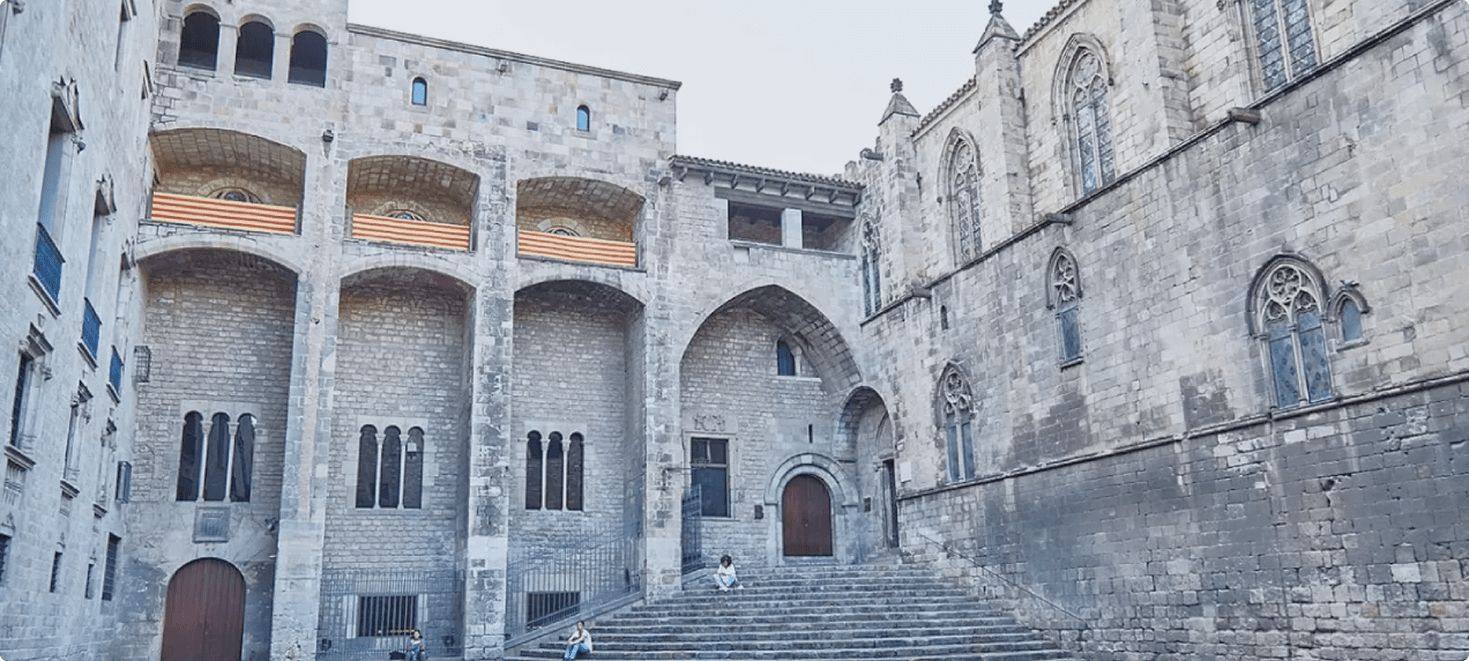
The most compact medieval palace complex in Barcelona: the Palau Reial Major; the Saló del Tinell, built between 1359 and 1370 with great arches spanning about 17 meters and no columns in between; the Chapel of Santa Àgata; and the 16th-century tower of King Martin. Your guide brings to life the tradition that places Columbus’s reception here in 1493, the palace’s use as the seat of the Inquisition and how the complex changed over the following centuries.
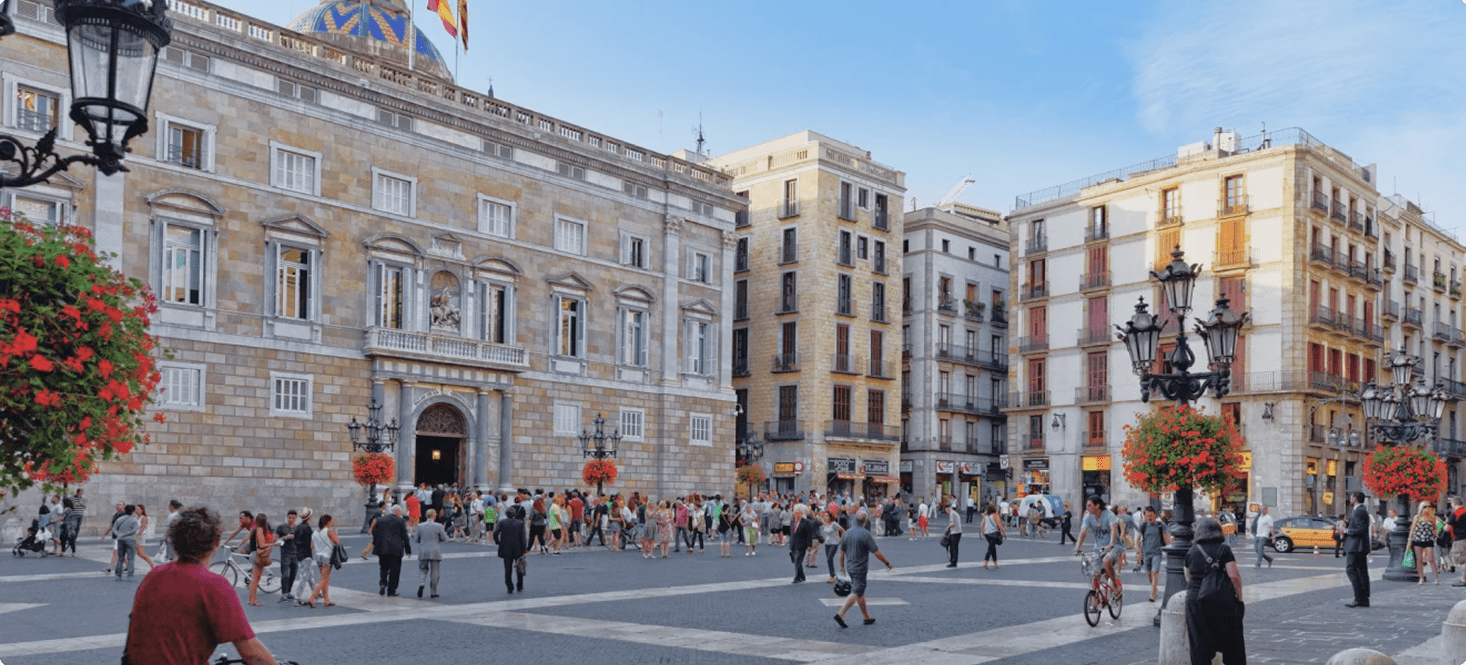
The political center of Barcelona since Roman times, where the two main axes of Barcino crossed: the cardo maximus and the decumanus maximus. The Roman forum extended exactly under this square. Today it is flanked by the Palau de la Generalitat (autonomous government, founded in 1403) and the Ajuntament de Barcelona (14th century). The guide explains the symbolic load accumulated from the center of Roman power to the scene of the main contemporary political events.
By tradition the oldest parish in Barcelona; the current building is Gothic, from the 14th century. It keeps a curious medieval privilege, the sacramental will: last wishes spoken before its altar were legally valid. Your guide explains how a church also became a legal space.
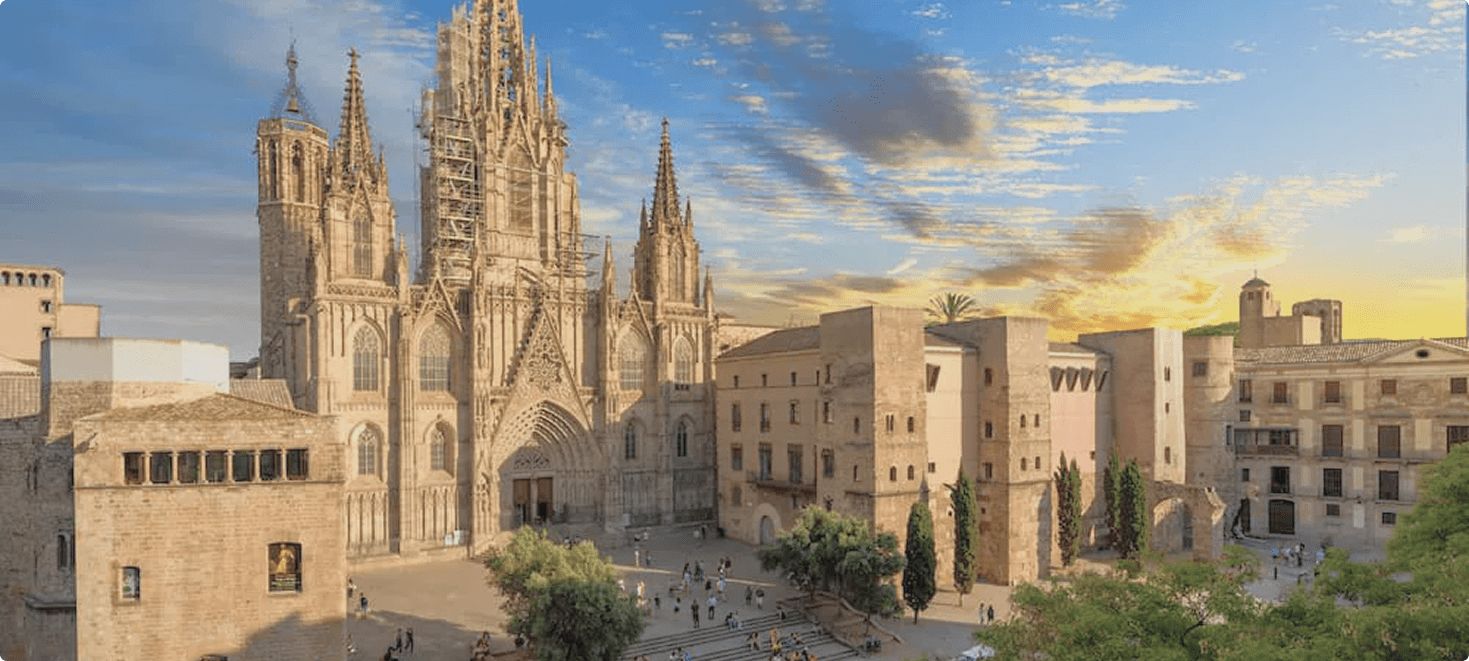
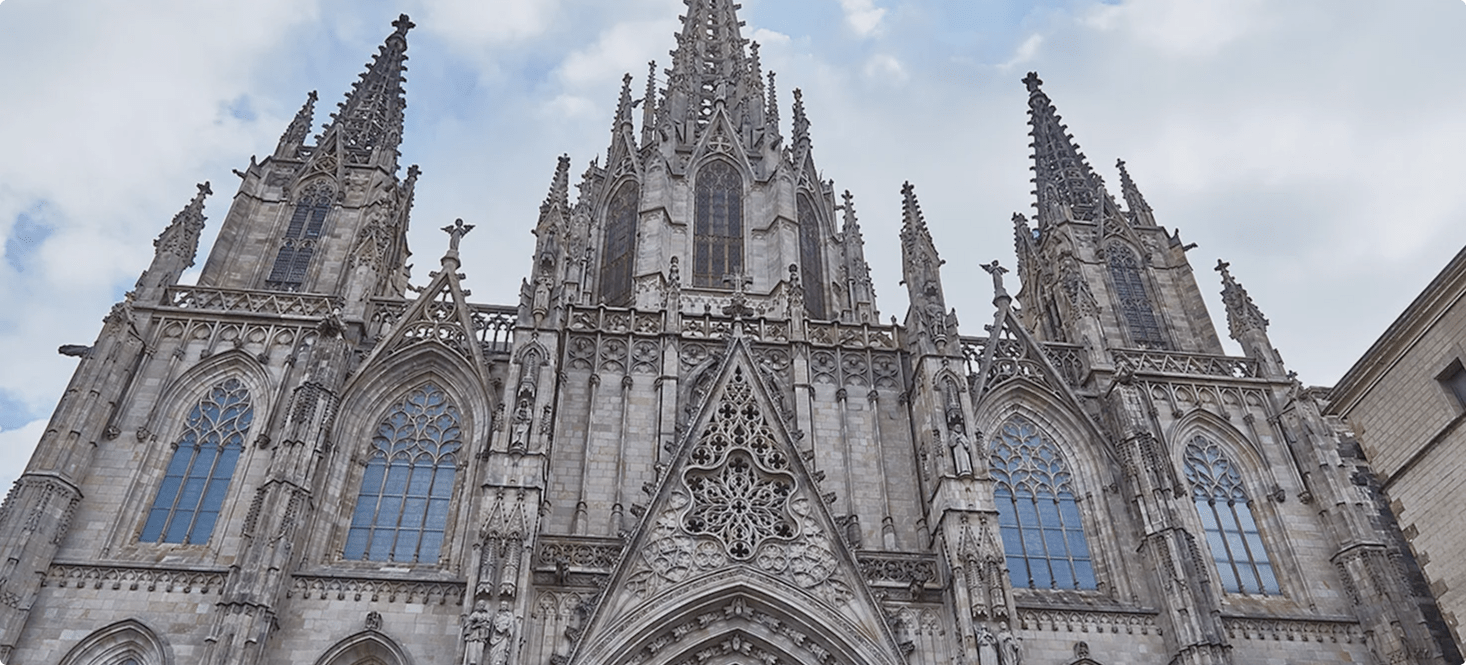
The Cathedral of the Holy Cross and Saint Eulàlia, dedicated to Barcelona’s co-patron saint, is the city’s great Gothic building. Construction began in 1298, under King James II, and went on for more than 150 years. The neo-Gothic façade you see today dates from the late 19th century: the original was left unfinished for centuries. The crypt holds the 14th-century tomb of Saint Eulàlia, and the cloister is home to thirteen white geese which, according to tradition, recall the saint’s age when she was martyred. Admission is included in the tour price.
One of the smallest and most historic squares in the neighborhood. In January 1938, during the Civil War, a bombing raid by Franco’s air force killed 42 people, mostly children who had come out of the nearby air raid shelter. Shrapnel marks are still visible on the church walls. The guide explains the context of the bombing, the history of the neighborhood and why this square is quieter than any other in the Gothic Quarter.
Between Sant Felip Neri and Santa Maria del Pi lies the Call, Barcelona’s medieval Jewish quarter; the word call means alley. One of the most important Jewish communities in the Crown of Aragon lived here until the attack of 1391. Your guide stops in front of the space identified as the old Sinagoga Major, where Rabbi Solomon ben Adret served in the 13th century, and shows you, at number 1 on the same street, the Hebrew plaque of the charitable foundation of Rabbi Samuel ha-Sardí (the original is kept at the Barcelona History Museum).
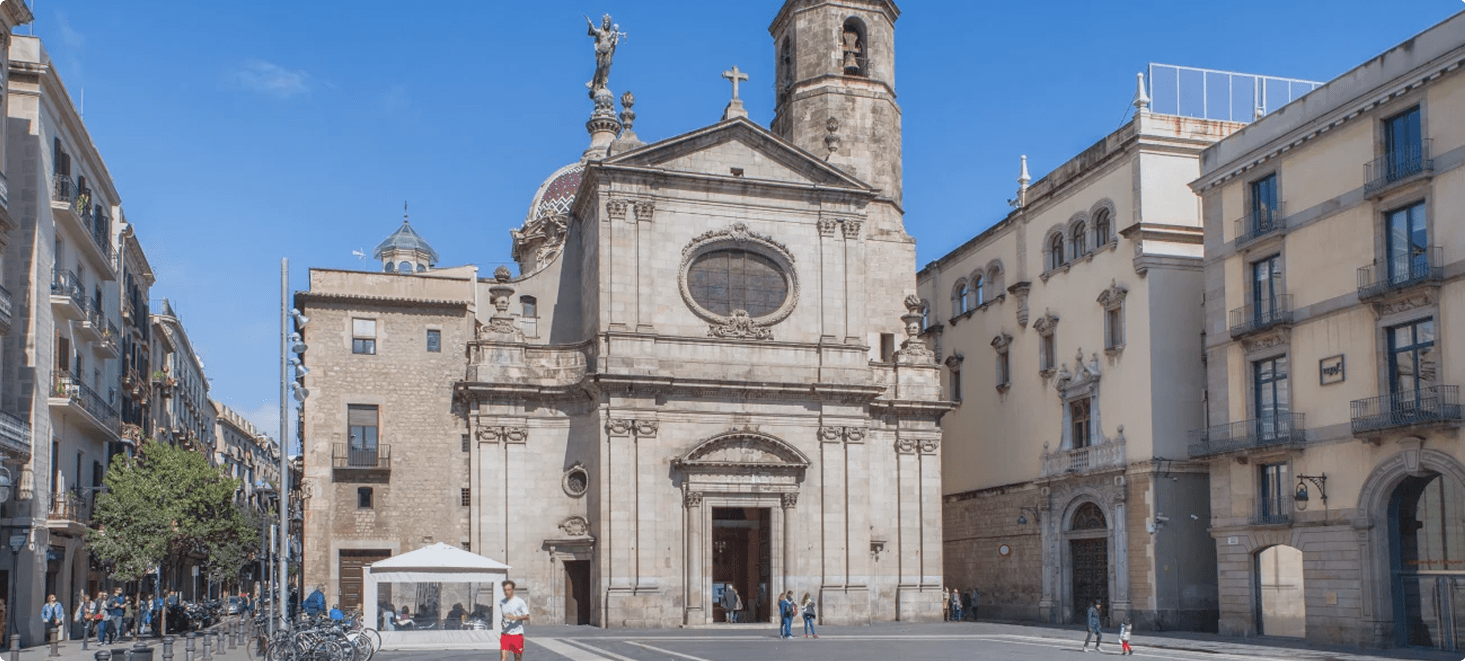
One of the great churches of Catalan Gothic, built outside the old Roman wall: work began in the early 14th century, the main body was finished in 1391 and the bell tower in 1497. According to tradition, its name comes from a pine tree (pi in Catalan) that grew in the square, and there is still one in front of the basilica today. Its most striking feature is the large twelve-spoke rose window above the main door: the 14th-century original was destroyed in the 1936 fire and rebuilt between 1939 and 1943 by architect Josep Maria Jujol, a collaborator of Gaudí. This is where the tour ends, outside the Roman enclosure, in the city that grew around it in the Middle Ages.
INCLUDED
NOT INCLUDED
The price is per group, not per person: the total is split among everyone, so the more people in your group, the less each person pays.
| People | Total | Per person |
|---|---|---|
| 1 person | €375.10 | €375.10 / person |
| 2 people | €387.20 | €193.60 / person |
| 3 people | €417.45 | €139.15 / person |
| 4 people | €508.20 | €127.05 / person |
| 5 people | €605.00 | €121.00 / person |
| 6 to 14 people | — | €114.95 / person |
| 15 people | €1,633.50 | €108.90 / person |
* Children (from 0 to 11 years old): free of charge. Entrance to the Cathedral is included in the tour price. No hidden fees or booking surcharges.
It’s one of our most popular tours: book early if you’re arriving in high season. It runs in two daily time slots:
* We recommend booking at least 7 days in advance. In high season (May–September) our guides are fully booked: the earlier you book, the more time slots you’ll have to choose from.
Your guide will be waiting for you in Plaça de l’Àngel, on Via Laietana, next to the exit of the Jaume I metro station (line 4, yellow). Look for the angel pointing its finger from a niche above number 2 on the square: that’s your landmark. After booking, we’ll send you the guide’s phone number so you can meet up without any hassle.
Plaça de l'Àngel (Jaume I Metro, L4)
Free cancellation available
You can cancel free of charge up to 48 hours before the tour start time. Cancellations made less than 48 hours in advance or no-shows will not be refunded.
Yes, the tour includes the inside of the Cathedral: the central nave, the side chapels, the cloister with its thirteen geese and the crypt of Saint Eulàlia. Your guide takes care of the tickets, so there’s nothing to buy separately and no ticket-office line.
The main difference is that at Willy’s Plan all guides have the Títol de Guia de Turisme de Catalunya issued by the Generalitat (an official qualification with an exam, not a company certificate) and entrance to the Cathedral is included at no extra cost. Beyond that, the itinerary covers the three historical layers of the neighborhood: Roman, medieval and modern, with specific references at each stop. Many tours of the Gothic remain on the visual surface of the neighborhood; this one goes into the Roman temple, the Jewish Call and the medieval palaces that most visitors pass by without identifying.
The tour includes the Plaça del Rei and the exterior of the MUHBA complex. Access to the Barcino subway site requires a separate entrance to the museum and has specific logistics that do not fit into the flow of the private guided tour. The guide explains in detail what is under the square and what is preserved in the subway. If you want to visit the MUHBA in depth, the most usual is to do it the next day, with the historical background that the tour will have given you.
Yes. The Gothic Quarter works very well with kids from about 6 or 7: narrow streets with history in plain sight, the Cathedral cloister with its geese, the Roman columns of the Temple of Augustus and Plaça del Rei make an impression without much explanation. Your guide adapts the language and pace to the group. Children ages 0 to 11 don’t pay for the tour. Let us know their ages when booking.
If medieval history has hooked you, the private Born and Ciutadella tour is the natural next step: El Born was the most prosperous neighborhood of medieval Barcelona, and it preserves the Basilica of Santa Maria del Mar and, beneath the old Mercat del Born, the remains of the neighborhood razed in 1714. If architecture interested you most, the private Modernisme tour follows the thread from the medieval city to the 20th century. And if you’re after 20th-century political history, the private Spanish Civil War tour starts from several of the places you’ll have seen in the Gothic Quarter.
Directly from the booking button on this page. You can also contact us by WhatsApp if you have doubts about which tour of the Gothic Quarter fits best with your group, the time you have in Barcelona or what to combine with this tour.
Tour guide was amazing. Personalized the tour and gave us fascinating details. Made us see how wonderful personal tours can be!
Very interesting to walk along streets learning the history. Our tour guide was very funny and accommodating.
Stephen was our tour guide. He gave us a very informative tour about the history of Spain… He explained great details on each site.
Robert is a superb guide who shows and explains every place perfectly.
If you have any questions or special needs before booking, write to us — we reply in less than 24 hours.