Private guided tour · El Born · La Ciutadella · Barcelona

Private tour of El Born and the Ciutadella with an official guide

Private tour of the Arc de Triomf, Ciutadella Park, the Cascada, the Parliament, El Born Market, Santa Caterina Market, the Picasso Museum, the Convent of Sant Agustí, and the Palau de la Música. Tour with an official tour guide.

Rating on TripAdvisor and Viator
0
Exterior and interior durability
0 h
Certified official tour guides
0 +
Exclusive private groups
0 %
About this tour

Private tour of El Born and the Ciutadella: two thousand years of history in one kilometer

El Born and the Ciutadella are the two spaces that best explain why Barcelona is the way it is: a neighborhood that for centuries concentrated the economic and cultural activity of the Crown of Aragon, and a park that occupies the site of the military fortress with which Philip V punished the city after the War of the Spanish Succession. Exploring them together in 3 hours is not just a historical walk — it is understanding the conflict between the city and the State that has defined Barcelona since 1714.

The tour starts under the Arc de Triomf and moves towards the Ciutadella Park — Gaudí’s Cascade, the lake, the Parliament. From there, it enters El Born: the Mercat del Born with the ruins of the razed neighborhood, the streets walked by a teenage Picasso, the Convent de Sant Agustí, and Domènech i Montaner’s Palau de la Música. Private tour: no audio guides, no shared groups, at your group’s own pace.


What we'll visit

Tour itinerary: from the Arc de Triomf to the Palau de la Música

The tour begins under the Arc de Triomf and heads towards the park before entering the medieval fabric of El Born. Each stop has a specific narrative.

Arc de Triomf (Passeig de Lluís Companys)

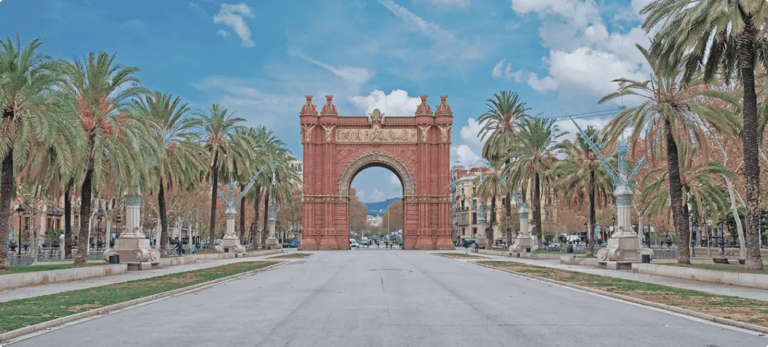
Built by Josep Vilaseca i Casanovas in 1888 as the main gateway to the Barcelona Universal Exposition. The arch does not commemorate any military victory: it is a showcase of the Catalan industrial bourgeoisie to Europe, built in exposed Moorish-Mudéjar brick when Modernisme was beginning to take shape just a few meters away. The frieze on the lintel depicts Barcelona welcoming the nations of the world, with the coats of arms of all Spanish provinces on the cornice. A political gesture as well as an architectural one.

Ciutadella Park

The park occupies the site of the military citadel that Philip V ordered to be built between 1716 and 1728, immediately after the defeat of Barcelona in the War of the Spanish Succession. To build the fortress, the La Ribera neighborhood was demolished — about a thousand houses — and its inhabitants were evicted by decree. For 150 years, the citadel was the physical symbol of Bourbon repression over the city. Barcelona claimed it for decades: finally, the State ceded the site to the city in 1869, and the architect Josep Fontserè was commissioned to convert it into a public park. The 1888 Universal Exposition completed its transformation.

The Monumental Waterfall

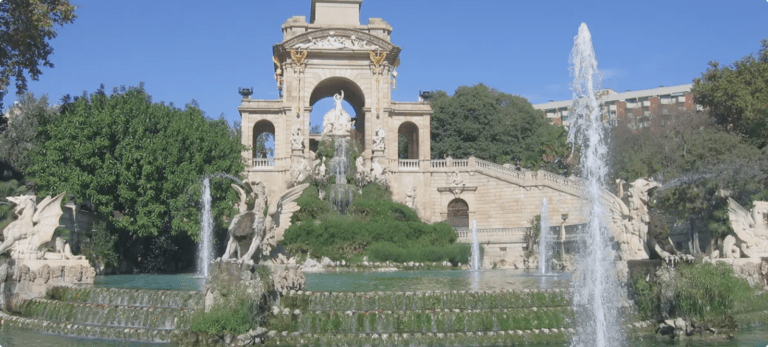
The park’s cascade, designed by Fontserè starting in 1875 and inaugurated in 1888, is one of Antoni Gaudí’s first documented works: he collaborated on the project as an architecture student, calculating the water reservoirs and the ornamental elements. The influence of Rome’s Trevi Fountain is explicit — Fontserè had studied it during his trip to Italy. The guide points out the details that foreshadow the artistic language that Gaudí would develop in the following decades.

The Parliament of Catalonia

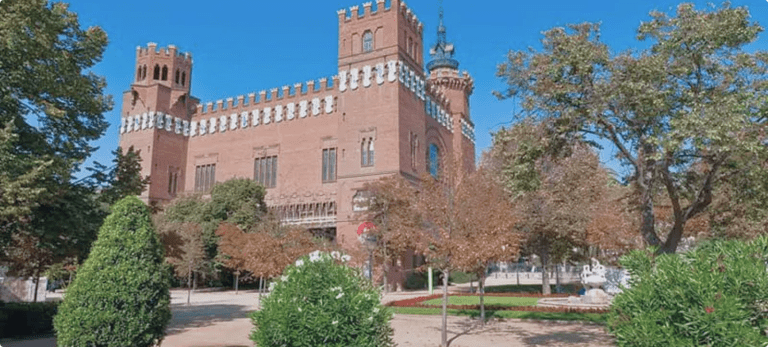
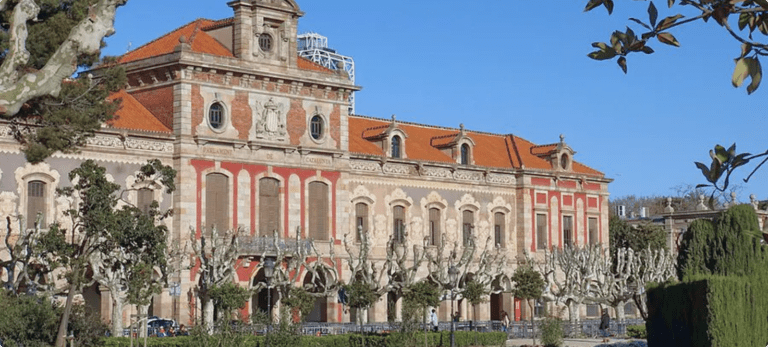
Housed in the former Ciutadella Arsenal, the most imposing building of the Bourbon military fortress, built between 1727 and 1731 to store weapons and ammunition. When the State ceded the site to the city in 1869, the Arsenal became a Royal Palace and later the seat of the Parliament of Catalonia, restored in 1977. The choice has a direct historical logic: the very building that served to control Barcelona for 150 years now houses the institution that represents Catalan autonomy.

Mercat del Born (former Central Market of Barcelona)

The market, built between 1874 and 1876 and designed by Josep Fontserè, was for decades Barcelona’s largest wholesale market. Closed in 1971 due to obsolescence, its demolition was planned to build a library. In 2001, during excavation works, the remains of the La Ribera neighborhood, razed in 1714, were uncovered: streets, houses, wells, and everyday objects from the exact moment of the Bourbon demolition. The discovery halted the library project and transformed the building into the El Born Cultural Centre, which opened in 2013. The archaeological site visible from the upper floor of the market is the only in situ archaeological evidence of Barcelona prior to the War of the Spanish Succession.

Santa Caterina Market

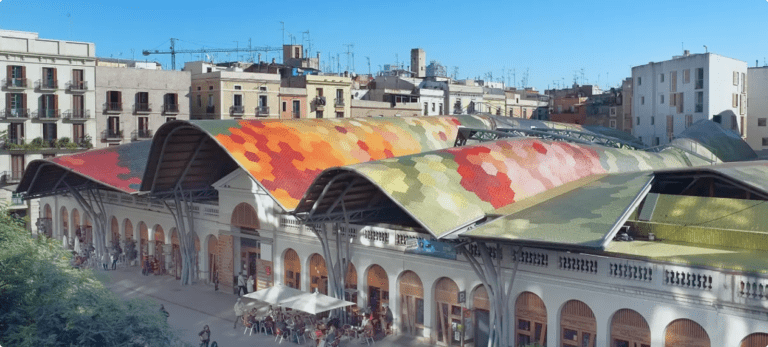
The Santa Caterina Market, renovated in 2005 by Enric Miralles and Benedetta Tagliabue, occupies the site of the former Convent de Santa Caterina — the first Gothic convent built in the Crown of Aragon, founded in 1223 and demolished in 1837. The undulating ceramic roof, with its 325,000 pieces in 67 different shades, is one of the most unique contemporary architectural elements in Barcelona. Beneath the market, archaeological remains of the original convent are preserved, visible through a glass panel inside.

The streets of the young Picasso — El Born

Pablo Ruiz Picasso arrived in Barcelona in 1895, at the age of 13, when his father obtained a teaching position at the Escola de Belles Arts de la Llotja. The family settled on Carrer de la Mercè, just a few meters from El Born. His first studio of his own was on Carrer de la Plata — there, at the age of 15, he painted *Science and Charity* (1897), now in the Museu Picasso. The guide covers the sites of the artist’s formative period: Els Quatre Gats — the modernist café-cabaret on Carrer de Montsió where he first exhibited in 1900 — and the streets of the Casc Antic that appear in his early works. The Museu Picasso in Barcelona, housed since 1963 in five medieval palaces on Carrer de Montcada, holds the most important collection of his early work.

Convent de Sant Agustí

Founded in 1309 by the Augustinian order, the convent was closed during the Mendizábal confiscation in 1835. Its history has an episode specifically linked to 1714: when the Bourbon citadel razed the La Ribera neighborhood, the people of Barcelona moved the municipal archive to the Convent de Sant Agustí to preserve it from demolition. For decades it served as barracks, a school, and the headquarters of various municipal institutions. Today, it functions as a cultural space for the Barcelona City Council. The guide explains the convent’s role as a repository of the city’s memory during its most critical moments.

Palau de la Música Catalana

Built between 1905 and 1908 by Lluís Domènech i Montaner to house the Orfeó Català, the Palau is the only Modernista concert hall in the world and a World Heritage Site since 1997, alongside the Hospital de Sant Pau by the same architect. The exterior facade boasts an unprecedented sculptural and chromatic density for the architecture of its time: busts of Bach, Beethoven, Palestrina, and Clavé, mosaics by Lluís Bru, and the sculptural group *La Cançó Popular Catalana* by Miquel Blay. The interior — not included in the outdoor tour, but visible in detail if requested by the group upon booking — features a stained-glass skylight weighing over three tons by Antoni Rigalt, the largest of its kind in the world. The guide explains the building’s connection to the Catalan Renaixença movement and the cultural and political project that drove it.


What's included

What is included in this private tour of El Born and the Ciutadella

INCLUDED

  • ✓ Official private tour guide
  • ✓ 3-hour walking tour
  • ✓ Arc de Triomf · Ciutadella · Born · Palau de la Música
  • ✓ Born Market · Santa Caterina Market
  • ✓ Available in Spanish and English
  • ✓ Free cancellation (up to 48h before)

NOT INCLUDED

  • ✗ Tickets to museums or indoor venues
  • ✗ Food or drinks
  • ✗ Transport to the meeting point

Pricing

Price of the tour of El Born and the Ciutadella — per group, not per person

The price is per group, not per person. The total is split among all participants. The more people, the lower the cost per head.

Low Season (October 1 – April 30)

PeopleTotalPer person
1 person€199€199 / person
2 people€178€89 / person
3 people€267€89 / person
4 or more people€70 / person

High Season (May 1 – September 30)

PeopleTotalPer person
1 person€330€330 / person
2 people€300€150 / person
3 people€330€110 / person
4 or more people€90 / person

Tour schedule

Time slots for the El Born and Ciutadella tour

The El Born and Ciutadella tour is one of the most popular among those who already know Barcelona’s city center and want to explore its densest historic neighborhood in detail — book well in advance if you are arriving during high season. The tour takes place during two daily time slots:

  • 10:30 AMMorning session
  • 4:30 PMAfternoon session

Tour details

Languages, accessibility and practical information

DURATION
3 hours
TOUR TYPE
100% private — only your group
LANGUAGES
Spanish · English
GUIDE
Official tourist guide (Catalonia Tourist Guide License, Government of Catalonia)
ACCESSIBILITY
The tour takes place mostly on flat streets. The historic Born district has cobbled sections and some narrow sidewalks — let us know your needs when booking and we will adjust the itinerary.
PETS
Check availability when booking
MINIMUM BOOKING
7 días antes (antes en temporada alta)
KIDS
Free (0–11 years). All ages welcome.

Meeting point

Where to find your guide for the El Born and Ciutadella tour

Just below the Arc de Triomf — Passeig de Lluís Companys, Barcelona

Your guide will be waiting for you at the foot of the Arc de Triomf. After booking, we will provide you with the guide’s phone number so you can meet up without any hassle. Nearest Metro: Arc de Triomf, L1.

Under the Arc de Triomphe

Tour checkpoints


Cancellation Policy

Free cancellation up to 48 hours before the tour

Free cancellation available

You can cancel free of charge up to 48 hours before the tour start time. Cancellations made less than 48 hours in advance or no-shows will not be refunded.


FAQs

Frequently Asked Questions about the private tour of El Born and the Ciutadella

What exactly happened in El Born in 1714 and what remains of it today?

On September 11, 1714, after a 14-month siege, the Bourbon troops of Philip V took Barcelona. The retaliation against the La Ribera neighborhood was immediate: to build the military citadel that would guarantee control of the city, the demolition of more than 1,000 houses and the forced eviction of their inhabitants was ordered. In 2001, during excavation works for a library under the Mercat del Born, the remains of that neighborhood appeared exactly as they were at the moment of demolition: streets, doorways, wells, ceramics. The El Born Cultural Centre, inaugurated in 2013, preserves these remains, visible from the market floor. It is the only archaeological site of pre-Bourbon Barcelona visible in situ.

What was Picasso's relationship with El Born? Does the tour pass by the Museu Picasso?

Picasso arrived in Barcelona in 1895 at the age of 13 and lived in the Casc Antic neighborhood until 1904. The family settled on Carrer de la Mercè; his first studio was on Carrer de la Plata and the second on Carrer de la Riera de Sant Joan, just a few meters from El Born. The tour passes through the streets where he lived and worked during his formative years, and Els Quatre Gats — the modernist café on Carrer de Montsió where he exhibited for the first time in February 1900. The Picasso Museum, housed in five medieval palaces on Carrer de Montcada since 1963, is on the route: the guide explains the collection from the outside and the context of the building. Admission to the inside of the museum is not included in the tour — if you want to visit the permanent collection, you can buy tickets separately at museupicasso.bcn.cat .

What is Gaudí's connection to the Ciutadella Park?

Gaudí collaborated on the construction of the Ciutadella Park Cascade as a fourth-year student at the Escola d’Arquitectura de Barcelona, between 1875 and 1877. He worked as an assistant to the architect Josep Fontserè, who was in charge of the park project. This collaboration is documented: Gaudí calculated the water reservoirs and designed some of the cascade’s ornamental elements. It is one of his earliest known works, predating even his graduation in 1878. The guide points out on-site which elements of the ensemble are attributed to his intervention.

What is the Palau de la Música Catalana like inside? Can you enter during the tour?

The Palau de la Música can be visited with an independent ticket or on a guided tour of the Palau itself — this is not included in this tour. What is included in the tour is a detailed reading of the exterior facade: the sculptural group of La Cançó Popular Catalana by Miquel Blay, the mosaics by Lluís Bru, the busts of composers, the exposed iron structure, and the ceramic cornice. The guide explains the history of the Orfeó Català, the political context of Catalan Modernisme, and why the building is a World Heritage Site. If you wish to visit the interior, you can book a guided tour of the Palau at least one week in advance at palaumusica.cat — we recommend doing it on a different day than this tour to avoid overloading your schedule.

Is it suitable for families with children?

Yes. The tour has an immediate visual appeal: the Arc de Triomf, the lake and the swans of the Ciutadella, the facade of the Palau de la Música. The guide adapts the vocabulary and pace to the group. Children under 12 are free. For groups with young children, the morning session usually works best. Please let us know the children’s ages when booking.

What other tours complement this tour well?

The El Born and Ciutadella tour covers medieval and 19th-century bourgeois Barcelona. If you want to delve deeper into the Gothic Quarter — the city’s Roman and medieval core — the Private Tour of the Gothic Quarter and the Cathedral is the natural complement: the two neighborhoods are adjacent but have distinct histories and layers, each deserving its own tour. If you are interested in Picasso beyond the streets of El Born, the Private Tour of Pablo Picasso’s Barcelona goes deep into his work and formative years. And if the Palau de la Música has piqued your curiosity about Modernisme, the Private Tour of Modernism in Barcelona covers the works of Domènech i Montaner, Puig i Cadafalch, and Gaudí on Passeig de Gràcia.


Reviews

Reviews of the private tour of El Born and Ciutadella

★★★★★

The account of what happened in 1714 in El Born was the most impactful part of the trip. You are literally walking above the neighborhood they demolished. Without the guide, we wouldn't have understood anything we were seeing.

Michael & Karen D.Boston, USA · TripAdvisor
★★★★★

We knew that Picasso had lived in Barcelona, but the guide took us to the exact places where he had been. Seeing the facade of Els Quatre Gats and understanding where he was in his life when he first exhibited there was incredible.

Isabelle M.Lyon, France · Google
★★★★★

The Palau de la Música is spectacular seen from the outside with someone explaining every detail to you. We hadn't booked tickets to go inside, and yet we left with the feeling of having fully understood it.

James & Lucy T.Edinburgh, UK · Viator
★★★★★

What surprised us most was the park's Cascade — we didn't know Gaudí had worked on it. And the Santa Caterina Market with its ceramic roof is amazing, we would never have visited it on our own.

Pablo G.Madrid, ES · TripAdvisor

Other tours you might also be interested in

More private tours in Barcelona

Private tour of Montjuïc with official guide

Tour of Montjuïc, the mountain from which power controlled Barcelona for centuries. From here, they bombarded the city and executed its president; on this very mountain, they staged a major International Exposition under the dictatorship of Primo de Rivera and hosted the Olympic Games that returned Barcelona to the world. Tour with an official tour guide.
Welcome tour to Barcelona

Private welcome itinerary through the central neighborhoods of Barcelona: the Arc de Triomf, Ciutadella Park, El Born, the Gothic Quarter, and El Raval. Sangria included at the end. Tour with an official tour guide.

Tour of mysterious and forbidden Barcelona

Walking itinerary through El Raval, the Gothic Quarter, Las Ramblas, and Plaza Cataluña: secret passages, public execution sites, famous crimes, and the stories that the official version of the city would prefer to forget. Tour with an official tour guide.

Contact

Do you have questions about the tour? We reply within 24h

If you have any questions or special needs before booking, write to us — we reply in less than 24 hours.


Write to us

Great! We have received your information.

We were unable to process your submission. Please try again.

You can also find us on

Reserva Ahora Reserva Ahora