We did it the first day in Barcelona and it was the best decision of the trip. The guide explained to us how to read the city - from there, everything we saw made much more sense.
Inicio / Tours privados / Private Tours in Barcelona / Welcome tour to Barcelona
Private welcome itinerary through the central neighborhoods of Barcelona: the Arc de Triomf, Ciutadella Park, El Born, the Gothic Quarter, and El Raval. Sangria included at the end. Tour with an official tour guide.


The welcome tour is the only guided tour by Willy’s Plan designed specifically for first-time visitors to Barcelona. It doesn’t start at the Sagrada Família or Passeig de Gràcia: it starts where it makes sense to start, at the Arc de Triomf, so that the itinerary follows the logic of the city rather than just a checklist of monuments.
Over a three-hour walking tour with an official tour guide, the tour lays the groundwork for exploring Barcelona on your own: the Born neighborhood and its connection to the defeat of 1714, the Gothic Quarter as a palimpsest of two thousand years of Roman and medieval occupation, and El Raval as the neighborhood the city always tried to hide and that best tells the story of its contradictions. Once the guided tour ends, every street you cross afterward will have a layer of meaning that would otherwise go unnoticed.
At the end of the tour, sangria is included for the group.
The walk starts under the Arc de Triomphe and goes through the central neighborhoods of Barcelona on foot. The order of the itinerary has a logic: from the bourgeois city of the 19th century to the medieval core, and from there to the neighborhood that the city always tried to control.
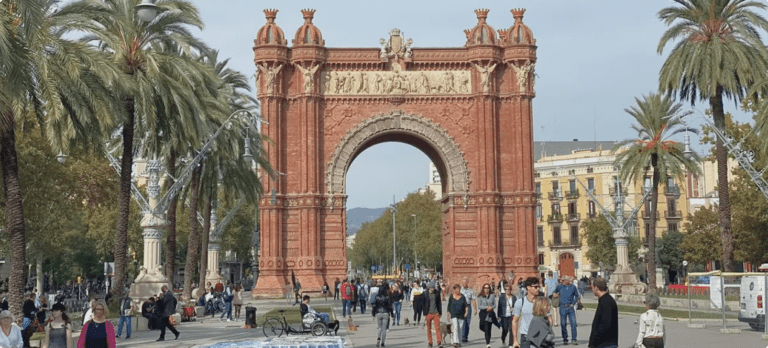
The arch does not commemorate any military victory. It was built by Josep Vilaseca in 1888 as a gateway to the Barcelona Universal Exposition, the event that transformed the city’s coastline and put Barcelona on the international map. The guide explains the political context of the Bourbon Restoration, the rivalry between Barcelona and Madrid, and why an industrial city wanted to present itself to the world with a triumphal arch of exposed brick in the midst of the effervescence of Modernisme.
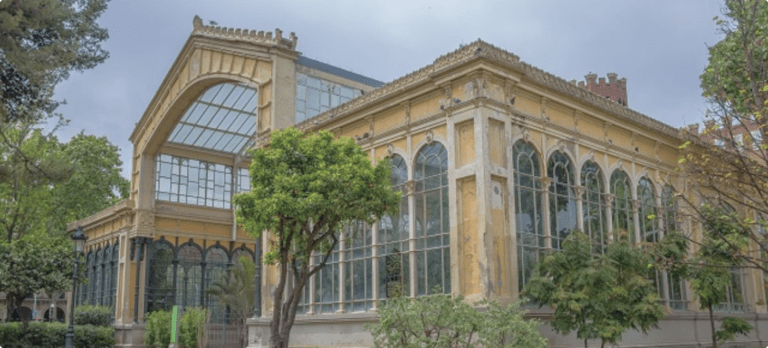
The park occupies the site of the military citadel that Philip V ordered built in 1716 after the defeat of Barcelona in the War of Succession. For 150 years it was the symbol of the Bourbon occupation: to build it, the entire neighborhood of La Ribera was demolished – about a thousand houses – and its residents were evicted by decree. The current park, designed by Josep Fontserè in 1872, is literally the restitution of that space to the city. The guide points out the monumental waterfall – in whose construction the young Antoni Gaudí collaborated as a student of architecture – and explains the relationship between the park, the Universal Exposition of 1988 and the Parliament of Catalonia, which today occupies the old greenhouse.
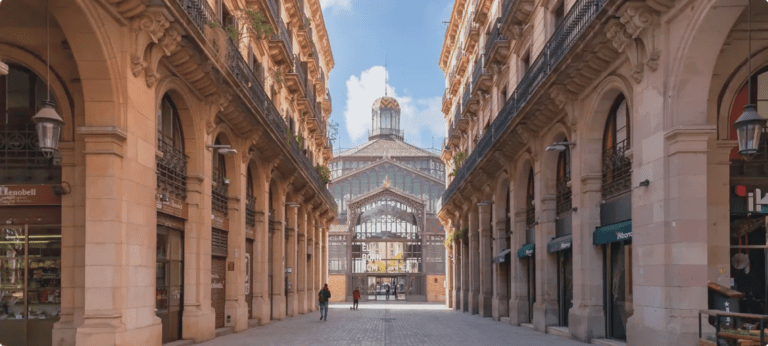
The neighborhood of merchants and artisans that during the Middle Ages concentrated the economic activity of the Crown of Aragon. The Mercat del Born – visible from the outside – is one of the best examples of 19th century iron architecture in Spain, and its subsoil holds the remains of the neighborhood razed to the ground in 1714. The guide walks through the streets of Carrer del Rec and around the Basilica of Santa Maria del Mar – built by the neighborhood’s own inhabitants between 1329 and 1383, without royal or episcopal commission – and explains why its construction was a political as well as an architectural act.
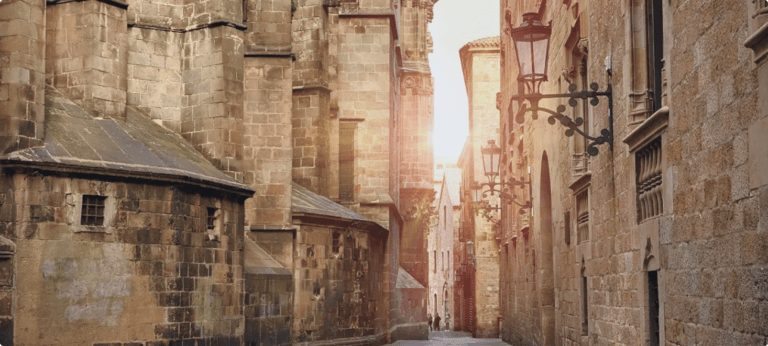
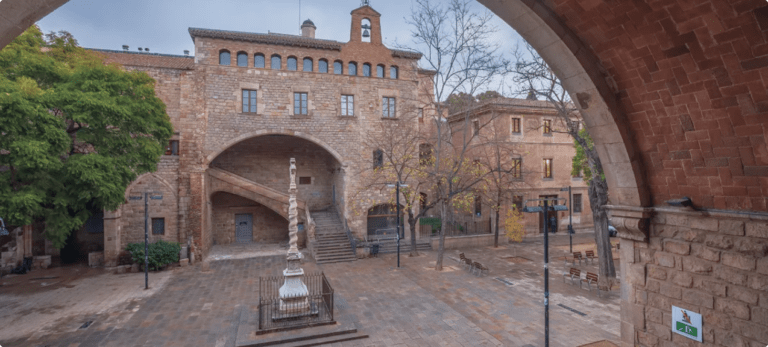
The core of Roman, medieval and Renaissance Barcelona. The guide locates the layout of the Roman cardus maximus and decumanus – still legible in today’s street map -, the 1st century Augustan wall that is partially preserved in the basement of the Museu d’Història de Barcelona, and the Pont del Bisbe, the neo-Gothic bridge that connects the Generalitat with the Palau del Lloctinent and that is less than 120 years old despite looking medieval. The Plaza de Sant Felip Neri, with its shrapnel marks from the bombing by Franco’s air force in January 1938, is one of the stops along the route.
Historically outside the medieval walls, the Raval was for centuries the space where everything that the city did not want inside was installed: convents, hospitals, slaughterhouses, factories and, from the nineteenth century, the working population that came to work in them. The guide explains the transformation of the neighborhood since the 1990s – the MACBA, the CCCB, the Rambla del Raval – and what remains of the historic Raval: the Hospital de la Santa Creu, founded in 1401 and today home to the Library of Catalonia, and the streets of the southern sector that official urban planning never finished intervening. The walking tour allows you to read the Raval for what it is: the neighborhood that best tells the contradictions of Barcelona.
At the end of the tour, sangria included for the group. The guide will also recommend you what to do with the time you have left in Barcelona according to what you have seen and what has interested you.
INCLUDED
NOT INCLUDED
The price is per group, not per people. The total is divided among all participants. The more people, the lower the cost per head.
| People | Total | Per person |
|---|---|---|
| 1 people | 199€ | 199€ / people |
| 2 people | 178€ | 89 / people |
| 3 people | 267€ | 89 / people |
| 4 people or more | - | 70 / people |
| People | Total | Per person |
|---|---|---|
| 1 people | 330€ | 330 / people |
| 2 people | 300€ | 150 / people |
| 3 people | 330€ | 110€ / people |
| 4 people or more | - | 90€ / people |
* Children (from 0 to 11 years old): free. Sangria included for all participants at the end of the tour. No hidden charges or reservation fees.
The Welcome Tour is the most popular during the first days of your stay – book early if you are arriving in high season. The tour runs in two daily time slots:
* We recommend booking at least 7 days in advance to guarantee guide assignment. In high season (May-September) the guides work at full capacity – the earlier you book, the more scheduling options you will have available.
Your guide will be waiting for you at the foot of the Arc de Triomphe. After booking, we will provide you with the guide’s telephone number so that you can be reached without any complications.
Under the Arc de Triomphe
Free cancellation available
You can cancel free of charge up to 48 hours before the tour start time. Cancellations made less than 48 hours in advance or no-shows will not be refunded.
Monument tours assume that you already have the general context of the city. The Welcome Tour provides that context: who founded Barcelona, how it grew, why certain neighborhoods have the character they do, and what the relationship is between them. With that mental map, a subsequent visit to the Sagrada Familia, the Gothic Quarter or any other part of the city takes on a completely different dimension.
If this is your first time in Barcelona and you want a tour to start getting to know the city, we recommend you to book this welcome tour on the second day at the latest. The reason is practical: the earlier you do it, the more you get out of the rest of the trip. Every place you visit afterwards – the Gothic Quarter, the Sagrada Família, the Born – already has a context that you would not have without the previous tour. Doing it on the last day is also possible, but you lose the main advantage: understanding Barcelona while you are still in it.
The standard itinerary runs through the Arc de Triomf, Ciutadella Park, El Born, the Gothic Quarter and El Raval – five areas with distinct historical identities that together cover the 2,500 years of accumulated history in the center of Barcelona. In 3 hours on foot at a comfortable pace, with time to stop and ask questions.
At the end of the tour. Sangria closes the tour at a point in the Raval or the Gothic Quarter that the guide will indicate during the tour. It is an informal closing moment where you can ask the guide the last questions about what to see during the rest of the tour.
Yes. The walk through the old town has an immediate visual level that works well with children from 5-6 years old: narrow streets, squares with history, the Ciutadella park with lake and waterfall. The guide adjusts the vocabulary and pace to the group. Children under 12 years old are free of charge. Please indicate the age of the children when booking.
It depends on what interested you most during the tour. If the Gothic Quarter has got you hooked, the Private Tour of the Gothic Quarter and Cathedral goes into detail on the two thousand years of history of the medieval core. If Gaudí has come up in conversation, the Sagrada Família Private Tour or the Modernisme Private Tour are the natural next steps. If what has moved you is the political history of the twentieth century, the Private Tour of Barcelona during the Civil War is the most demanded by this profile. The guide will guide you at the end of the tour.
Directly from the booking button on this page, through our Fareharbor system. You can also contact us by WhatsApp if you have any doubts before booking – we will advise you on which tours to combine depending on the time you have in Barcelona.
We did it the first day in Barcelona and it was the best decision of the trip. The guide explained to us how to read the city - from there, everything we saw made much more sense.
The walk through the Born and the Gothic was incredible. I would never have known that underneath the Gothic is the Roman Barcelona. And the sangria at the end, perfect.
We have been to Barcelona for three trips and we had never understood the Ciutadella as it was explained to us on this tour. The history of what was there before the park is brutal.
We were 6 people and the guide adapted the tour perfectly. The Raval section was amazing - a neighborhood we would never have explored alone.
If you have any questions or special needs before booking, write to us — we reply in less than 24 hours.