Guided tour of Montjuïc

Private tour of Montjuïc with an official guide

Tour of Montjuïc, the mountain from which power controlled Barcelona for centuries. From here, they bombarded the city and executed its president; on this very mountain, they staged a major International Exposition under the dictatorship of Primo de Rivera and hosted the Olympic Games that returned Barcelona to the world. Tour with an official tour guide.

Rating on TripAdvisor and Viator
0
Exterior and interior durability
0 h
Certified official tour guides
0 +
Exclusive private groups
0 %
About this tour

Private Tour of Montjuïc: the mountain that has watched over Barcelona since the Romans

Montjuïc is not a park with a view. It is the place where some of the most violent contradictions in Barcelona’s history have played out: the military fortress that for three centuries pointed its cannons at the city itself, the 1992 Olympic Games that transformed it and projected it to the world, and the monumental complex on the southern slope built for the 1929 International Exposition—an exercise in political propaganda that remodeled the entire mountain to show the world a Spain that barely existed. This private guided tour exists so that none of those layers are lost in the landscape.

Over a three-hour walking tour, the itinerary passes through the places where that history became physical: a castle that was a prison and an execution wall, gardens designed for an exposition that concealed a dictatorship, a stadium that saw a city reinvent itself live before the world, and an art palace built on the sanctioned looting of Pyrenean churches. Montjuïc is the only place in Barcelona where all of that fits onto a single hillside.


What we'll visit

Tour itinerary: from the Three Chimneys Park to the National Palace

The tour starts at Metro Drassanes (L3, exit La Rambla) and advances towards the mountain following the logical order of the ascent. The guide traces the route in such a way that each stop connects with the next one without jumps or backtracking.

Park of the Three Chimneys (industrial Barceloneta, XIX-XX century)

The starting point is not a monument: it is a scar. The three chimneys that give the park its name belonged to the Barceloneta thermal power station, built in 1899 to supply electricity to the city’s first streetcars. For decades, the Montjuïc coastline was an industrial area – shipyards, warehouses, depots – that functioned as a barrier between the sea and the mountains. The guide places the starting point in that context: the Barcelona that worked facing the port, invisible to visitors who only saw the Gothic Quarter.

Miramar lookout point (246 m a.s.l.)

The first terrace overlooking the port and the Mediterranean coastline. From here you can read the layout of the Olympic Port – built for the 1992 Games on what used to be the industrial mouth of the coast – and the coastline that Barcelona recovered for its citizens in the same process. The guide explains the urban transformation that the Games imposed on the city and why Barcelona is today a city facing the sea when for centuries it had turned its back on it.

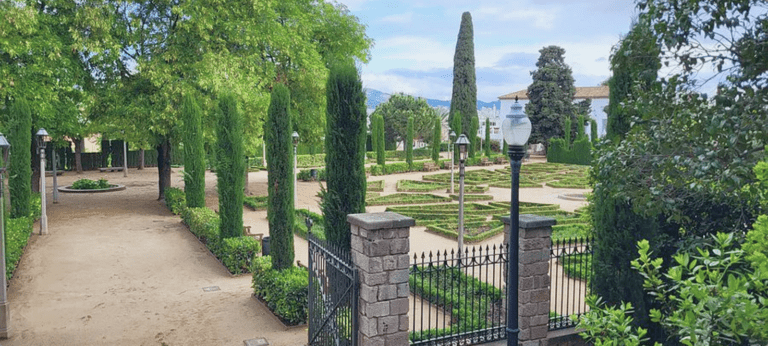
Laribal Gardens

The most unknown garden of Montjuïc and one of the most unique in Barcelona. It was designed by Jean-Claude Nicolas Forestier in 1920 – the same landscape designer who renovated the Champs-Élysées in Paris and designed the Maria Luisa Park in Seville – commissioned by the Barcelona City Council for the 1929 International Exposition. Forestier took the Nasrid gardens of the Alhambra as a reference: stepped terraces that descend the hillside following the natural slope, water steps, stone pergolas and fountains that work by gravity without any pumping mechanism. The guide explains the hydraulic logic of the design and the relationship between the gardens and the urban planning operation of the Exposition, which transformed the entire slope of Montjuïc into a representative space.

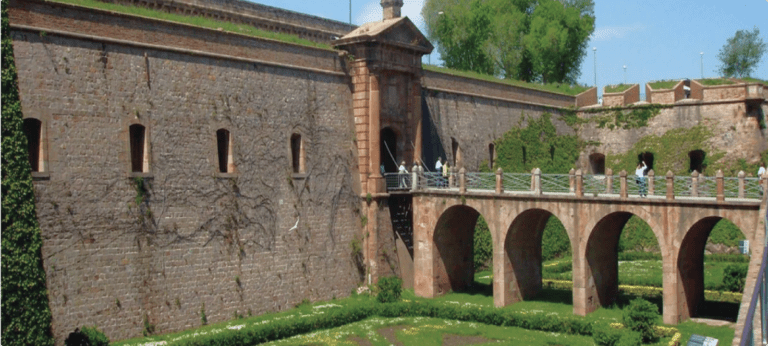
Montjuïc Castle (military fortress, 17th-20th c.)

The fortress that today is one of the most photographed viewpoints in Barcelona was, for three centuries, a permanent threat to the city. Philip V expanded it after the War of Succession in 1714, not to defend Barcelona from the outside world, but to control the city itself from above: its cannons were aimed at the city center. The castle was a political prison until 1960: Lluís Companys was executed here in 1940 -president of the Generalitat de Catalunya, shot by order of Franco- and hundreds of republicans after the war. The guide tours the outer bastions and explains the history of the fortress from its first construction in the seventeenth century until its transfer to the City of Barcelona in 2007.

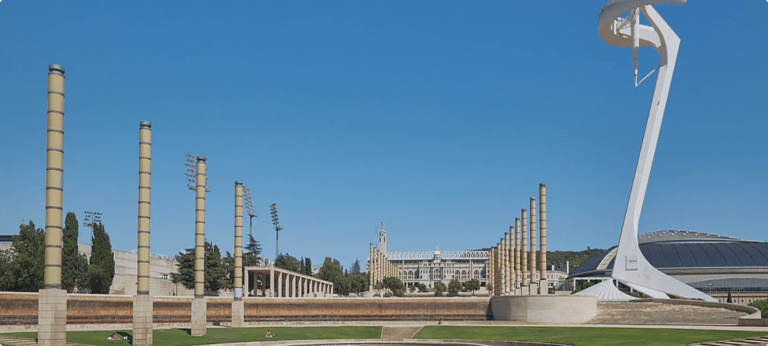
92 Olympic Ring - Lluís Companys Olympic Stadium and Palau Sant Jordi

The complex built for the 1992 Barcelona Olympic Games. The Stadium, inaugurated in 1929 for the International Exposition and renovated for the Games, was the scene of the opening ceremony on July 25 and the athletics events where Spain won its first Olympic medals in track and field. The guide explains the urban planning that the Games set in motion: the Olympic Village, the redevelopment of industrial Poblenou and the opening of the coastline. The Palau Sant Jordi, designed by Arata Isozaki and inaugurated in 1990, has a steel and aluminum roof mounted entirely on the ground and raised to a height of 45 meters in a single operation.

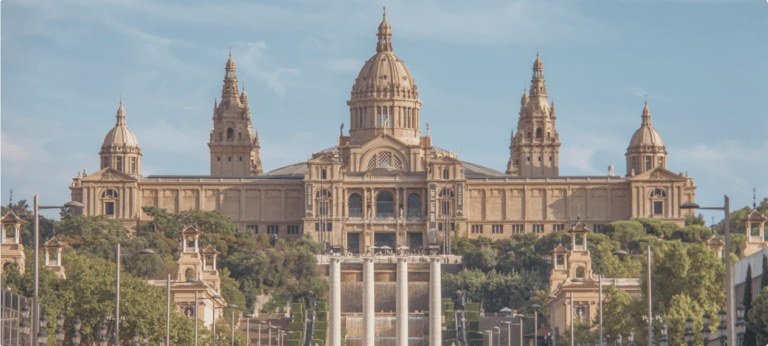
National Palace - Museu Nacional d'Art de Catalunya (MNAC)

The National Palace was built as the central venue for the 1929 Barcelona International Exposition, an image operation designed by Primo de Rivera’s dictatorship to show the world a modern and prosperous Spain. The building, in neo-baroque style with a central dome 57 meters high, houses since 1934 the most important collection of Romanesque art in the world: more than 21,000 works from Catalan Pyrenean churches, rescued in the early twentieth century by a team of technicians from the Junta de Museus that removed the frescoes from the apses to save them from the international art market. The guide explains the origin of the collection – the controlled looting that was, paradoxically, an act of preservation – and the political history of the building from 1929 to the present day.

Magic Fountain and Avenida de la Reina Maria Cristina - Plaza España

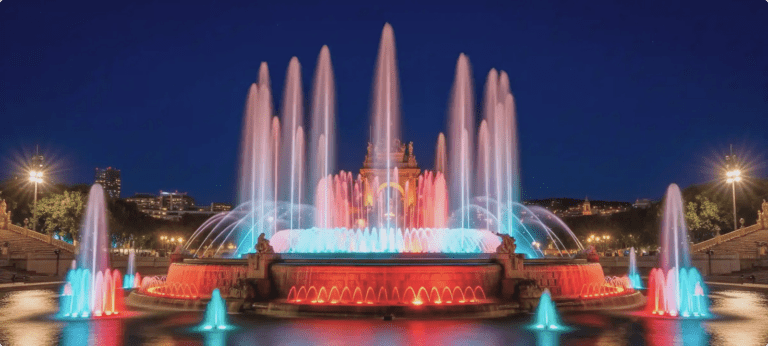
The final point of the tour closes the monumental perspective of Montjuïc towards the city. The Magic Fountain, designed by the engineer Carles Buïgas for the 1929 Exhibition, has a hydraulic system of 3,620 nozzles capable of raising the water up to 52 meters high. The guide explains the urban logic of the axis formed by the Avenida de la Reina Maria Cristina, the Pavelló Mies van der Rohe – also built for the 1929 Exposition and rebuilt in 1986 on its original plans – and the Venetian Towers that flank the entrance to the avenue from Plaza España.


What's included

What's included in this private tour of Montjuïc

INCLUDED

  • ✓ Private official tour guide
  • ✓ 3-hour guided walking tour.
  • ✓ Castle - Jardins de Laribal - Olympic Ring - MNAC - Magic Fountain
  • ✓ Available in English and Spanish
  • ✓ Free cancellation (up to 48 hours before)

NOT INCLUDED

  • ✗ Entrances to the interior of the MNAC or the Castle.
  • ✗ Transport to the meeting point.
  • ✗ Food or beverages

Pricing

Price of the private tour of Montjuïc - per group, not per people

The price is per group, not per people. The total is divided among all participants. The more people, the lower the cost per head.

Low Season (October 1 - April 30)

PeopleTotalPer person
1 people199€199€ / people
2 people178€89 / people
3 people267€89 / people
4 people or more-70 / people

High Season (May 1 - September 30)

PeopleTotalPer person
1 people330€330 / people
2 people300€150 / people
3 people330€110€ / people
4 people or more-90€ / people

Tour schedule

Available time slots

The private tour of Montjuïc is one of the most popular tours for groups who already know the historic center of Barcelona and want a different perspective of the city – book in advance if you are arriving in high season.

  • 10:00 hs.Morning session
  • 16:00 hs.Afternoon session

Tour details

Languages, accessibility and practical information

DURATION
3 hours
TOUR TYPE
100% private - only your group
LANGUAGES
Spanish - English
GUIDE
Official tourist guide (Títol de Guia de Turisme de Catalunya, Generalitat de Catalunya)
ACCESSIBILITY
Uneven terrain with steep slopes. Indicate reduced mobility when booking - the guide will adapt the itinerary.
MASCOTAS
Suitable for pets in the outdoor areas of the course
MINIMUM RESERVE
7 days before (before in high season)
CHILDREN
Free (0-11 years). All ages welcome.

Meeting point

Where to find your Montjuïc tour guide

Metro Drassanes (L3) - Exit La Rambla

Your guide will be waiting for you at the La Rambla exit of the Drassanes metro station (line 3, green). After booking we will provide you with the guide’s phone number so that you can find him/her without difficulty.

Metro Drassanes L3 - Exit La Rambla

Tour checkpoints


Cancellation Policy

Free cancellation up to 48 hours before the tour

Free cancellation available

You can cancel free of charge up to 48 hours before the tour start time. Cancellations made less than 48 hours in advance or no-shows will not be refunded.


FAQs

FAQ about the private Montjuïc tour

Does the tour include entering the interior of the Montjuïc Castle or the MNAC?

No. The itinerary covers the exterior of the castle and the public areas of the enclosure – bastions, dry moat and terrace overlooking the harbor – without access to the interior rooms. Admission to the interior costs 12€ (adults). The same goes for the MNAC: the guide explains the National Palace from the esplanade and the history of the collection, but the tour does not include entrance to the museum. If you want to visit the interior, the adult ticket costs about 12€ (free on the first Saturdays of the month from 15h and every Sunday from 15h) – more info at museunacional.cat .

Is this tour suitable for people who are elderly or families with small children?

The tour of Montjuïc is the one with the most walking of all our offer. Keep in mind: the first part of the tour is a continuous climb up the mountain, with steep slopes, especially at the access to the castle. It is not a flat walk. For people with reduced mobility or families with strollers, please indicate when booking – the guide can incorporate the Montjuïc Funicular in some sections without losing the essential points. For children from 6-7 years it is perfectly feasible with breaks.

Is it possible to see the Magic Fountain show at the end of the tour?

Yes, the tour ends at the Magic Fountain and Plaza España, so you can stay to see the water and light show without any additional travel. The show runs from Thursday to Sunday with times varying according to the season – in summer it starts at dusk, in winter earlier. If you want to plan it, choose the afternoon session and ask us for the specific date: we will confirm the time of the Fountain so that the end of the tour coincides with the beginning of the show.

Is the Pavilion Mies van der Rohe part of the itinerary?

The guide points it out and explains it from the outside during the final part of the tour, in the section of Avenida de la Reina Maria Cristina and Plaza España. The visit inside the Pavilion – one of the most influential buildings of 20th century architecture, built for the 1929 International Exposition and rebuilt in 1986 on the original plans of Mies van der Rohe – is not included in the tour but is compatible with the end of the tour. Admission is €9 (adults) and can be purchased on the spot.

What exactly happened at Montjuïc Castle with President Companys?

Lluís Companys i Jover, president of the Generalitat de Catalunya since 1934, was captured in France by the Gestapo in August 1940 and handed over to Franco’s regime. He was transferred to Montjuïc Castle, subjected to a summary court martial on October 14, 1940 and shot at dawn on October 15 in the castle’s pits. He is the only president of a European government executed by the Nazi regime and its Francoist ally. The figure of Companys and the history of the castle as a place of political repression are one of the axes of the guided tour.


Reviews

Reviews of our private tour of Montjuïc

★★★★★

The castle section was brutal - we had no idea that the president of Catalonia had been shot from there. The guide explained it in such detail that we got goose bumps.

Amanda R.Boston, USA - TripAdvisor
★★★★★

We were familiar with the 92 Olympic Stadium but knew nothing of the history behind it. The guide told us how the city transformed Poblenou for the Games - fascinating. Three hours that went by in a flash.

Mark & Caroline T.Edinburgh, UK - Viator
★★★★★

We had gone to Montjuïc alone before and didn't understand anything we were seeing. With the private tour it was completely different - the guide connected the '29 Exposition, Franco's regime and the '92 Games in a story that made a lot of sense.

Lucía M.Madrid, ES - Google
★★★★★

The best tour we have done in Barcelona. There were four of us and the guide adapted the pace perfectly - we stopped quite a bit at the castle because we were interested in the Civil War and then sped up on the MNAC section. That's the great thing about private.

The Hoffmann FamilyMunich, DE - TripAdvisor

Other tours you might also be interested in

More private tours in Barcelona

Welcome tour to Barcelona

Private welcome itinerary through the central neighborhoods of Barcelona: the Arc de Triomf, Ciutadella Park, El Born, the Gothic Quarter, and El Raval. Sangria included at the end. Tour with an official tour guide.
Tour of mysterious and forbidden Barcelona

Walking itinerary through El Raval, the Gothic Quarter, Las Ramblas, and Plaza Cataluña: secret passages, public execution sites, famous crimes, and the stories that the official version of the city would prefer to forget. Tour with an official tour guide.
Tour of Gràcia district

Walking tour through the Barcelona neighborhood that was an independent municipality until 1897 and still feels like one: squares and streets with names that evoke specific historical events, a 19th-century iron market designed by Rovira i Trias, and a density of daily life that does not exist in any other Barcelona neighborhood. Guided tour with an official tour guide.

Contact

Do you have questions about the tour? We reply within 24h

If you have any questions or special needs before booking, write to us — we reply in less than 24 hours.


Write to us

Great! We have received your information.

We were unable to process your submission. Please try again.

You can also find us on

Reserva Ahora Reserva Ahora