We had been visiting the Gothic for years without understanding anything we saw. The guide explained the Roman, medieval and modern layers in order. Now it makes perfect sense.
Inicio / Tours privados / Private Tours in Barcelona / Tour of the Gothic Quarter of Barcelona
Walking itinerary from the Old Port to Plaça de Sant Felip Neri: Plaça de la Mercè, Basílica dels Sants Màrtirs Just i Pastor, Plaça de Sant Jaume with the City Hall and the Generalitat, Plaça del Rei, Barcelona Cathedral (admission included), and Plaça de Sant Felip Neri. Tour with an official tour guide.


The Gothic Quarter packs 2,000 years of history into less than a square kilometer. Beneath today’s medieval streets lies a 1st-century BC Roman city: Barcino, a colony founded under the reign of Augustus, complete with a forum, temple, defensive wall, and aqueduct. Today, the forum lies buried beneath Plaça de Sant Jaume. The temple dedicated to Emperor Augustus is preserved almost intact inside a 15th-century building on Carrer del Paradís. The towers and sections of the Roman wall emerge between apartment blocks and souvenir shops, with hardly anyone noticing them.
On top of that Roman layer, medieval Barcelona was built: the Jewish Quarter (El Call) —one of the most active in the Crown of Aragon until the pogroms of 1391—, the palaces of the Counts of Barcelona, the Gothic Cathedral begun in 1298, the Basilica of Sants Màrtirs Just i Pastor —the oldest in the city, which held the right to make oral wills before its facade until the 19th century— and the Plaça del Rei, the administrative epicenter of the kingdom where, according to tradition, Columbus was received by the Catholic Monarchs in 1493 upon his return from America.
On this 3-hour private historical walking tour, your official tour guide will take you through these layers of time in an orderly way, with concrete references and no fluff. Admission to the Cathedral is included in the tour price.
The tour starts at the Barceloneta metro station (L4) and proceeds from the old port towards the historic center of Barcino.
The starting point allows us to read Barcelona’s historical relationship with the sea before entering the old town. The old port – today occupied by the Moll de la Fusta and the Pla de Palau – was for centuries the gateway to the city and the economic engine of the Crown of Aragon. The guide puts the tour in context before entering the medieval streets.
The square that houses the Basilica de la Mercè, patron saint of Barcelona along with Santa Eulàlia. The current temple is from the 18th century, but the cult to the Virgin of La Mercè in this location dates back to the 13th century, when the Order of La Merced -founded in Barcelona in 1218 by Pere Nolasc- established its headquarters here. The feast of September 24, La Mercè, is the city’s main festival.
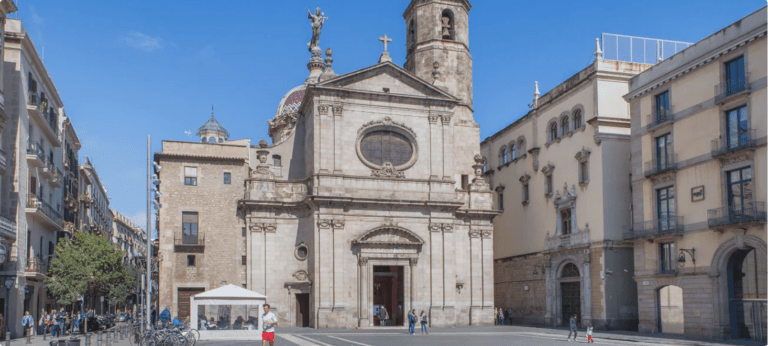
Documented since the 6th century, although the present structure dates from the 14th century. It was the only church in Barcelona with the privilege of validating verbal wills made in front of its façade -a legal provision in force until the 19th century-, which made it a legal as well as a religious space. It preserves in its interior one of the few Gothic altarpieces that survived the fires of 1936.
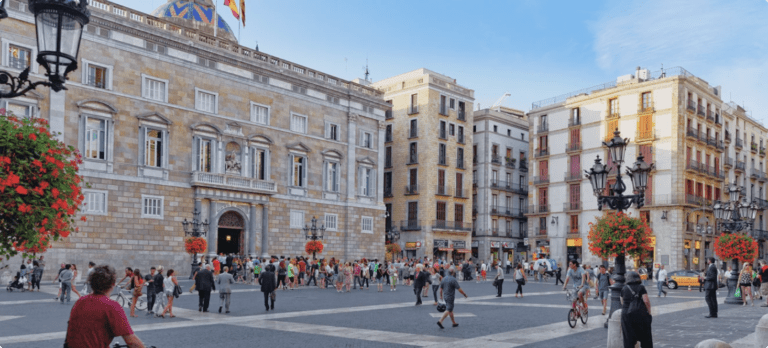
The political center of Barcelona since Roman times, where the two main axes of Barcino crossed: the cardo maximus and the decumanus maximus. The Roman forum extended exactly under this square. Today it is flanked by the Palau de la Generalitat (autonomous government, founded in 1403) and the Ajuntament de Barcelona (14th century). The guide explains the symbolic load accumulated from the center of Roman power to the scene of the main contemporary political events.
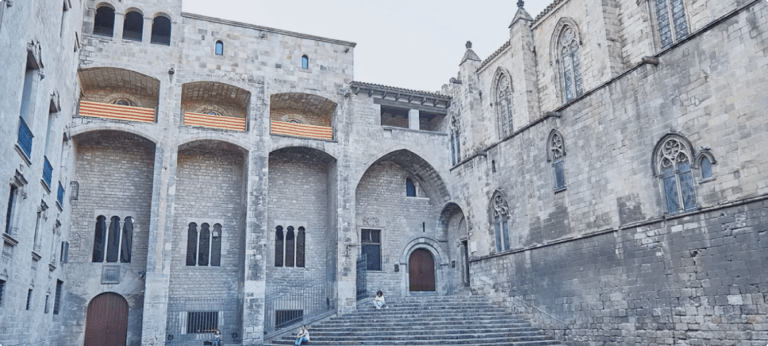
The most compact medieval palace complex in Barcelona: the Palau Reial Major (12th century), the Saló del Tinell -built between 1359 and 1370 without intermediate arches, with vaults of 17 meters span-, the Capella de Santa Àgata and the Torre del Rei Martí (16th century). The guide reconstructs the reception of Columbus in 1493, the function of the Saló del Tinell as the seat of the Inquisition in the 17th century and the transformation of the complex in the following centuries.
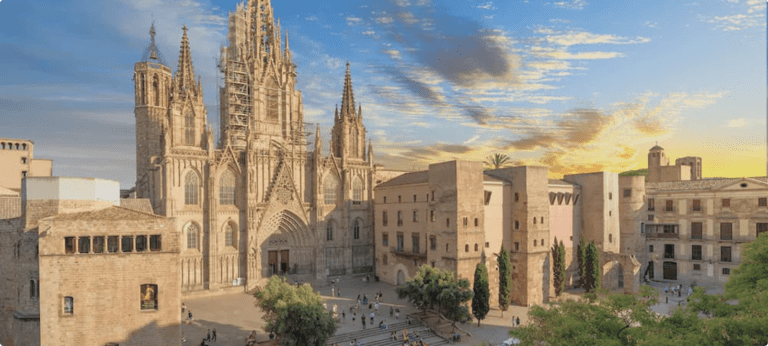
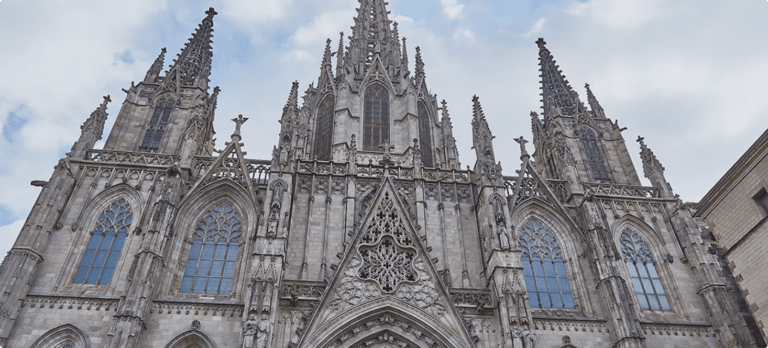
The Cathedral of Santa Eulàlia, dedicated to the patron saint of Barcelona, is the most important Gothic building in the city. The construction of the present temple began in 1298 under the reign of Jaume II and lasted more than 150 years. The neo-Gothic facade that can be seen today dates from 1887: the original was left unfinished for centuries and was covered by a simple stone wall. The interior preserves 28 side chapels and the tomb of Santa Eulàlia in the crypt (14th century). In the cloister, thirteen white geese guard the Gothic fountain since the 14th century, in memory of the thirteen years of the saint when she was martyred. Admission is included in the tour price.
One of the smallest and most historic squares in the neighborhood. In January 1938, during the Civil War, a bombing raid by Franco’s air force killed 42 people – mostly children who had come out of the nearby air raid shelter. Shrapnel marks are still visible on the church walls. The guide explains the context of the bombing, the history of the neighborhood and why this square is quieter than any other in the Gothic Quarter.
INCLUDED
NOT INCLUDED
The price is per group, not per people. The total is divided among all participants. The more people, the lower the cost per head.
| People | Total | Per person |
|---|---|---|
| 1 people | 199€ | 199€ / people |
| 2 people | 178€ | 89 / people |
| 3 people | 267€ | 89 / people |
| 4 people or more | - | 70 / people |
| People | Total | Per person |
|---|---|---|
| 1 people | 330€ | 330 / people |
| 2 people | 300€ | 150 / people |
| 3 people | 330€ | 110€ / people |
| 4 people or more | - | 90€ / people |
* Children (from 0 to 11 years old): free of charge. Entrance to the Cathedral is included in the tour price. No hidden fees or booking surcharges.
The private tour of the Gothic Quarter and Cathedral is the most popular among first-time visitors to Barcelona – book early if you are arriving in high season. It takes place in two daily time slots:
* We recommend booking at least 7 days in advance. In high season (May-September) the guides work at full capacity – the earlier you book, the more scheduling options you will have available.
Your guide will be waiting for you at the exit of the metro station Barceloneta (line 4, yellow). After booking we will provide you with the guide’s phone number so that you can meet him/her without complications.
Barceloneta Subway (L4)
Free cancellation available
You can cancel free of charge up to 48 hours before the tour start time. Cancellations made less than 48 hours in advance or no-shows will not be refunded.
The tour includes the complete interior of the Cathedral: central nave, side chapels, cloister with the thirteen geese and crypt of Santa Eulàlia. The entrance is managed by the guide – there is no need to buy it separately or queue at the ticket office. What is not included is access to the bell towers, which can be purchased optionally at the ticket office if you are interested in going up during the tour.
The main difference is that at Willy’s Plan all guides have the Títol de Guia de Turisme de Catalunya issued by the Generalitat – an official qualification with an exam, not a company certificate – and entrance to the Cathedral is included at no extra cost. Beyond that, the itinerary covers the three historical layers of the neighborhood: Roman, medieval and modern, with specific references at each stop. Many tours of the Gothic remain on the visual surface of the neighborhood; this one goes into the Roman temple, the Jewish Call and the medieval palaces that most visitors pass by without identifying.
The tour includes the Plaça del Rei and the exterior of the MUHBA complex. Access to the Barcino subway site requires a separate entrance to the museum and has specific logistics that do not fit into the flow of the private guided tour. The guide explains in detail what is under the square and what is preserved in the subway. If you want to visit the MUHBA in depth, the most usual is to do it the next day, with the historical background that the tour will have given you.
Yes, the Gothic Quarter works very well with children from 6-7 years old: narrow streets with immediate visual history, the cloister of the Cathedral with the geese, the Roman columns of the Temple of Augustus and the Plaça del Rei have a direct impact that does not need much additional explanation. The guide adapts the vocabulary and pace to the group. Children under 12 years old do not pay admission. Please indicate the age of the children when booking.
If medieval history has hooked you, the private tour of El Born and the Citadel is the natural step: El Born was the most prosperous neighborhood of medieval Barcelona and preserves the basilica of Santa Maria del Mar, the medieval market and the site of 1714 under the Mercat del Born. If what interests you most is the architecture, the private Modernism Tour takes the chronological thread from the medieval city to the 20th century. And if what you are looking for is the political history of the 20th century, the Private Tour of the Barcelona of the Civil War starts from several of the spaces you have visited in the Gothic Quarter.
Directly from the booking button on this page, through our Fareharbor system. You can also contact us by WhatsApp if you have doubts about which tour of the Gothic Quarter fits best with your group, the time you have in Barcelona or what to combine with this tour.
We had been visiting the Gothic for years without understanding anything we saw. The guide explained the Roman, medieval and modern layers in order. Now it makes perfect sense.
The Temple of Augustus part was the most amazing. We had the Roman Forum literally under our feet and didn't know it. The guide explained it in a way we will not forget.
We did it with our 8 and 11 year old children. The guide adapted the whole tour for them without losing historical rigor. The geese in the cloister of the Cathedral were the favorite spot.
The Cathedral included makes all the difference. You don't just walk in - you understand what you see. The mailbox of the Casa de l'Ardiaca and the story of the architect behind it: that is only told by a guide who really knows the neighborhood.
If you have any questions or special needs before booking, write to us — we reply in less than 24 hours.