We already knew the Gothic from previous trips. This tour took us to the side we hadn't seen. The explanation of Palau Güell was extraordinary - we didn't understand why it was in the Raval and now it makes perfect sense.
Inicio / Tours privados / Private Tours in Barcelona / Tour of El Raval
Private guided tour of the Raval: the Reials Drassanes and the Maritime Museum of Barcelona, Gaudí's Palau Güell, the Liceu Theatre, the Rambla del Raval, the MACBA, the Hospital de la Santa Creu, the Church of Sant Pau del Camp, and the Boqueria Market. Visit with an official tour guide.


El Raval occupies the space left to the west of the medieval walls when the city grew outside its first walled perimeter, back in the 13th century. For six hundred years, it was the territory of what the city did not want visible within its walls: the mendicant orders that needed land for vegetable gardens, the municipal slaughterhouse, the hospitals for the poor and sick, the factories of the first Catalan industrialization of the 19th century, and the working-class population that arrived from all over Spain to work in them. The sum of these layers produced Barcelona’s densest, most contradictory, and most misunderstood neighborhood. Also its most interesting.
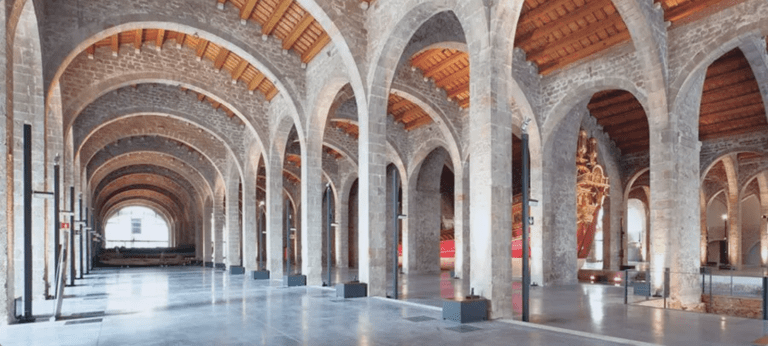
During a three-hour private guided walk, the tour starts at Les Reials Drassanes—the best-preserved shipyard in the world, built between the 13th and 14th centuries to build the galleys of the Crown of Aragon, today home to the Museu Marítim de Barcelona—and crosses El Raval from south to north: Gaudí’s Palau Güell (1889, the architect’s first official work in the city), the Liceu Opera House rebuilt after the 1994 fire, the Rambla del Raval with Botero’s cat, Richard Meier’s MACBA opened in 1995, the Hospital de la Santa Creu founded in 1401 and today home to the Biblioteca de Catalunya, the Church of Sant Pau del Camp—the oldest Romanesque building in Barcelona—and the Mercat de la Boqueria. The tour does not exist to clean up El Raval’s image. It exists to understand it for what it is.
The walk begins at the southern end of the Raval, next to the port, and proceeds northward through the historical layers of the neighborhood in chronological order: first the medieval and monarchical city, then the working-class and industrial neighborhood, and finally the urban interventions that transformed it from the 1990s onward.
The royal shipyard of the Crown of Aragon, built between the thirteenth and fourteenth centuries and expanded in the sixteenth century under Pere el Cerimoniós. Sixteen parallel stone ships where the galleys with which Aragon dominated the western Mediterranean for two hundred years were manufactured. It is the best preserved medieval shipyard in the world; today it houses the Maritime Museum of Barcelona. The guide explains the relationship between les Reials Drassanes, the medieval port and the commercial expansion of the Crown of Aragon that made Barcelona one of the most important cities in Europe in the 14th century.
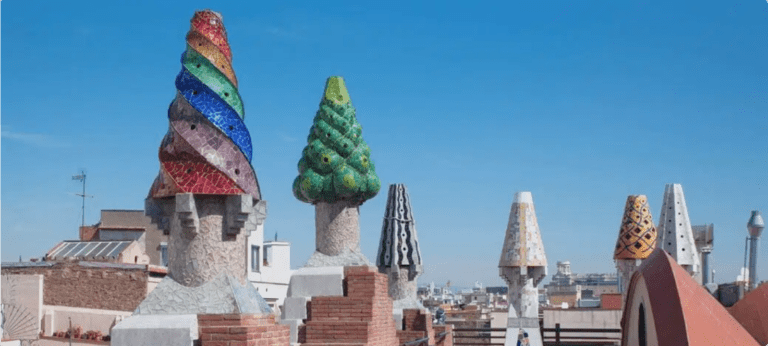
Built between 1886 and 1890 by Antoni Gaudí for the textile industrialist Eusebi Güell, the Palau Güell is the first large-scale work that Gaudí executed in Barcelona. It has been a UNESCO World Heritage Site since 1984. The guide explains the two parabolic arches of the façade, the iron slabs of the doors, the roof terrace with the trencadís-clad chimneys – the ceramic technique that Gaudí would later perfect in Park Güell and the Sagrada Família – and why Güell chose this site in the Raval, then an area with a very bad reputation, to build his private residence.
The Raval began to be called Barrio Chino in 1925 when the journalist Francesc Madrid borrowed the name of the marginal neighborhood of San Francisco to describe this sector in an article, without there ever being a Chinese community in the area. It was the sector where the brothels, gambling dens and varietés venues frequented by sailors and the bohemians of the interwar period were concentrated. Jean Genet lived here in the late thirties and described it in Diary of the Thief . The guide walks through the streets of Carrer de la Cera and the surroundings of Sant Pau explaining the urban morphology before the great demolitions of the Interior Reform Plan and what the urbanism of the twentieth century took ahead. The official name of the neighborhood has always been and still is El Raval.
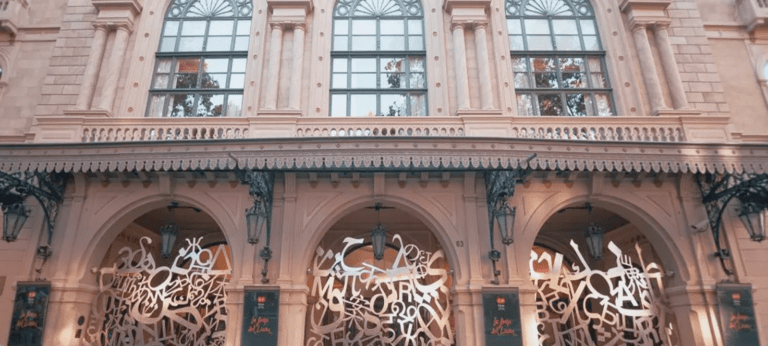
Inaugurated in 1847, the Liceu is one of the five most important opera houses in Europe and the largest in Spain in terms of seating capacity. Built by private subscription -without public funding- as a symbol of the new Catalan industrial bourgeoisie. It suffered a partial fire in 1861, the anarchist attack of 1893 in which two Orsini bombs were thrown from paradise during a performance -twenty dead-, and the total fire of January 1994 that completely destroyed it. The guide reconstructs these episodes and explains the reconstruction, inaugurated in 1999.
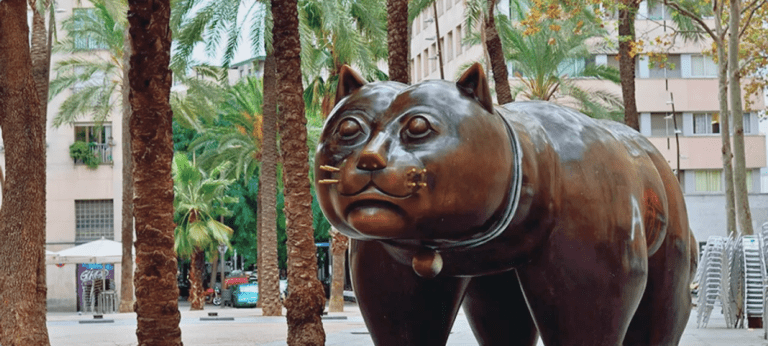
The Rambla del Raval was opened in 2000 through the demolition of an entire block of 19th century buildings: four streets disappeared to create this boulevard 320 meters long and 48 meters wide. The urban operation exemplifies the Barcelona City Council’s sponging strategy in the densest fabric of the neighborhood. At its center is Fernando Botero’s Gato (2003), a 3.5-meter bronze sculpture donated by the Colombian sculptor to the city. The guide explains the urban logic of the intervention, its consequences in terms of displacement of neighbors and why the debate on the gentrification of the Raval is still open.
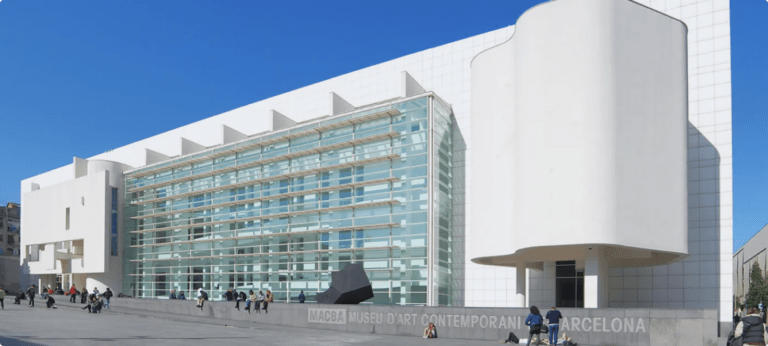
Project by Richard Meier, inaugurated in 1995. The white building, with its glass ramps overlooking the Plaça dels Àngels, was the first great gesture of urban regeneration in the Raval. From day one, the square became one of the most renowned urban skate spots in Europe – a scene that has existed for thirty years and is now in danger of disappearing: since January 2025 Plaça dels Àngels has been undergoing expansion works by MACBA with the idea of replacing the ramps where skaters used to train with green areas and other spaces. The museum remains open during the works. The guide explains the relationship between MACBA, the CCCB and the cultural strategy of the City Council to transform the image of the Raval in the nineties, and what this new intervention implies for the neighborhood thirty years later.
Founded in 1401 by order of King Martí l’Humà, it was for almost five hundred years the largest hospital in Barcelona. It was in its rooms that Antoni Gaudí died on June 12, 1926, three days after being run over by a streetcar on Gran Via – his state of neglect led the rescue services to take him for a beggar. Today the Gothic building houses the Biblioteca de Catalunya and the Institut d’Estudis Catalans. The inner courtyard, which is open to the public, is one of the most surprising and least visited spaces in the city.
Inaugurated in 2012 in the building designed by Josep Lluís Mateo. The square is named after the anarcho-syndicalist leader of the CNT murdered in 1923 by gunmen of the Patronal, at the height of the pistolerismo in Barcelona. The guide explains the context of the workers’ struggles in the Raval at the beginning of the 20th century, which had here one of its central scenarios.
The oldest Benedictine monastery in Barcelona, first documented in 911, rebuilt in the 12th century in the Lombard Romanesque style. Sant Pau del Camp means “Saint Paul in the countryside”: when it was founded, the monastery was surrounded by farmland, far from the urban center. Today it is completely integrated into the fabric of 19th century blocks. The floor plan, the cloister and the Romanesque capitals are still intact. It is one of the least visited and most valuable medieval buildings in the Raval.
The most famous covered market in Spain, with its origins in the open-air market that vendors used to set up in front of the old Porta de la Boqueria. The iron structure that now covers it was built between 1840 and 1853 on the site of the convent of Sant Josep, disentailed in 1835. The guide explains the history of the market and the difference between what the tourist-oriented stalls sell and what the locals sell – a contrast that tells, in miniature, the story of what has happened to the Raval in the last thirty years.
INCLUDED
NOT INCLUDED
The price is per group, not per people. The total is divided among all participants. The more people, the lower the cost per head.
| People | Total | Per person |
|---|---|---|
| 1 people | 199€ | 199€ / people |
| 2 people | 178€ | 89 / people |
| 3 people | 267€ | 89 / people |
| 4 people or more | - | 70 / people |
| People | Total | Per person |
|---|---|---|
| 1 people | 330€ | 330 / people |
| 2 people | 300€ | 150 / people |
| 3 people | 330€ | 110€ / people |
| 4 people or more | - | 90€ / people |
* Children (0 to 11 years old): free of charge. No hidden charges or reservation surcharges.
The Raval tour is one of the most popular tours for those who already know the Gothic Quarter and want to go one step further – book in advance if you arrive in high season. The tour runs in two daily time slots:
* We recommend booking at least 7 days in advance. In high season (May-September) the guides work at full capacity – the earlier you book, the more scheduling options you will have available.
Your guide will be waiting for you at the main door of Drassanes, next to the Avinguda de les Drassanes. After booking we will provide you with the guide’s telephone number so that you can be reached without complications.
Entrance to Drassanes
Free cancellation available
You can cancel free of charge up to 48 hours before the tour start time. Cancellations made less than 48 hours in advance or no-shows will not be refunded.
To get to know the old town of Barcelona in detail, the ideal is to combine the tour of the Raval with the private tour of the Gothic Quarter and the Cathedral. The two together cover the two halves of the historic center with different logics: the Gothic is the institutional and medieval Barcelona -the Roman, the episcopal, the monarchic-; the Raval is the Barcelona that was left out of that story, the working class, the industrial, the one that the city tried to control for centuries. Done on consecutive days, they give a complete reading of the old town that neither tour provides separately. If you want to add a third layer, the private tour of El Born and the Citadel closes the triangle of the historic center from the east.
The Palau Güell is part of the complete exterior tour, which is free of charge: the Rambla façade with the parabolic arches, the iron forging and the historical and architectural context that the guide explains on site. The entrance to the interior of the building is optional and can be purchased separately at the ticket office or on the Palau Güell website. If you would like to include the interior, please indicate this when booking and the guide will adjust the itinerary to coincide with the access schedule.
The Raval is safe for tourists, and on this tour you are always accompanied by an official tour guide who knows the neighborhood thoroughly and knows exactly where to go at all times. This eliminates any uncertainty about areas or streets. As a general recommendation -valid in any central neighborhood of Barcelona-, do not leave your belongings unattended at any time, especially in crowded areas such as La Boqueria or La Rambla, and avoid getting into poorly lit alleys or walking at night in areas you do not know. The southern sector of the Raval has a more residential and quiet character than its historical reputation suggests, but as in any big city, common sense is the best guide.
The private tour of the Raval is suitable for children from 6-7 years old. The tour has powerful visual content for all ages: the medieval scale of les Reials Drassanes, the terrace of Palau Güell with its trencadís chimneys, Botero’s cat on the Rambla del Raval, the iron structure of the Boqueria. The guide adapts the vocabulary and the level of historical depth to the group. Children under 12 years old are free of charge. Please let us know the age of the children when booking.
Yes, and that’s what we recommend. The three-hour guided tour covers the main stops with their historical context, but the Raval has layers that deserve time of their own. Carrer de Joaquín Costa is a good example of what this neighborhood is all about: Casa Almirall, founded in 1865 with its modernist bar intact, coexists on the same street with Two Schmucks, one of the best cocktail bars in the world. History and present a few meters away, without either of them clashing.
The Raval is directly related to Gaudí because the Palau Güell – his first major work in Barcelona, built between 1886 and 1890 – is in the Raval, not in l’Eixample. It predates Casa Batlló, Casa Milà and Sagrada Família as they are known today. If you want to delve deeper into Gaudí and Modernisme beyond this tour, the Antoni Gaudí Modernisme Private Tour and the Sagrada Família Private Tour are natural continuations.
The difference between the Raval tour and the Mysterious Barcelona tour is the focus: the Raval tour is an urban and social history tour that explains how the neighborhood was formed, what institutions defined it and how different eras transformed it. The Private Tour of Mysterious and Forbidden Barcelona focuses on dark episodes, legends and places steeped in black history that cross several neighborhoods. They share some geographical points, but the content is different. Many visitors do both on different days.
The private tour of the Raval is booked directly from the booking button on this page, through our Fareharbor system. You can also contact us by WhatsApp if you have any doubts before booking – we will advise you on which tours to combine according to the time you have in Barcelona and what you want to see.
We already knew the Gothic from previous trips. This tour took us to the side we hadn't seen. The explanation of Palau Güell was extraordinary - we didn't understand why it was in the Raval and now it makes perfect sense.
The Chinatown section was the most amazing. The guide knew every street with real names, dates and people. These are not anecdotes, this is real history. The courtyard of the Hospital de la Santa Creu left us speechless.
We have been visiting Barcelona for three years and had never entered the courtyard of the Hospital de la Santa Creu. The guide knew exactly when Gaudí died there and how he got there. No guidebook tells us that.
Visiting the Boqueria with someone who explains what stall to look at and why is completely different from going in alone.
If you have any questions or special needs before booking, write to us — we reply in less than 24 hours.