Guided tour of Barcelona's markets

Private tour of Barcelona's markets with an official guide

Barcelona's most iconic covered markets in a single private tour: the Mercat de Santa Caterina, the Mercat de la Boqueria, and the Mercat de Sant Antoni. Three markets, three stories, three architectural styles — and the culinary culture of a city that has been feeding its people through them for eight centuries. Tour with an official tour guide.

Rating on TripAdvisor and Viator
0
Exterior and interior durability
0 h
Certified official tour guides
0 +
Exclusive private groups
0 %
About this tour

Private tour of Barcelona's markets: history, architecture and local gastronomic culture

Barcelona has more than 40 covered municipal markets — one of the densest and best-preserved urban supply systems in Europe. Most visitors only know La Boqueria: the city’s most photographed market and, at the same time, the one that least reflects what Barcelona’s markets have been and continue to be for its locals. During a 3-hour private guided tour, the itinerary connects three markets with completely different histories, architectures, and functions: the Mercat de Santa Caterina, rebuilt between 1997 and 2005 by architect Enric Miralles on the foundations of a 13th-century Gothic convent; the Mercat de la Boqueria, the city’s oldest in continuous operation since 1217, with the iron and glass structure that still defines it dating back to 1840; and the Mercat de Sant Antoni, opened in 1882, closed for comprehensive renovation in 2009, and reopened in 2018 with its Modernist structure meticulously restored. Three markets, three centuries of architecture, and eight centuries of gastronomic history in a single tour.


What we'll visit

Tour itinerary: from El Born to Mercat de Sant Antoni

The route starts at Passeig de Lluís Companys, under the Arc de Triomf, and proceeds westward through the Born, Las Ramblas and the Raval. The itinerary develops as follows:

Arc de Triomphe and Passeig de Lluís Companys

Meeting point and starting point of the tour. The arch, built in 1888 as a monumental entrance to the Universal Exposition of Barcelona, is the work of Josep Vilaseca i Casanovas. Unlike classical European triumphal arches, it does not commemorate any military victory: it was Barcelona’s first great gesture towards the modern world. The guide places here the historical context of the city in the 19th century – industrialization, the demolition of the city walls in 1854 and the expansion of the Eixample – which explains why the covered markets are children of that very moment.

Born and Mercat del Born Streets

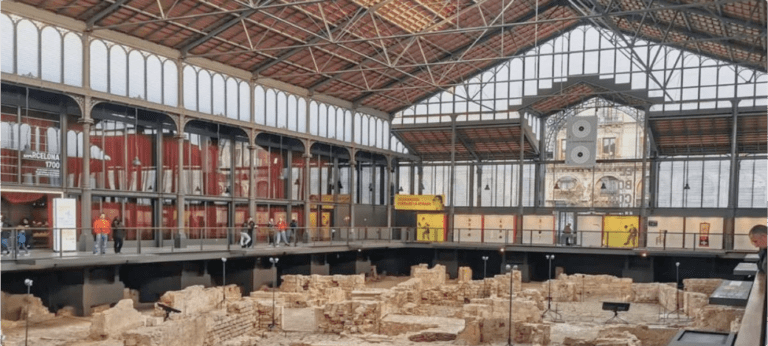
The Born district was the commercial and artisan center of medieval Barcelona. The guide walks through the streets that preserve the layout of the Middle Ages – Carrer del Born, Carrer dels Flassaders, Carrer del Rec – and explains why the neighborhood declined for three centuries and what put it back on the map in the 1990s. At the center of the neighborhood is the Mercat del Born: an iron and glass structure by architect Josep Fontserè inaugurated in 1876 that served as Barcelona’s central supply market until 1971. When the City Council began renovation work to convert it into a library in 2002, excavators found under the ground the Ribera neighborhood as it was buried after the Bourbon siege of 1714 – streets, houses, wells, domestic utensils – in the most important archaeological find of modern times in Catalonia. The library project was abandoned and the building was converted into the Centre Cultural El Born, which since 2013 has preserved the site visible through the glass floor.

Santa Caterina Market (Avinguda de Francesc Cambó, 16)

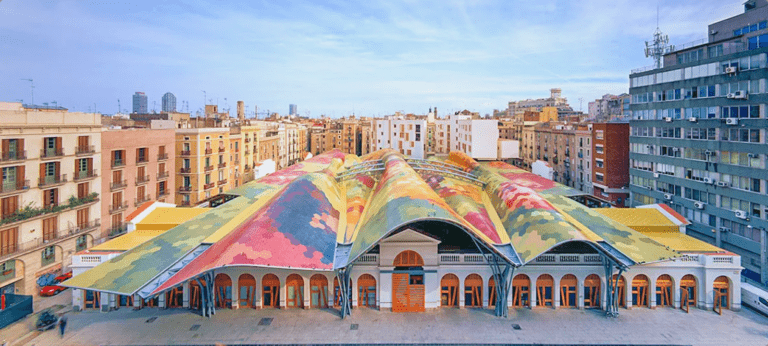
First main stop. The market stands on the site of the Dominican convent of Santa Caterina, founded in 1219 and demolished in 1837 during the Disentailment of Mendizábal. The reconstruction project by Enric Miralles and Benedetta Tagliabue, begun in 1997 and completed in 2005 – after Miralles’ death in 2000 – is one of the most significant buildings in Spanish architecture in recent decades. The guide discusses the ceramic mosaic roof that reproduces, in colorful fragments, the organic shapes of the market’s fruits and vegetables – an explicit nod to Gaudí’s Modernisme – and the criterion of preserving the archaeological remains of the convent visible under the market’s glass floor. Santa Caterina remains a neighborhood market: its customers are the residents of Barri de Sant Pere, not tourists. The guide explains what to buy, which stalls have been in the same place for three generations and how the offer is structured.

Las Ramblas

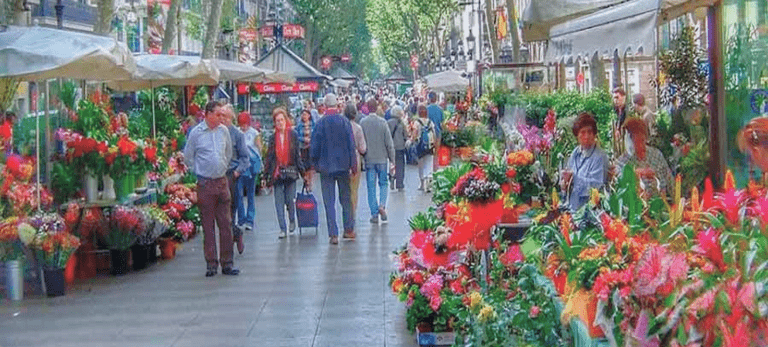
The tour crosses Barcelona’s best-known promenade as a transition between El Born and El Raval. The guide briefly contextualizes Las Ramblas: not a tourist attraction in origin, but the rambla – the bed of a seasonal torrent – that delimited the medieval wall of the 13th century. La Boqueria opens directly onto Las Ramblas because the convent of the Carmelites Descalços, which had occupied the site since 1586, was demolished in 1836 – the same disentailment cycle that liquidated the convent of Santa Caterina.

Mercat de la Boqueria (La Rambla, 91)

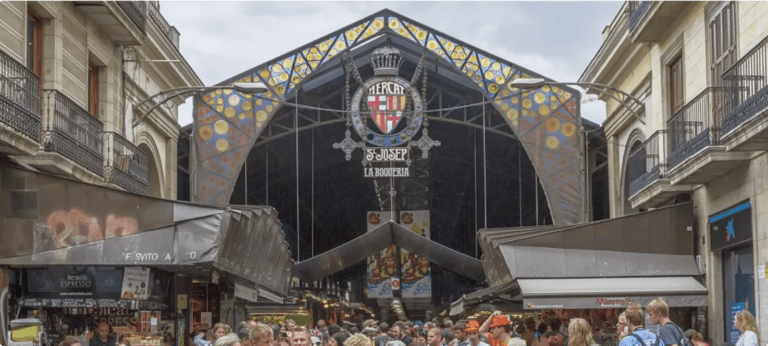
The oldest continuously operating market in Barcelona, with documentary records of meat sales at the gates of the Convent del Carme since 1217. The neoclassical metal structure that defines its current image was inaugurated in 1840, designed by Mas Vilà. The tour is not limited to the most photographed stalls: the guide explains the structure of municipal concessions, how the interior distribution by guilds – fish, meat, fruit, spices – works, what remains of the neighborhood supply vocation and what has changed with the tourist pressure of the last twenty years. La Boqueria concentrates every year more than 50,000 daily visits in high season – and that has consequences on who uses it and how.

Sant Antoni Market (Carrer del Comte d'Urgell, 1)

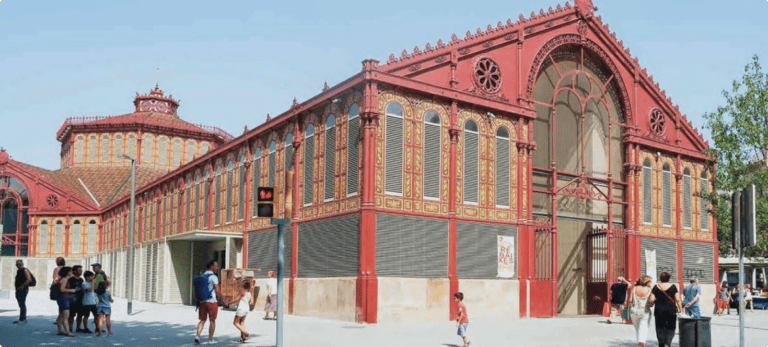
Last stop and perhaps the most revealing. The Mercat de Sant Antoni was inaugurated in 1882, with a project by architect Antoni Rovira i Trias – the same architect who lost the Eixample competition to Ildefons Cerdà in 1859 – and is the only market in Barcelona built outside the old town, in the first expansion. Its iron, glass and brick structure is an exceptional example of 19th century historicist eclecticism. The comprehensive rehabilitation of 2009-2018, led by architects Antoni Vilanova i Otzet and José António Martínez Lapeña, returned the building to its original appearance, restored the stained glass windows of the facade and added a subway space where remains of the Roman wall from the 1st century AD are preserved. The market also recovered the Mercat Dominical de Sant Antoni – a second-hand market specializing in books, comics and collectibles that has been active since 1978 -, which on Sundays occupies the sidewalks outside the building.


What's included

What is included in this private tour of Barcelona's markets?

INCLUDED

  • ✓ Private official tour guide
  • ✓ 3-hour guided tour.
  • ✓ Tour of the three main markets.
  • ✓ Stroll along the Born and Las Ramblas
  • ✓ Available in English and Spanish
  • ✓ Free cancellation (up to 48 hours before)

NOT INCLUDED

  • ✗ Food or beverages
  • ✗ Shopping in the markets
  • ✗ Transport to the meeting point.

Pricing

Price of the private tour of Barcelona's markets - per group, not per people

The price is per group, not per people. The total is divided among all participants. The more people, the lower the cost per head.

Low Season (October 1 - April 30)

PeopleTotalPer person
1 people199€199€ / people
2 people178€89 / people
3 people267€89 / people
4 people or more-70 / people

High Season (May 1 - September 30)

PeopleTotalPer person
1 people330€330 / people
2 people300€150 / people
3 people330€110€ / people
4 people or more-90€ / people

Tour schedule

Available time slots

The private tour of Barcelona’s markets takes place in the morning only – the three markets on the tour open early and are at their busiest before noon:

  • 10:30 hs.Single session - morning

Tour details

Languages, accessibility and practical information

DURATION
3 hours
TOUR TYPE
100% private - only your group
LANGUAGES
Spanish - English
GUIDE
Official tourist guide (Generalitat de Catalunya)
ACCESSIBILITY
The route runs mostly on flat and accessible areas. The markets are wheelchair accessible. Please let us know of any needs when booking.
MASCOTAS
Check availability when booking
MINIMUM RESERVE
7 days before (before in high season)
CHILDREN
Free (0-11 years). All ages welcome.

Meeting point

Where to find your Barcelona market tour guide

Just below the Arc de Triomphe - Passeig de Lluís Companys, Barcelona

Your guide will be waiting for you at the foot of the Arc de Triomphe. After booking, we will provide you with the guide’s telephone number so that you can be reached without any complications. Metro: Arc de Triomf (L1).

Under the Arc de Triomphe

Tour checkpoints


Cancellation Policy

Free cancellation up to 48 hours before the tour

Free cancellation available

You can cancel free of charge up to 48 hours before the tour start time. Cancellations made less than 48 hours in advance or no-shows will not be refunded.


FAQs

FAQ about the private tour of Barcelona's markets

Is there time to buy something at the markets during the tour?

Yes, the itinerary includes free time in each market so you can shop if you wish. The guide will also point out the best stalls in case you want to stay and shop or have a drink in the market bars at the end of the tour. In the Boqueria and Santa Caterina you will find fruit, cheese, charcuterie and local products – the guide will advise you which stalls are worthwhile and which to avoid, a particularly useful criterion in the Boqueria, where the prices of the stalls in front of Las Ramblas have nothing to do with those in the interior.

Is it possible to eat in the markets of Barcelona?

After the tour it is a good idea to stay for lunch – all three markets have bars that are part of the history of the place. In the Mercat de Santa Caterina, Bar Joan has been in the same place for decades, serving traditional Catalan cuisine: capipota for breakfast, chistorra sandwich at mid-morning and daily specials at lunchtime. In the Boqueria, Kiosco Universal has been in the market since 1973, specializing in grilled fish and seafood – one of the most reliable and long-lived bars in the market, far from the touristy front of Las Ramblas. In the Mercat de Sant Antoni, the mythical Bar Pinotxo – for decades one of the most beloved bars in the Boqueria – has moved here while maintaining its essence: fork breakfasts, chickpeas with squid and cap i pota. The guide will give you information about each option at the end of the tour.

What is the difference between the Mercat de Santa Caterina and the Boqueria - why visit both?

They are radically different markets in history, architecture and function. La Boqueria has eight centuries of documented history and a 19th century iron structure; Santa Caterina is a 2005 contemporary architectural project built on the remains of a 13th century medieval convent. La Boqueria today functions mostly for tourism; Santa Caterina remains the market of the Sant Pere neighborhood. Comparing the two on the same guided tour allows us to understand how the city’s relationship with its markets has evolved in recent decades.

Do you recommend doing the tour on a Sunday?

No. On Sundays, the three fresh markets along the route – Santa Caterina, la Boqueria and Sant Antoni – are closed inside. The Mercat de Sant Antoni houses on Sunday mornings (9:00-14:30 h) the Mercat Dominical de Sant Antoni, a second-hand market specializing in books, comics and collectibles active since 1978 that occupies the sidewalks outside the building – worth a visit on your own, but not enough to sustain a market tour. If you’re traveling on a weekend, Saturday is the best day: all three markets are open full hours.

Is this tour compatible with the tour of the Gothic Quarter or the Born?

Yes, and they complement each other well. The market tour covers El Born and Las Ramblas in a cross-cutting way, from the perspective of gastronomic culture and market architecture. The private tour of the Gothic Quarter delves into the medieval history of the old town, and the private tour of El Born and Ciutadella goes into detail on the urban fabric and history of the neighborhood. All three are compatible on different days without overlapping tours.


Reviews

Reviews of the private tour of Barcelona's markets

★★★★★

I knew the Boqueria but had never entered the Mercat de Santa Caterina. The contrast between the two markets was a lesson in architecture and history of the city that we had not expected.

Patricia & George L.San Francisco, USA - TripAdvisor
★★★★★

Our guide took us to stalls in the Boqueria that we would never have found on our own - not the ones at the front, but the ones that have been in the same corner for three generations. We bought cheese and ham for the rest of the trip.

Mark & Claire D.Manchester, UK - Viator
★★★★★

The best part was the Mercat de Sant Antoni - we didn't even know it existed. The history of the building and the renovation was amazing. The guide explained very well what was under the glass floor.

Ana M.Madrid, ES - Google
★★★★★

We are four very foodie friends and it was the activity we enjoyed the most of the whole trip. The guide knew exactly where to buy, what to avoid and what was the story behind each product.

Tobias W.Berlin, DE - TripAdvisor

Other tours you might also be interested in

More private tours in Barcelona

Private tour of Montjuïc with official guide

Tour of Montjuïc, the mountain from which power controlled Barcelona for centuries. From here, they bombarded the city and executed its president; on this very mountain, they staged a major International Exposition under the dictatorship of Primo de Rivera and hosted the Olympic Games that returned Barcelona to the world. Tour with an official tour guide.
Welcome tour to Barcelona

Private welcome itinerary through the central neighborhoods of Barcelona: the Arc de Triomf, Ciutadella Park, El Born, the Gothic Quarter, and El Raval. Sangria included at the end. Tour with an official tour guide.

Tour of mysterious and forbidden Barcelona

Walking itinerary through El Raval, the Gothic Quarter, Las Ramblas, and Plaza Cataluña: secret passages, public execution sites, famous crimes, and the stories that the official version of the city would prefer to forget. Tour with an official tour guide.

Contact

Do you have questions about the tour? We reply within 24h

If you have any questions or special needs before booking, write to us — we reply in less than 24 hours.


Write to us

Great! We have received your information.

We were unable to process your submission. Please try again.

You can also find us on

Reserva Ahora Reserva Ahora