The stretch of Paral·lel was a revelation. I never imagined that avenue had been Barcelona's equivalent of Broadway. The guide had vintage photos on their phone so we could see what it used to look like.
Inicio / Tours privados / Private Tours in Barcelona / Barcelona Music Tour
Walking itinerary through the landmarks that define Barcelona's musical history: the Arc de Triomf, the Palau de la Música Catalana by Lluís Domènech i Montaner, Carrer Petritxol, La Rambla, the Gran Teatre del Liceu, El Raval, and Paral·lel — Barcelona's Broadway during the first half of the 20th century. Guided tour with an official guide.


Barcelona has been building a musical identity for more than two thousand years: from the singers of the medieval cathedral to the Italian opera companies that filled the Liceu in the 19th century, the orchestras of the Raval’s *cafés cantantes*, the *cupletistas* and variety artists who turned Paral·lel into the center of Catalan popular entertainment between 1894 and 1939, and the Palau de la Música Catalana, built by Lluís Domènech i Montaner between 1905 and 1908 as a secular temple of Catalan choral song — a UNESCO World Heritage Site since 1997.
This private guided tour connects the specific places where this history unfolded: the theaters, cafés, streets, and squares where composers, performers, and audiences shaped the city’s musical life. At each stop, the guide places each building in its historical context, with names, dates, and facts that cannot be found on any plaque.
The guided tour lasts 3 hours and is a walking tour through Barcelona’s historic center. Your official tour guide — holding the *Títol de Guia de Turisme de Catalunya* issued by the Generalitat de Catalunya — will accompany you throughout the tour.
The route starts at Arc de Triomf and heads south through the historic center to El Paral·lel:
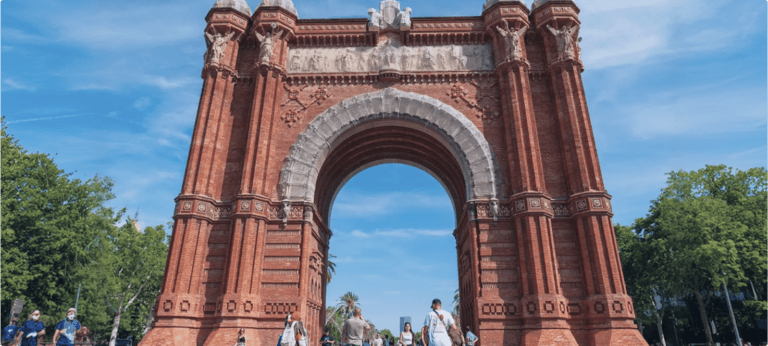
The starting point is not random: the arch, built in 1888 by Josep Vilaseca i Casanovas as the main entrance to the Universal Exposition, was also the stage for the first major gatherings of Catalan choral singers. The 19th-century choral movement — the musical Renaixença — has one of its foundational moments here: thousands of singers gathered before a red-brick arch that Barcelona built in four years to show the world that it was a modern city. The guide contextualizes this moment and explains why choral music was politically inseparable from cultural Catalanism.
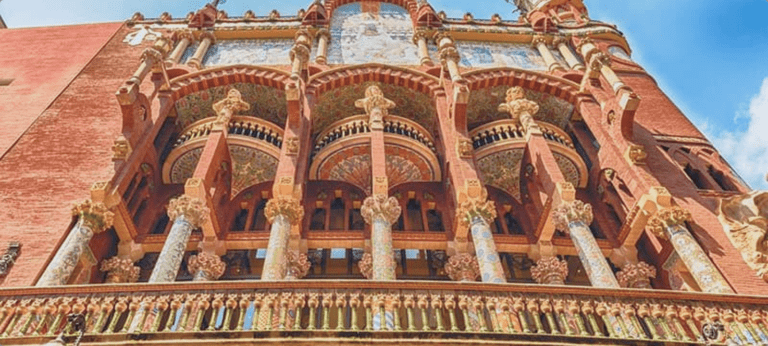
The most important Modernisme building after the Sagrada Família and the only one in the city that Domènech i Montaner conceived as a concert hall from the ground up. The Societat Coral Orfeó Català commissioned it in 1904 to replace the hall on Carrer Jonqueres where the Orfeó had performed since its founding in 1891. In two years and eight months of construction — between 1905 and 1908 — Domènech designed a hall with no interior columns, featuring an inverted stained-glass dome of 2,000 colored pieces, a stage framed by the muses of Catalan folk music on the left and those of universal classical music on the right, and an exterior facade where the ceramic Modernisme of Lluís Bru and Mario Maragliano reaches its highest density. The guide tours the exterior facade and explains the complete iconography — the bust of Beethoven, els orfeonistes, the frieze of the sixteen muses — with the level of detail that only a private tour allows.
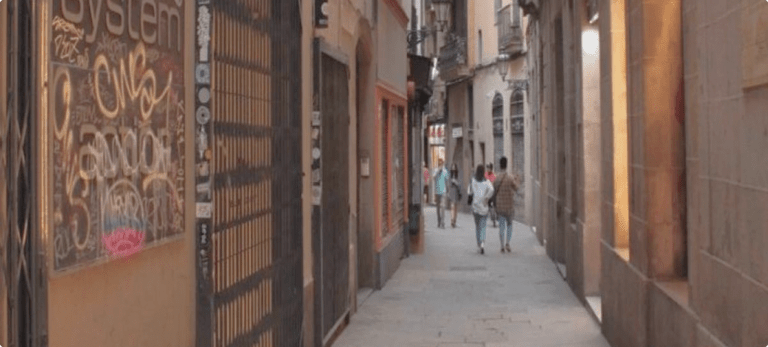
One of the narrowest and best-preserved streets in the medieval quarter. From the 16th century, it was home to printers and booksellers; in the 19th, to the cafés and literary and musical salons where Barcelona’s bourgeoisie debated Italian opera versus Spanish zarzuela, Verdi versus Barbieri. The guide reconstructs this controversy that culturally divided Barcelona’s society for decades and which has a specific setting here.
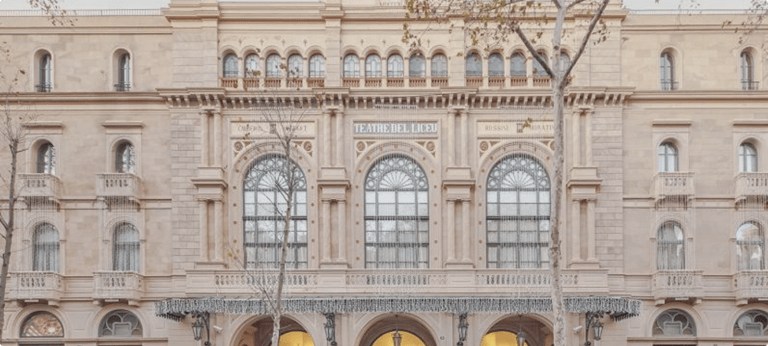
For more than a century, Barcelona’s most famous promenade was the hub of the city’s musical life: cafés with orchestras, libretto sellers, and opera lovers discussing sopranos and tenors as they strolled. At the center of the route, the Gran Teatre del Liceu, inaugurated in 1847, was from its opening the second-largest opera house in Europe by capacity — 3,500 seats — and the most important in the Iberian Peninsula throughout the second half of the 19th century. The guide explains the fire of 1861, the reconstruction within two years, the anarchist attack of 1893 — a bomb thrown from the upper gallery during a performance of William Tell that killed 20 people — and the second fire of 1994, which destroyed the stage and the stalls without affecting either the foyer or the boxes. Today’s Liceu is the reconstruction inaugurated in 1999.
The neighborhood located to the left of La Rambla was, during the 19th century and the first half of the 20th, the center of Barcelona’s urban popular music: cafés-chantants with flamenco, variety shows, and popular songs in venues that occupied the ground floors of residential buildings. The guide walks through the streets where the most famous venues were located and explains the coexistence — and the tension — between the classical music of the Liceu and the popular music of the Raval, separated by barely a hundred meters of La Rambla.
For almost half a century — from 1894 to 1939 — the avenue was the center of popular entertainment in Catalonia. The name comes from its exact alignment with the 41° 22′ north latitude parallel. Along its route, more than forty theaters, cabarets, café-concerts, and variety halls coexisted at the same time: the Teatre Arnau, the Teatre Apol·lo, the Edén Concert, the Teatre Victòria, the Molino. The guide reconstructs the atmosphere of that avenue — cuplés, bohemian nights, artists like Raquel Meller and La Bella Dorita — and explains why the Franco regime progressively left it empty from 1939 onwards, and why some of those venues, like the Teatre Apol·lo, are still standing.
INCLUDED
NOT INCLUDED
The price is per group, not per person. The total is split among all participants. The more people, the lower the cost per head.
| People | Total | Per person |
|---|---|---|
| 1 person | €199 | €199 / person |
| 2 people | €178 | €89 / person |
| 3 people | €267 | €89 / person |
| 4 or more people | — | €70 / person |
| People | Total | Per person |
|---|---|---|
| 1 person | €330 | €330 / person |
| 2 people | €300 | €150 / person |
| 3 people | €330 | €110 / person |
| 4 or more people | — | €90 / person |
* Children (0 to 11 years old): free. No hidden fees or booking surcharges.
The private music tour in Barcelona is one of the most specific itineraries in the catalog — book well in advance if you are arriving during high season.
* We recommend booking a minimum of 7 days in advance to guarantee guide assignment. During peak season (May–September), guides work at full capacity.
Your guide will be waiting for you at the foot of the Arc de Triomf, on Passeig de Lluís Companys. After booking, we will provide you with the guide’s phone number so you can meet up without any hassle. Metro: Arc de Triomf (L1).
Under the Arc de Triomf
Free cancellation available
You can cancel free of charge up to 48 hours before the tour start time. Cancellations made less than 48 hours in advance or no-shows will not be refunded.
No. The itinerary includes the complete exterior facade of the Palau, with a detailed explanation of all its iconography — the frieze of the sixteen muses by Eusebi Arnau, the ceramic dome on the corner, and the sculptural group dedicated to popular and classical music. Entrance to the interior of the Palau requires a tour or concert ticket, and is not included in this tour. If you want to go inside, you can purchase a guided tour of the Palau separately and combine it with this tour.
The itinerary focuses on the musical history of Barcelona from Roman times to the mid-20th century, with special attention to Modernisme, opera, and the popular entertainment of Paral·lel. The contemporary scene — 1960s and 70s jazz, rock català, 90s electronic music — is not included in the standard tour because the venues are scattered across neighborhoods that would significantly lengthen the itinerary. If you have a specific interest in a particular scene, please mention it when booking and the guide can advise you.
To enjoy this tour, you don’t need to know anything about music. The tour assumes no prior musical knowledge. The guide contextualizes each location historically before going into any technical or musical details. The main focus is urban history: why Barcelona built these venues, what social and political conflicts they reflected, and how they transformed the neighborhoods that hosted them.
No. It is a guided walking tour of the historic venues, not a concert experience. If you are looking to combine the tour with a live performance, the Palau de la Música schedules concerts almost daily — you can check the schedule at palaumusica.cat and book tickets separately for the same night or the day after the tour.
The Private Modernism Tour in Barcelona expands the context of the Palau de la Música to the rest of the Modernist movement — Casa Batlló, Casa Milà, Hospital de Sant Pau — and places Domènech i Montaner in relation to Gaudí and Puig i Cadafalch. If you are interested in the Raval neighborhood in depth — its history, its transformation, and its cultural present — the Private Raval Tour dedicates three full hours to a neighborhood that is only touched upon tangentially in this music tour.
The stretch of Paral·lel was a revelation. I never imagined that avenue had been Barcelona's equivalent of Broadway. The guide had vintage photos on their phone so we could see what it used to look like.
We are musicians and were in Barcelona for a concert. We took this tour the day before, and the context it gave us about the Liceu and the 1893 anarchist attack was incredible. Highly recommended for anyone coming to play here.
Solo la explicación del exterior del Palau de la Música ya valió la pena por todo el tour. Nuestro guía nos explicó cada una de las esculturas de la fachada y pasamos 40 minutos allí de pie. Excelente.
The story of the attack at the Liceu in 1893 left us speechless. A bomb in the middle of the opera. You won't find that level of historical detail in any travel guide.
If you have any questions or special needs before booking, write to us — we reply in less than 24 hours.