Guided tour of Barcelona's Modernism

Private tour of Modernism in Barcelona with an official guide

Walking itinerary through the Arc de Triomf, the Parc de la Ciutadella, the Palau de la Música Catalana, the Dreta de l'Eixample and Passeig de Gràcia — with Casa Batlló, Casa Milà and Casa Amatller. Visit with an official tour guide.

Rating on TripAdvisor and Viator
0
Exterior and interior durability
0 h
Certified official tour guides
0 +
Exclusive private groups
0 %
About this tour

Private Tour of Modernism in Barcelona: the architectural icons driven by the Catalan bourgeoisie

Catalan Modernisme was a cultural, political, and architectural movement that, between approximately 1880 and 1920, transformed Barcelona from an industrial city into a European capital with its own identity. Three architects left the movement’s most ambitious works in the Eixample and the surroundings of El Born: Antoni Gaudí, Lluís Domènech i Montaner, and Josep Puig i Cadafalch. All three are recognized as UNESCO World Heritage sites, although the third rarely appears on standard Modernisme routes.

This private guided tour explores the movement’s most significant works without limiting itself to the figure of Gaudí. The itinerary begins at the Arc de Triomf — built by Josep Vilaseca in 1888 as the gateway to the Universal Exposition, in exposed red brick that foreshadows the Neo-Mudéjar vocabulary of early Modernisme — and continues to Domènech i Montaner’s Palau de la Música Catalana, inaugurated in 1908 and the only Modernista auditorium in the world illuminated entirely by natural light. The central section of the tour crosses the Dreta de l’Eixample and Passeig de Gràcia, where in just 500 meters you will find Puig i Cadafalch’s Casa Amatller (1900), Gaudí’s Casa Batlló (1906), and Domènech i Montaner’s Casa Lleó Morera (1906) — the block known as the *Manzana de la Discordia* (Block of Discord). The tour concludes in front of Casa Milà, La Pedrera, completed by Gaudí in 1912 and the last residential building he designed before dedicating himself exclusively to the Sagrada Família.

During this 3-hour private guided tour, your official tour guide will connect the buildings with the historical and political context that made them possible: the Catalan bourgeoisie of the late 19th century, the cultural *Renaixença*, the 1888 Universal Exposition, and the rivalry between architects that turned the Eixample into the world’s densest showcase of Modernista architecture.


What we'll visit

Tour route: from Arc de Triomf to Passeig de Gràcia

Arc de Triomf (1888) — Passeig de Lluís Companys

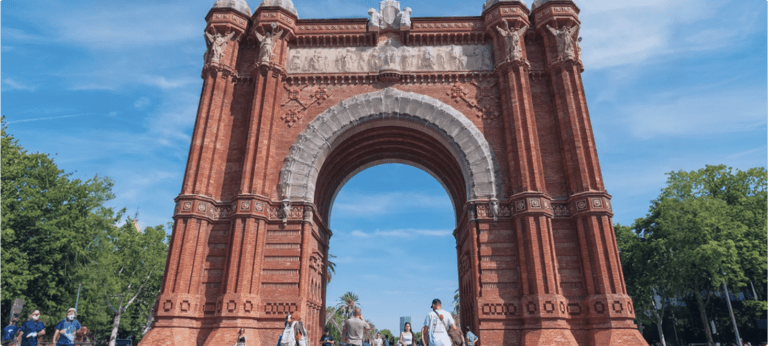
Tour starting point. Built by Josep Vilaseca i Casanovas as the main entrance to the 1888 Universal Exposition, it was the first major public commission of avant-garde Catalan architecture. The guide contextualizes the historical moment: a Barcelona that wanted to prove to the rest of Europe that it was a modern city, with its own industry, bourgeoisie, and a distinct cultural identity.

Parc de la Ciutadella — Hivernacle and Umbracle (1884–1888)

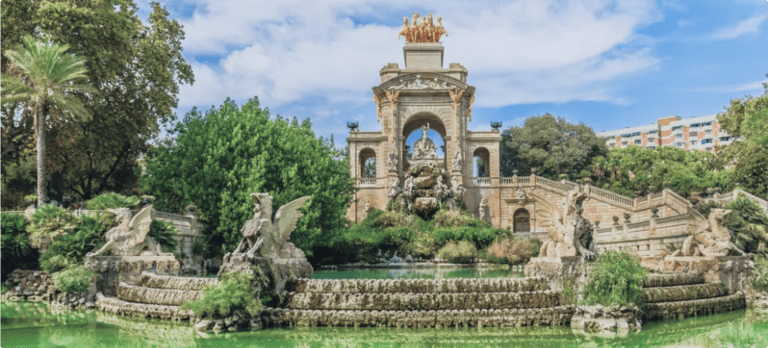
Within the grounds of the former Bourbon citadel — demolished in 1869 to return the land to the city — two iron and glass structures were erected during the Universal Exposition that anticipate the structural language of Modernisme: the Hivernacle by Josep Amargós and the Umbracle by Josep Fontserè. The guide explains the political transformation of the site: from a repressive fortress to a public park, an urban planning gesture with enormous symbolic weight in Restoration-era Barcelona.

Palau de la Música Catalana (1905–1908) — Carrer de Sant Pere més Alt

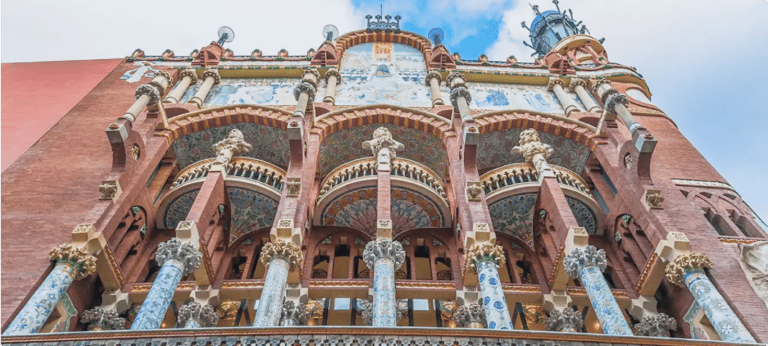
A work by Lluís Domènech i Montaner for the Orfeó Català, inaugurated in 1908 and declared a UNESCO World Heritage Site in 1997. It is the only auditorium designed to function without artificial lighting: the leaded stained-glass roof by Rigalt, Granell i Cia. creates a dome of overhead light that changes with the hours of the day. The guide points out the sculptural figures by Miquel Blay on the facade — the central group represents the Catalan Folk Song — and the sixteen polychrome terracotta muses emerging from the stage. Domènech built this building at the same time as the Hospital de Sant Pau — his other work declared a World Heritage Site, which he would not live to see completed: he died in 1923 and the works were completed by his son Pere Domènech i Roura in 1930.

Block of Discord — Passeig de Gràcia 35–43

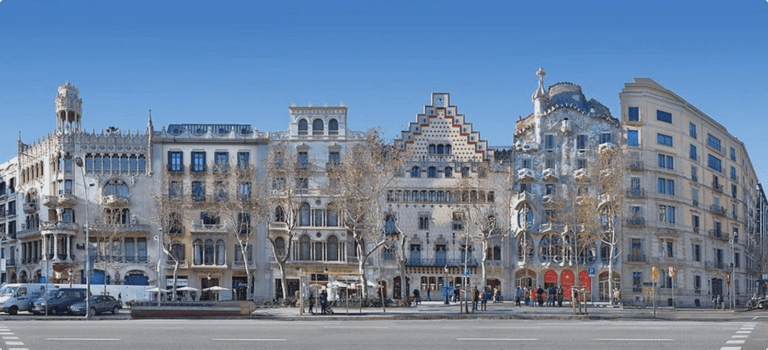
Along a 100-meter stretch of Passeig de Gràcia, three buildings commissioned by three families of the Catalan upper bourgeoisie and designed by the three greats of Modernisme coexist in direct competition. Casa Lleó Morera by Domènech i Montaner (No. 35, 1906), Casa Amatller by Puig i Cadafalch (No. 41, 1900), and Casa Batlló by Gaudí (No. 43, 1906). The nickname “Manzana de la Discordia” (Apple of Discord) is a later addition and has a double meaning: that of a hazelnut tree (amatller, in Catalan) and that of “manzana” as a city block. The guide deciphers the iconography of each facade: the dragon and Sant Jordi at Casa Batlló, the Flemish-inspired stepped gable and flamboyant arches of Casa Amatller — commissioned by the chocolatier Antoni Amatller i Costa, who traveled regularly to the Netherlands and wanted to bring that reference to his residence —, and the floral ceramic mosaics on the ground floor of Casa Lleó Morera, which were partially destroyed in the 1940s to open a shop.

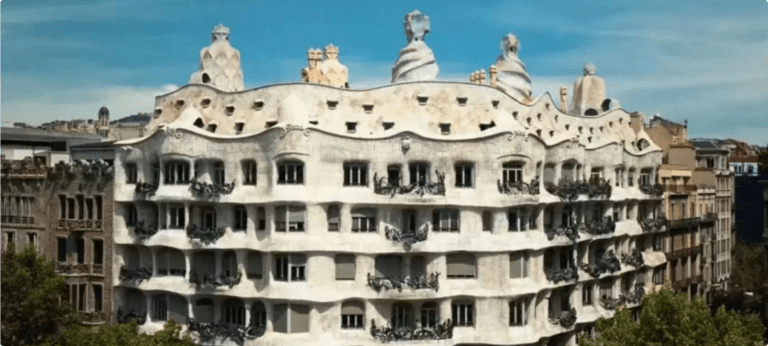
Casa Milà · La Pedrera (1906–1912) — Passeig de Gràcia 92

Gaudí’s last residential building, completed in 1912. The nickname “La Pedrera” (the quarry) was coined by the satirical press of the time, which saw its undulating limestone facade with no right angles as an unfinished or outright ridiculous work. Now a World Heritage Site, the building features on its rooftop the most photographed ventilation and chimney system in Barcelona: the stone warriors, which Gaudí designed as abstract sculptures integrated into the structure. The guide explains why Gaudí never finished the commission as he conceived it: the conflict with the owners Roser Segimon and Pere Milà, who refused to install the sculptural group of the Virgin of the Rosary planned for the facade, following the burning of convents during the Tragic Week of 1909.


What's included

What is included in this private tour of Modernism

INCLUDED

  • ✓ Official private tour guide
  • ✓ 3-hour guided tour
  • ✓ Arc de Triomf and Ciutadella Park
  • ✓ Palau de la Música Catalana (exterior)
  • ✓ Block of Discord (exterior)
  • ✓ Casa Milà · La Pedrera (exterior)
  • ✓ Available in Spanish and English
  • ✓ Free cancellation (up to 48h in advance)

NOT INCLUDED

  • ✗ Entry to the interior of the buildings
  • ✗ Food or drinks
  • ✗ Transportation to the meeting point

Pricing

Price of the private Modernism tour — per group, not per person

The price is per group, not per person. The total is split among all participants. The more people, the lower the cost per head.

Low Season (October 1 – April 30)

PeopleTotalPer person
1 person€199€199 / person
2 people€178€89 / person
3 people€267€89 / person
4 or more people€70 / person

High Season (May 1 – September 30)

PeopleTotalPer person
1 person€330€330 / person
2 people€300€150 / person
3 people€330€110 / person
4 or more people€90 / person

Tour schedule

Available time slots

The private Modernism tour is one of the most in-demand among architecture lovers — book well in advance if you are arriving during high season.

  • 10:30 AMMorning session
  • 4:30 PMAfternoon session

Tour details

Languages, accessibility and practical information

DURATION
3 hours
TOUR TYPE
100% private — only your group
LANGUAGES
Spanish · English
GUIDE
Official tourist guide (Catalonia Tourist Guide License, Government of Catalonia)
ACCESSIBILITY
The route runs mainly along sidewalks and pedestrian areas with no steps. Wheelchair accessible for most of the itinerary. Please let us know your requirements when booking.
PETS
Check availability when booking
MINIMUM BOOKING
7 days prior (earlier during high season)
KIDS
Free (0–11 years). All ages welcome.

Meeting point

Where to find your guide for the Modernism tour

Under the Arc de Triomf — Passeig de Lluís Companys, Barcelona

Your guide will be waiting for you at the foot of the Arc de Triomf, on Passeig de Lluís Companys. After booking, we will provide you with the guide’s phone number so you can meet up without any hassle.

Under the Arc de Triomf

Tour checkpoints


Cancellation Policy

Free cancellation up to 48 hours before the tour

Free cancellation available

You can cancel free of charge up to 48 hours before the tour start time. Cancellations made less than 48 hours in advance or no-shows will not be refunded.


FAQs

Frequently Asked Questions about the private Modernism tour

Which tour is recommended after this Modernism tour?

It depends on what interested you most during the tour. If Gaudí was the focus of the conversation, the natural next step is the Sagrada Família Private Tour — dedicated exclusively to the interior and exterior of the building, with a level of detail that doesn’t fit into a general tour. If you were more interested in the figure of the architect than his individual works, the Private Tour of the Life and Work of Antoni Gaudí connects his biography with each commission. If the Eixample and Passeig de Gràcia captivated you as an urban space, the Passeig de Gràcia Private Tour delves into the history of the boulevard and its facades with more time than this general tour allows. Your guide will help you decide at the end.

Does the tour go inside Casa Batlló, La Pedrera, or the Palau de la Música?

No. The tour is outdoors. The guide explains each building from the street, with the time and depth needed to read the facades, understand the iconography, and connect each work with the context of who commissioned it and who built it. Access to the interior of Casa Batlló, La Pedrera, or the Palau de la Música requires separate tickets, which each visitor manages on their own. If you are interested in combining the guided tour with interior access to any of these buildings, please ask us when booking and we will guide you on how to organize it.

Who was Domènech i Montaner and why doesn't he appear as much as Gaudí on the Modernism routes?

Lluís Domènech i Montaner (1850–1923) is, alongside Gaudí, the most important architect of Catalan Modernisme. Two of his buildings have been declared World Heritage Sites by UNESCO — the Palau de la Música Catalana (1908) and the Hospital de Sant Pau (1930, completed by his son) — and he was director of the Escola d’Arquitectura de Barcelona and president of the Centre Excursionista de Catalunya. His lesser presence on Modernism routes is partly due to the fact that his buildings do not concentrate the more photogenic and easily identifiable Gaudí iconography in a single spot. The guide dedicates a specific section to him on the tour.

Do you need to know anything about architecture to enjoy the tour?

No. The guide starts from scratch and builds the narrative from the historical context — who the Catalan bourgeoisie of 1888 was, what they wanted to demonstrate with these commissions, how the architects related to one another — before diving into the formal elements of each building. Technical knowledge is introduced when it adds something concrete: why the facade of La Pedrera has no right angles, what structural system allows the Palau de la Música to function without interior columns. If you have a background in architecture or art history, the guide adjusts the level of the conversation.

Can this tour be done with children?

Yes, it works well from ages 7–8. The Block of Discord has an immediate visual appeal — the dragons and scales of Casa Batlló, the medieval-style pinnacles of the Amatller, the ceramic flowers of the Lleó Morera — that instantly engages without the need for prior explanations. The guide adapts the vocabulary to the group. Children under 12 are free. Please let us know the children’s ages when booking.

Do this tour and the Welcome Tour overlap at any point along the route?

The itinerary shares the Arc de Triomf and the Parc de la Ciutadella as a starting point. From there, they diverge completely: the Welcome Tour turns towards El Born, the Gothic Quarter, and El Raval; this tour heads towards the Palau de la Música, the Eixample, and Passeig de Gràcia. If you have already done the Welcome Tour, there is no significant overlap. If you haven’t, the Arc de Triomf and the Ciutadella receive a treatment in this tour focused exclusively on Modernisme, without the general context of the city provided by the Welcome Tour.


Reviews

Reviews of the Barcelona Modernism private tour

★★★★★

We have been visiting cities with Modernist architecture for years and this was the best tour we've ever done. The guide explained the Manzana de la Discordia building by building — we knew nothing about Puig i Cadafalch and we left fascinated.

Robert & Anne M.Boston, USA · TripAdvisor
★★★★★

The Palau de la Música section was what surprised us the most. We had walked past it without ever going inside and had no idea what it hid. The guide explained Domènech i Montaner's natural light system to us in incredible detail.

Elena y Marcos F.Madrid, ES · Viator
★★★★★

We are architects and we had doubts about whether the tour would offer us anything. We were wrong. The history of La Pedrera and the conflict between Gaudí and the Milàs over the sculpture of the Virgin was something we were completely unaware of.

James & Claire W.London, UK · Google
★★★★★

We did it after the Welcome Tour and it was the perfect combination. With the context of the city already in place, understanding Modernism from Passeig de Gràcia made much more sense. The guide connected everything with the political history of the time.

Patricia S.Chicago, USA · TripAdvisor

Other tours you might also be interested in

More private tours in Barcelona

Private tour of Montjuïc with official guide

Tour of Montjuïc, the mountain from which power controlled Barcelona for centuries. From here, they bombarded the city and executed its president; on this very mountain, they staged a major International Exposition under the dictatorship of Primo de Rivera and hosted the Olympic Games that returned Barcelona to the world. Tour with an official tour guide.

Welcome tour to Barcelona

Private welcome itinerary through the central neighborhoods of Barcelona: the Arc de Triomf, Ciutadella Park, El Born, the Gothic Quarter, and El Raval. Sangria included at the end. Tour with an official tour guide.

Tour of mysterious and forbidden Barcelona

Walking itinerary through El Raval, the Gothic Quarter, Las Ramblas, and Plaza Cataluña: secret passages, public execution sites, famous crimes, and the stories that the official version of the city would prefer to forget. Tour with an official tour guide.

Contact

Do you have questions about the tour? We reply within 24h

If you have any questions or special needs before booking, write to us — we reply in less than 24 hours.

Write to us

Great! We have received your information.

We were unable to process your submission. Please try again.

You can also find us on

Reserva Ahora Reserva Ahora