We had been to Barcelona three times and had never made it to the Laberint d'Horta. The guide explained the entire history of the Marquis of Llupià and the iconography of the sculptures — something we would never have discovered on our own.
Inicio / Tours privados / Private Tours in Barcelona / Barcelona Labyrinth Park Tour
Guided tour of the Laberint d'Horta: the cypress labyrinth designed in 1791 by the Marquis of Llupià, the neoclassical terraces with mythological sculptures, the Venetian canal, the grotto of the nymph Egeria, and the 19th-century romantic gardens. Visit with an official tour guide.


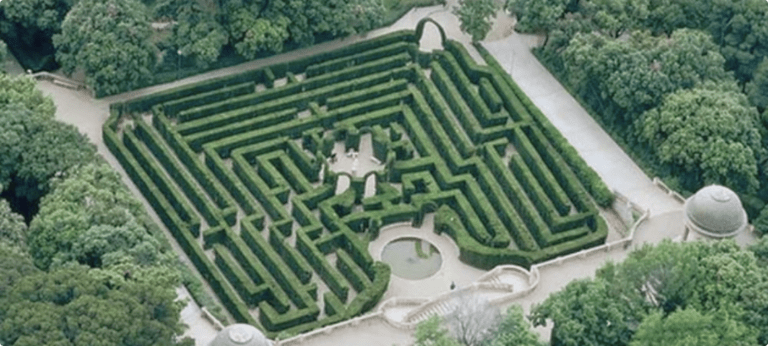
The Laberint d’Horta is the oldest surviving public garden in Barcelona. It was commissioned by Joan Antoni Desvalls i d’Ardena, the first Marquis of Llupià, in 1791, on an estate in the Collserola mountain range that his family had acquired in the 16th century. The first phase of construction was completed in 1808, just as Napoleon was entering Spain. The garden survived wars, land confiscations, and 20th-century urban speculation thanks to its declaration as an Asset of Cultural Interest, and since 1971 it has belonged to the Barcelona City Council. It is also the city’s only hedge maze and one of the few of its kind and age remaining in Spain.
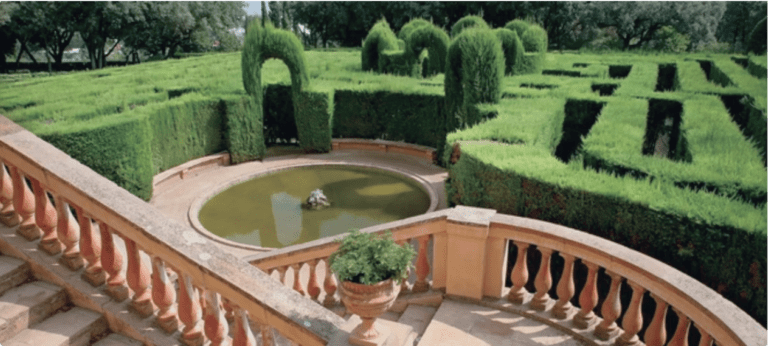
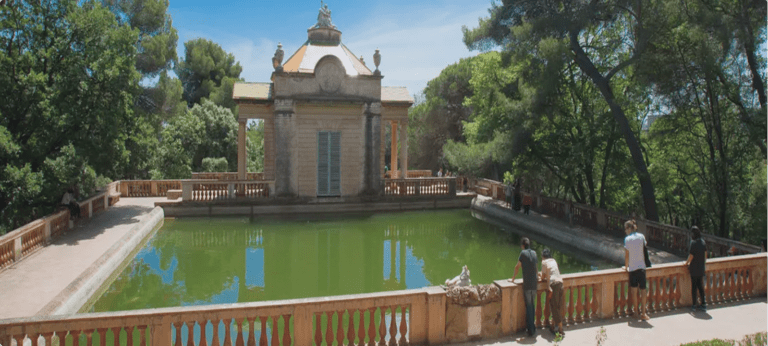
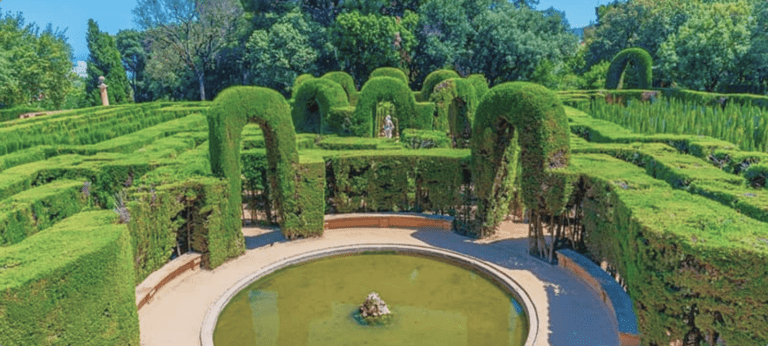
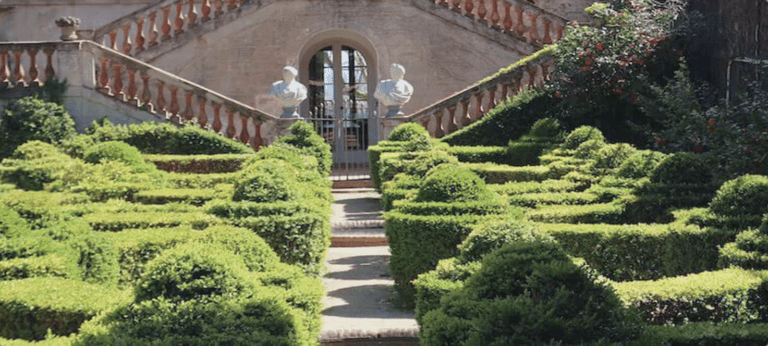
The original design follows the canons of the Italian neoclassical garden: rigorous geometry, stepped terraces, trimmed cypress paths, mythological sculptures, and a botanical architecture that aims to demonstrate the dominance of reason over nature. The cypress maze—built with Cupressus sempervirens, the species found in Mediterranean gardens since antiquity—occupies the lower level of the complex and serves as the visual and symbolic axis of the entire route. From the 19th century onwards, the third Marquis of Llupià expanded the garden with romantic elements—the artificial grotto, the Venetian canal, the poets’ garden—which coexist with the original neoclassical rigor in a blend that is unusual for Barcelona.
Over the course of 3 hours, the tour follows the logic of the garden from top to bottom: the history of the Marquis of Llupià, the iconography of the sculptures, the two construction phases, and the ongoing restoration of the cypress maze.
The tour begins at the main entrance of the park, on Passeig dels Castanyers. From there, the itinerary descends through the three levels of the garden, following the original sequence of the neoclassical design:
The entrance to the garden is structured around a portico of Doric columns that marks the boundary between the ordinary world and the garden as a space of representation. The guide contextualizes the figure of Joan Antoni Desvalls, his education in Italy, and the model of Venetian gardens that he used as a reference to design the estate.
The garden is organized into three levels connected by stone staircases. On the balustrades and pedestals of each terrace, there are marble sculptures—mostly nineteenth-century copies of Greek and Roman originals—representing Ariadne, Eros, Dionysus, and the Muses. The guide identifies each figure and explains the iconographic intent of the ensemble: the garden as an allegory of the triumph of love over the labyrinth of life.
The heart of the garden and the element that gives it its name. A kilometer and a half of paths laid out with Cupressus sempervirens cypress hedges, arranged in a spiral around a central platform where there is a sculpture of Eros. The convention of the labyrinth dictates that only those who reach the center have found love; those who fail to escape are trapped forever. During the restoration works (2025–2026), 2,211 new cypress trees are being planted, with a height of between 150 and 175 centimeters, and the entire irrigation system is being renovated. The guide explains the restoration and what the labyrinth will regain once it is completed.
The water canal that runs along the lower perimeter of the garden is a romantic addition by the third Marquis in the mid-19th century. Next to the canal is an artificial grotto built with volcanic tuff, inside of which is a sculpture of the nymph Egeria—the mythological figure who advised King Numa Pompilius in ancient Rome. The contrast between the neoclassical geometric coldness and the romantic picturesque artificiality is one of the most unique aspects of the Laberint d’Horta.
The highest part of the complex, expanded during the 19th century with an English-influenced landscape garden design: winding paths, irregular vegetation, ponds and a collection of busts of Catalan poets —Jacint Verdaguer, Joan Maragall, Àngel Guimerà— that turn this level into a vegetal pantheon of Catalan culture of Romanticism.
The original 16th-century masia was renovated in the 19th century to become a neoclassical mansion. The building is not open to the public, but the guide explains its history, the role of the Desvalls family in 19th-century Catalan political history, and the process by which the estate passed from private hands to the Barcelona City Council in 1971.
INCLUDED
NOT INCLUDED
The price is per group, not per person. The total is split among all participants. The more people, the lower the cost per head.
| People | Total | Per person |
|---|---|---|
| 1 person | €199 | €199 / person |
| 2 people | €178 | €89 / person |
| 3 people | €267 | €89 / person |
| 4 or more people | — | €70 / person |
| People | Total | Per person |
|---|---|---|
| 1 person | €330 | €330 / person |
| 2 people | €300 | €150 / person |
| 3 people | €330 | €110 / person |
| 4 or more people | — | €90 / person |
* Children (0 to 11 years old): free. Admission to the Laberint d’Horta is included in the tour price. No hidden fees or booking surcharges.
The private tour of the Laberint d’Horta is one of the most popular tours off the beaten path — book well in advance if you arrive during peak season.
* The morning session is the most recommended: the park receives fewer visitors in the early hours and the light among the cypresses is especially good for those who want to photograph the route. Book at least 7 days in advance to guarantee the assignment of a guide.
Your guide will be waiting for you at the Mundet metro exit (line 3, green), next to the stairs leading to the street. From there, you will walk together to the park entrance, about a 10-minute walk away. After booking, we will provide you with the guide’s phone number so you can easily find each other.
Metro Mundet L3, single exit
Free cancellation available
You can cancel free of charge up to 48 hours before the tour start time. Cancellations made less than 48 hours in advance or no-shows will not be refunded.
The works began in March 2025 and have been underway for over a year, with the cypress maze closed to the public. The final reopening also depends on an additional closure period to allow the vegetation to take root properly, so the date has not yet been confirmed. The rest of the park —terraces, Venetian canal, romantic garden, Desvalls Palace— is open and accessible as usual. As soon as the City Council confirms the reopening, we will update it here and let you know if you have an active booking.
With the labyrinth closed, the park loses its most unique feature. The rest of the grounds —the neoclassical terraces, the Venetian canal, the grotto of Egeria— is interesting, but the visit feels incomplete compared to what it will be when it reopens. If you have flexible dates, the honest recommendation is to wait until the restoration is finished: the newly planted cypress labyrinth, with the vegetation in place, is what makes this park unique. In the meantime, if you want a tour of Barcelona off the beaten path, the Private Tour of the Gràcia neighborhood or the Private Tour of Poble Sec are good alternatives with a similar visitor profile.
The most direct way is by metro: line 3 (green), Mundet station. From the exit, it is about a 10-minute walk to the park entrance via Passeig dels Castanyers. There is no parking on site; if you come by car, the nearest parking area is at the Horta Velodrome, about a 5-minute walk away.
Yes, especially for children aged 5–6 and up. The hedge maze —when open— works as a game in itself. During the works, the tour of the terraces, sculptures, and the grotto maintains visual interest. Children under 12 get in free. The terrain has steps between the three levels of the garden, so the full tour is not suitable for strollers. Please let us know the age of the children when booking.
Due to its location —in the far north of the city, in the Horta neighborhood— this tour works better as a standalone activity rather than combined on the same day with tours of the city center. The most logical option is to do it on a different day than the Gothic Quarter or Gràcia tours, which are the closest routes geographically. If you want a full day in the northern area, we can design a custom itinerary combining the Laberint d’Horta with Tibidabo or Creueta del Coll park.
We had been to Barcelona three times and had never made it to the Laberint d'Horta. The guide explained the entire history of the Marquis of Llupià and the iconography of the sculptures — something we would never have discovered on our own.
The grotto of the nymph Egeria and the Venetian canal are incredible. I had no idea they existed. The guide knew every corner of the park with a precision I haven't seen on any other tour.
Vinimos con nuestros dos hijos —de 7 y 10 años— y les encantó cada minuto. El laberinto fue su parte favorita. El guía los mantuvo entretenidos todo el tiempo con la mitología detrás de las esculturas.
Completely different from any other tour we've done in Barcelona. No crowds, no city noise. The 19th-century romantic garden is a gem. I would return just to stroll through it.
If you have any questions or special needs before booking, write to us — we reply in less than 24 hours.