I had walked along La Rambla three times before this tour and knew nothing of what the guide told me. The history of the Liceu and the 1893 attack left me speechless.
Inicio / Tours privados / Private Tours in Barcelona / Tour of La Rambla in Barcelona
Walking itinerary along Barcelona's most famous promenade: the Canaletes Fountain, Rambla dels Estudis, Rambla de Sant Josep with the Boqueria Market, Rambla dels Artistes with Miró's mosaic, the Gran Teatre del Liceu, Rambla dels Caputxins, Palau Güell, and Rambla de Mar to the port. Tour with an official tour guide.


La Rambla is actually five distinct promenades —Rambla de Canaletes, Rambla dels Estudis, Rambla de Sant Josep, Rambla dels Artistes, and Rambla dels Caputxins— that stretch in succession from Plaça de Catalunya to the port over 1.2 kilometers. The singular name became established through popular use, but the original plural —Las Ramblas— better describes its nature: each section has its own character, its own buildings, and its own history.
The origin of La Rambla lies in a *riera* —a seasonal drainage channel— that ran outside the walls of medieval Barcelona. From the 16th century onwards, with the progressive demolition of the medieval walls and the urbanization of the dry riverbed, the space was transformed into a tree-lined public avenue. In 1775, it was opened to carriage traffic and the first plane trees were planted. Since then, La Rambla has been the central stage for the most important episodes in Barcelona’s modern history: the First Carlist War, the Tragic Week of 1909, the proclamation of the Republic in 1931, the street fighting of May 1937 that George Orwell described in *Homage to Catalonia*, and, more recently, the terrorist attack of August 2017.
On this 3-hour private guided tour, the itinerary covers the five sections from north to south, with stops at each to explore the unique buildings, specific historical events, and details that visitors miss when they walk down the street on their own. The tour includes the Palau de la Virreina, the Boqueria Market, the Gran Teatre del Liceu, the Joan Miró mosaic on the ground of the Rambla dels Artistes, Gaudí’s Palau Güell visible from the street, and the Columbus Monument at the end.
The tour begins at Plaça de Catalunya and heads south, following the five sections of the axis. Each stop has a specific theme:
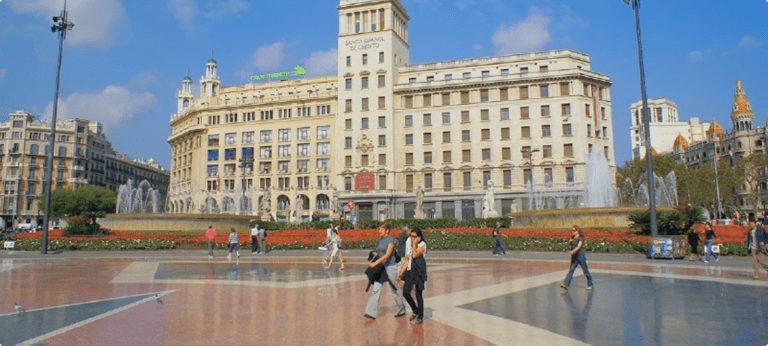
The link between the Eixample and the old town, built in its current form between 1926 and 1929 on the site left after leveling the slope of the old Portal de la Boqueria. This stop traces the relationship between the square, the boulevards, and the layout of Cerdà’s Eixample (1860)—the urban plan that shaped modern Barcelona.
The cast-iron fountain installed in 1892 over the old Canaletes spring, which supplied the neighborhood before the municipal network arrived. The legend —that whoever drinks from its waters will always return to Barcelona— was spread in the early 20th century by press correspondents who waited here for the results of Barça’s matches, when telegraphic dispatches arrived at the newsrooms on La Rambla. In this section, you will also see the commemorative plaque for Federico García Lorca on the facade of No. 74, and the poet’s relationship with the Els Quatre Gats café will be explored.
Named after the Estudi General, the former University of Barcelona located in this section until 1714. Following the defeat in the War of the Spanish Succession, Philip V abolished the university and transferred its collections to Cervera as a punishment to Barcelona for having supported the Austrian claimant. For decades, this section housed the bird and animal stalls that gave it its popular name. In this section, you will see the facade of Palau Moja (1784), residence of the Captain General and one of the few neoclassical palaces in Barcelona that is preserved intact.
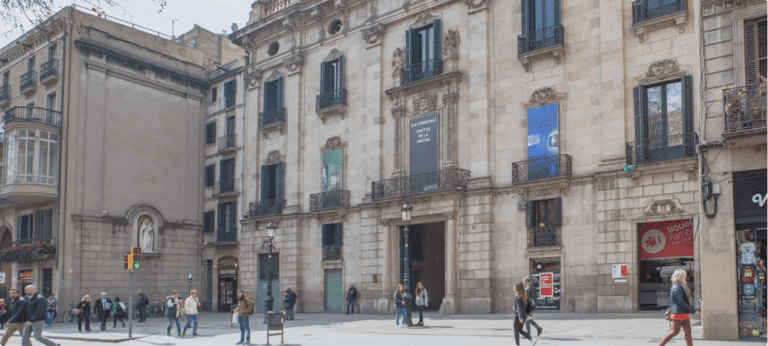
Built between 1772 and 1778, commissioned by Manuel d’Amat i de Junyent, Viceroy of Peru, who wanted to build the most ostentatious palace of his time in Barcelona. The architect was Josep Ausich, although the work was directed in its final phase by Carlos Grau. The facade combines Baroque and Rococo elements in an unusual composition for the sobriety of Catalan architecture of the period. Today, it is the headquarters of the Institut de Cultura de Barcelona.
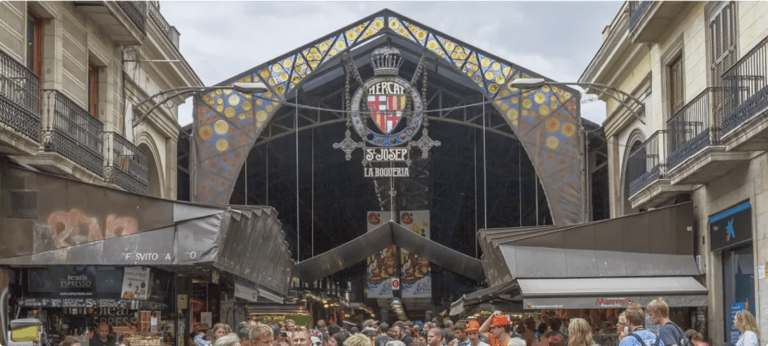
Spain’s most visited indoor market, featuring a cast-iron structure inaugurated in 1840 on the site of the former convent of Sant Josep, demolished during the exclaustration of 1835. La Boqueria has records of merchants at this location dating back to 1217. This stop addresses the difference between the market as a historical institution and the market as a current tourist stage, and why today’s Barcelonans shop at other neighborhood markets.
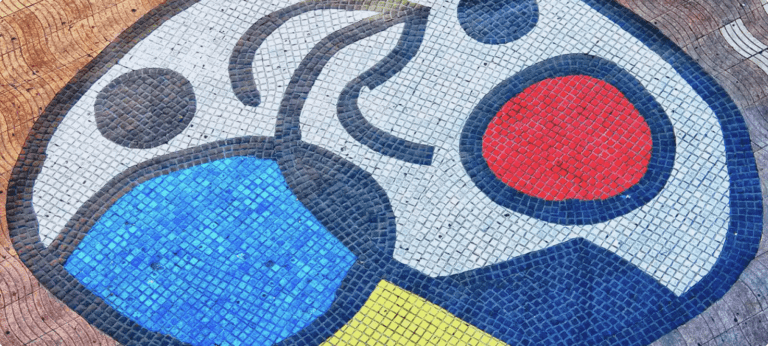
The eight-meter-diameter mosaic pavement that Miró installed in 1976, the first year after Franco’s death, as a reclamation of the city’s public space. Miró deliberately chose the center of Barcelona’s busiest street so that the work would be stepped on and experienced, not contemplated from a display case. The chromatic coordinates of the mosaic —red, yellow, blue and black— connect with the visual vocabulary of the artist’s late works.
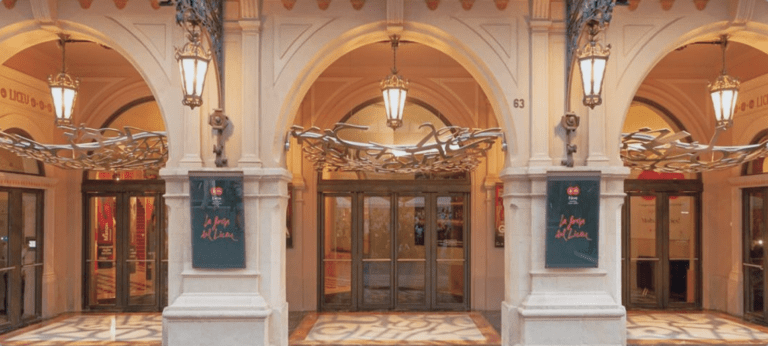
Spain’s largest opera house, inaugurated in 1847 on the site of the former convent of Mare de Déu de Montserrat. The Liceu was destroyed by fire twice —in 1861 and in 1994— and was the scene of the 1893 anarchist attack, when Santiago Salvador threw two Orsini bombs into the stalls during a performance of Guglielmo Tell, causing 22 deaths. This stop traces the 1999 reconstruction and the architectural controversy over whether to rebuild or create a new building.
The palace that Gaudí built between 1886 and 1890 for Eusebi Güell, his patron, on Carrer Nou de la Rambla —a few meters from the main street—, recognizable by its two parabolic wrought-iron gates. It is Gaudí’s first major work in Barcelona and the one that earned him international recognition. The facade will be viewed and its subsequent history will be explored: headquarters of the Civil Government during the Primo de Rivera dictatorship, barracks of the International Brigades during the Civil War, and a Francoist police station.
The most populous stretch of Las Ramblas, between the Liceu and the Mirador de Colom. To the right, the Barri Xino —a name popularized in the 1920s by the journalist Francisco Madrid, who took it from the Chinatowns of American port cities, without there being any Chinese community in it— was the neighborhood of prostitution, anarchists, and artists frequented by Picasso, Jean Genet, and George Orwell. Today it is officially called El Raval.
The 60-meter column topped by the figure of Christopher Columbus pointing to the horizon, inaugurated in 1888 for the Universal Exposition that transformed Barcelona’s waterfront. Columbus points towards the south —towards the Mediterranean— and not towards America, which lies to the west: a detail that Barcelonians point out with humor. The itinerary ends at the Rambla de Mar, the pedestrian swing bridge over the harbor inaugurated in 1994, with views of the Moll de la Fusta and the Olympic Port on the horizon.
INCLUDED
NOT INCLUDED
The price is per group, not per person. The total is split among all participants. The more people, the lower the cost per head.
| People | Total | Per person |
|---|---|---|
| 1 person | €199 | €199 / person |
| 2 people | €178 | €89 / person |
| 3 people | €267 | €89 / person |
| 4 or more people | — | €70 / person |
| People | Total | Per person |
|---|---|---|
| 1 person | €330 | €330 / person |
| 2 people | €300 | €150 / person |
| 3 people | €330 | €110 / person |
| 4 or more people | — | €90 / person |
* Children (0 to 11 years old): free. No hidden fees or booking surcharges.
The private tour of La Rambla is the most in-demand among groups arriving in Barcelona on weekends — book well in advance if you arrive during peak season.
* We recommend booking at least 7 days in advance to guarantee the assignment of the guide and your chosen time slot.
Your guide will be waiting for you next to the Canaletes Fountain, at the northern end of the promenade, near Plaça de Catalunya. It is the most recognizable landmark at the start of Las Ramblas. After booking, we will provide you with the guide’s phone number so you can easily find each other.
Canaletes Fountain, start of La Rambla
Free cancellation available
You can cancel free of charge up to 48 hours before the tour start time. Cancellations made less than 48 hours in advance or no-shows will not be refunded.
Yes, the tour of La Rambla includes a stop at the Mercat de la Boqueria, where you will see the cast-iron structure and the market’s main points of interest. What is not included is any consumption inside the venue. If you are interested in making a longer stop and trying something at one of the indoor stalls, let the guide know at the start of the tour and we will adjust it.
The tour includes the facade of Palau Güell from Carrer Nou de la Rambla, with an explanation of the building and its history. The visit to the interior requires an entrance ticket (approximately €12 per person) purchased separately at palauguell.cat . If you want to combine the tour with the interior visit to Palau Güell, contact us when booking and we will coordinate the itinerary.
La Rambla has a very high tourist density, especially between the Boqueria and the Liceu, and pickpockets operate in highly crowded areas. The guide points out the areas of highest concentration and gives you practical advice at the start of the tour. The basic advice: keep your documents and cash in inside pockets, not in your backpack. The neighborhood is safe to walk around; the precautions are the same as in any top-tier European tourist destination.
The morning session (10:30 am) offers a walk with fewer tourists and the Boqueria market in full swing—stalls start to close from midday. The afternoon session (4:30 pm) has more atmosphere but also larger crowds between the Boqueria and the Liceu. In both time slots, the full route is possible; the difference is the pace when passing through the busiest areas.
La Rambla can be explored on your own, but most people walk down it without understanding what they are seeing. La Rambla has an unusual historical density: packed into 1.2 kilometers are a market with records dating back to 1217, Spain’s only opera house destroyed twice by fire, Gaudí’s first major building, a Miró mosaic with a very specific political meaning, and the column where Columbus points in the wrong direction. Without context, they are just pretty facades. With a guide who knows every layer, the tour changes completely.
A minimum of 7 days. During high season (May–September), guides work at full capacity — if you are traveling in summer, book two weeks in advance to have available time slots.
I had walked along La Rambla three times before this tour and knew nothing of what the guide told me. The history of the Liceu and the 1893 attack left me speechless.
The detail about Miró's mosaic and what it means for it to be on the ground of the promenade, to be stepped on, was the most interesting part of the tour. The guide has a way of explaining things that really hooks you.
We went with the kids and the guide adapted the level perfectly. The Boqueria part was what they liked the most. Highly recommended for families.
I didn't know that La Rambla is actually five different ramblas. That detail, which seems small, completely changes how you read the promenade as you walk. Three hours very well spent.
If you have any questions or special needs before booking, write to us — we reply in less than 24 hours.