It was our third trip to Barcelona and we decided to get off the beaten path. The history of Refugi 307 and the 1938 bombings was the most impactful thing we have heard on a tour. Absolutely recommended.
Inicio / Tours privados / Poble Sec Tour
Walking itinerary through Poble Sec: Drassanes Metro, Portal de Santa Madrona, Plaza de las 3 Chimeneas, Miramar Gardens, Civil War Shelter, Calle Blai, the Teatre Grec, and Paral·lel Avenue. Tour with an official tour guide.


Poble Sec has a dense, unpolished layer of history that standard tourist routes do not reach. The neighborhood was born at the end of the 19th century as a welcoming area for workers arriving in industrial Barcelona — immigrants from southern Spain, Valencia, and Aragon — and built its collective identity around labor, popular theater, and political resistance.
This private guided tour covers Poble Sec from the port boundary to the slopes of Montjuïc, from the Portal de Santa Madrona — the last vestige of the medieval wall that separated the city from the outskirts — to Paral·lel Avenue, the popular entertainment hub that, at the beginning of the 20th century, concentrated the highest density of theaters, cabarets, and music halls in all of Spain. Along the way, the tour climbs the slopes of Montjuïc to the Miramar Gardens and the air-raid shelter hand-dug by residents between 1936 and 1938 — one of the 1,400 shelters that the Barcelona Passive Defense Board ordered to be built to protect the civilian population from attacks by Francoist and Italian aviation.
The tour also passes through Carrer de Blai, the neighborhood’s gastronomic epicenter and one of Barcelona’s most famous pintxo streets, and ends on Paral·lel Avenue, where the guide reconstructs the backbone of the neighborhood’s working-class and cultural history.
The itinerary follows a logic: first the historical boundary of the old city, then the geography and memory of the war, and finally the social and everyday fabric of the neighborhood.
Starting point of the tour. The guide contextualizes Poble Sec on the city map: why it was left out of the 1860 Ildefons Cerdà expansion, how Montjuïc mountain defined its western boundary, and what it meant for its inhabitants to live between the medieval city and the new industrial Barcelona.
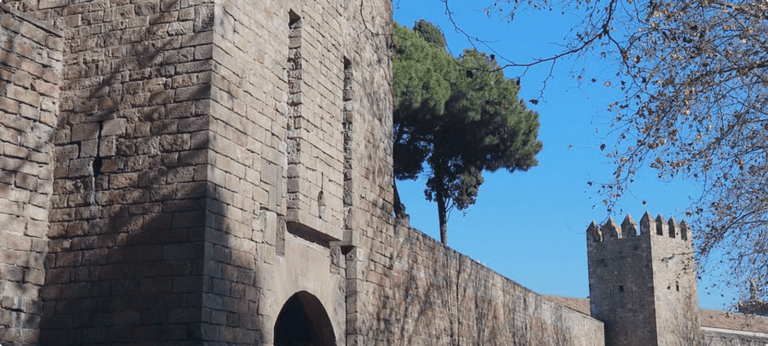
One of the few preserved remains of Barcelona’s sea wall, built in the 14th century. The portal was not just a gate: it marked the boundary between the walled city and the territory of the Drassanes — the royal shipyards that built the galleys of the Crown of Aragon. The guide explains the difference between the sea wall and the land wall, and why Poble Sec developed as an extramural suburb for centuries.
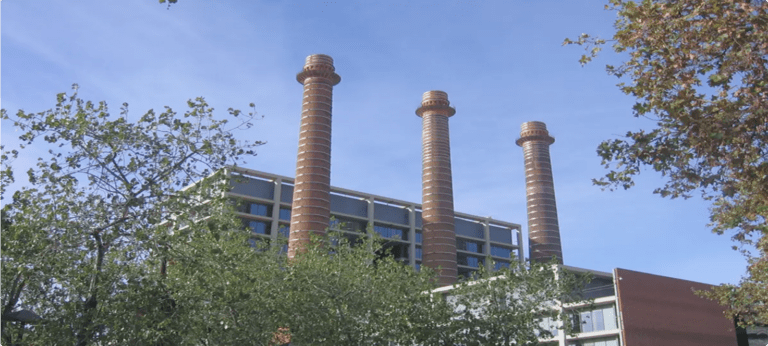
The three chimneys are all that remains of the Barceloneta thermal power plant, built in 1896 and demolished in 1988. For almost a century, they were the visual symbol of Poble Sec from the port. The guide reconstructs the transformation of this area with the 1992 Olympic Games and the urban planning debate surrounding the chimneys as industrial heritage.
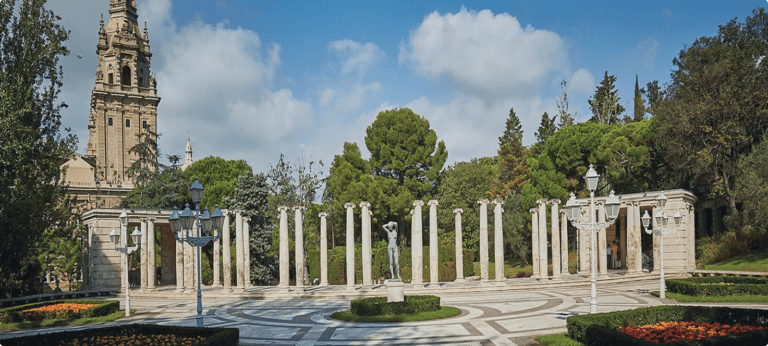
From the Miramar Gardens, you get one of the best views of the port and coastline of Barcelona. The gardens are part of the complex created for the 1929 International Exposition, the event that transformed Montjuïc from a quarry and cemetery into an urban park. The guide explains the political significance of the ’29 Exposition under the dictatorship of Primo de Rivera — and the irony that the same year Barcelona inaugurated its great international showcase, the Second Republic was less than two years away from being proclaimed.
Excavated by hand between 1936 and 1938 by the residents of Poble Sec themselves, following the instructions of the Junta de Defensa Passiva, Refugi 307 has 200 meters of underground tunnels beneath the hillside of Montjuïc, with a capacity for more than two thousand people. Barcelona suffered more than 194 bombings between 1936 and 1939 — more than any other European city up to that point. The guide describes the raids by the Italian Aviazione Legionaria on March 16, 17, and 18, 1938, which killed more than 1,000 people in three consecutive days and made Barcelona the first city in the world to suffer systematic bombing of the civilian population. A visit inside the shelter can be added to the itinerary with a reservation and a separate ticket.
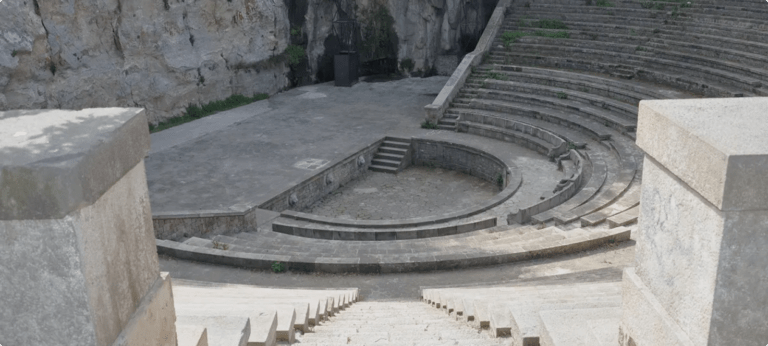
Built in 1929 as a neoclassical open-air theatre for the International Exposition, the Teatre Grec is integrated into the living rock of Montjuïc, taking advantage of a stone quarry. The guide places the theatre in the context of the festival that has borne its name since 1976 — the Barcelona Grec Festival, one of the most important performing arts festivals in Spain — and explains the relationship between the topography of Montjuïc and the history of the neighborhood that grew at its feet.
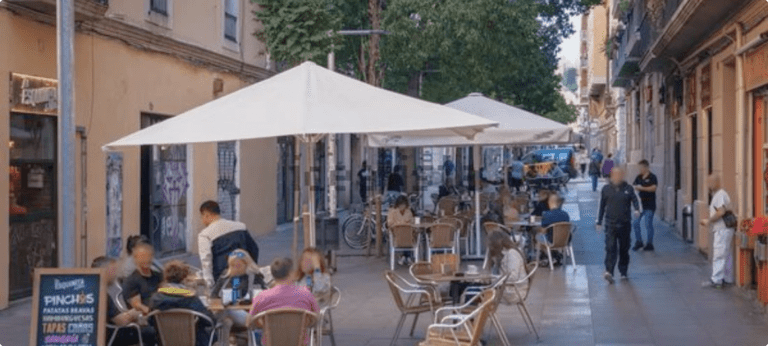
The best-known street in Poble Sec and one of Barcelona’s busiest gastronomic hubs, with an unusual concentration of pintxo bars that began in the mid-nineties. The guide explains the neighborhood’s transformation since the eighties: from a stigmatized area to the epicenter of the city’s alternative and gastronomic scene. Time for a break if the group wishes.
The end of the tour. El Paral·lel takes its name from its alignment with the 41° 22′ north latitude parallel — a geographical curiosity that today is a mere anecdote. What is no anecdote is its history: between 1890 and 1939, it was the hub of Barcelona’s popular theater, with more than twelve active venues including cabarets, variety theaters, circuses, and café-concerts. El Arnau, El Apolo, El Molino — the guide reconstructs El Paral·lel as the Broadway of working-class Barcelona, its relationship with anarchism and the labor movement, and the cultural repression that followed the Francoist victory.
INCLUDED
NOT INCLUDED
The price is per group, not per person. The total is split among all participants. The more people, the lower the cost per head.
| People | Total | Per person |
|---|---|---|
| 1 person | €199 | €199 / person |
| 2 people | €178 | €89 / person |
| 3 people | €267 | €89 / person |
| 4 or more people | — | €70 / person |
| People | Total | Per person |
|---|---|---|
| 1 person | €330 | €330 / person |
| 2 people | €300 | €150 / person |
| 3 people | €330 | €110 / person |
| 4 or more people | — | €90 / person |
* Children (0 to 11 years old): free. No hidden fees or booking surcharges. Admission to the interior of Refugi 307 (optional) is paid separately at the ticket office.
The Poble Sec tour is in growing demand among those who already know Barcelona and are looking to get off the beaten tourist track — book well in advance if you are arriving during high season. The tour takes place in two daily time slots:
* We recommend booking at least 7 days in advance to guarantee guide assignment. During high season (May–September), guides work at full capacity — the earlier you book, the more schedule options you will have available.
Your guide will be waiting for you at the exit of the Drassanes Metro on the La Rambla side. After booking, we will provide you with the guide’s phone number so you can meet up without any hassle.
Metro Drassanes (L3) · La Rambla exit
Free cancellation available
You can cancel free of charge up to 48 hours before the tour start time. Cancellations made less than 48 hours in advance or no-shows will not be refunded.
The itinerary climbs up to the Miramar Gardens, on the southern slope of Montjuïc, along a moderately steep route. It is not a hiking trail, but there is a real elevation gain: about an 80-meter climb between the Portal de Santa Madrona and the gardens. The descent back to the neighborhood is easy. If anyone in the group has mobility difficulties, please let us know when booking and the guide will adapt the route to avoid this part without missing out on the rest of the itinerary.
The tour includes the exterior of the shelter and the complete historical explanation of the 1938 bombings. The visit to the inside of the galleries is optional and is managed directly with the Museu d’Història de Barcelona (MUHBA) — on their website you will find opening hours, prices, and how to book. If you would like to include the inside, please indicate this when booking and we will adjust the itinerary time.
The Civil War is one of the threads of the tour, not the only one. The air-raid shelter and the context of the 1938 bombings are a specific stop within a broader itinerary that includes the neighborhood’s working-class history, the culture of Paral·lel, and the geography of Montjuïc. If you are looking for a tour dedicated entirely to the Barcelona of the Civil War and the Republic, the Private Civil War Barcelona Tour covers this topic in depth across the entire city.
Yes, and in fact, it is one of the most highly rated tours for returning visitors to the city. Poble Sec rarely appears on standard tourist itineraries — anyone who comes here with an official guide reaches a neighborhood that most visitors don’t see, with a history that isn’t told in the museums of La Rambla. If you have already done the Gothic Quarter, the Sagrada Família, or El Born, this tour adds a completely different layer to your knowledge of the city.
Quimet & Quimet (Carrer del Poeta Cabanyes, 25): a 25 m² bodega opened in 1914, run by the fifth generation of the same family, with no chairs or reservations. The montaditos are assembled at the bar with premium canned goods — salmon with yogurt and truffled honey, anchovy with Nevat cheese — and the vermouth is one of the best in Barcelona. NYT, Condé Nast, and The Guardian have it on their must-visit lists. To avoid lines: arrive before 1 p.m. or at 6 p.m. sharp.
El Sortidor de la Filomena Pagès (Plaça del Sortidor, 5): a Modernist establishment from 1908 that preserves its built-in wooden icebox intact — from where neighbors used to buy blocks of ice before electric refrigerators existed. The name pays tribute to the grandmother of one of the owners, who during the post-war period distributed among the neighbors the provisions her husband had accumulated through the black market before going into exile in France. A story that fits the tone of the tour.
The afternoon session (4:30 PM) has a specific advantage: the Miramar Gardens offer a sunset light over the port and the coastline that doesn’t exist in the morning. Additionally, Calle Blai is at its liveliest from 6 PM – 7 PM onwards, so if the group wants to take a food break at the end, the afternoon session is a better fit. The morning session is cooler in summer, which is much appreciated during the uphill climb to Montjuïc.
It was our third trip to Barcelona and we decided to get off the beaten path. The history of Refugi 307 and the 1938 bombings was the most impactful thing we have heard on a tour. Absolutely recommended.
We had no idea that Poble Sec existed. The climb up to the Miramar Gardens with the views of the port, the explanation of the Paral·lel and Calle Blai at the end — a perfect route.
We have lived in Barcelona for years and had never heard the story of Paral·lel explained like this. The guide connected the architecture, politics, and daily life of the neighborhood in a way we didn't expect.
We took the sunset tour — the views from Miramar with the light falling over the harbor are incredible. And the history of the three chimneys and what that place was before '92 makes you see the city in a different way.
If you have any questions or special needs before booking, write to us — we reply in less than 24 hours.