I knew that Columbus had arrived in America, but I didn't know that he had presented the trip in Barcelona. The guide's explanation of the Indianos and the Eixample buildings was the most interesting part of the trip.
Inicio / Tours privados / Private Tours in Barcelona / Tour of US culture in Barcelona
Private guided tour of the connections between Barcelona and the United States: the music that arrived from the other side of the Atlantic, the American writers who lived in these streets, and the figures and episodes that connect both cultures from the 15th century to today. Tour with an official tour guide.


On October 12, 1492, Christopher Columbus landed in the Caribbean islands and returned to the Iberian Peninsula with the news that would change the world. King Ferdinand II and Queen Isabella I received him in Barcelona in May 1493—according to the chronicles, the meeting took place in the Saló del Tinell of the Palau Reial Major, in the heart of the Gothic Quarter. With that voyage, Barcelona entered the history of the American continent before anyone knew exactly what lay on the other side of the ocean.
But the connection between this city and the Americas does not end in 1493. Throughout the 19th century, thousands of Catalans emigrated to Cuba, Puerto Rico, Mexico, and the Río de la Plata. Those who returned with fortunes—the so-called *indianos*—built the most ostentatious buildings in the Eixample, funded churches, founded banks, and left an architectural footprint in the city that is directly traceable to transatlantic trade. At the same time, American popular culture—the jazz of the 1920s, Hollywood cinema, the rock of the ’50s and ’60s—penetrated Barcelona through El Raval and the Barrio Chino with an intensity unmatched by any other Spanish city.
This 3-hour private guided tour explores the settings where this history intersects: from Plaça de Catalunya, where cultural traffic between continents became visible in the 20th century, to the Rambla de Mar and the Olympic Port, which in 1992 redesigned Barcelona’s relationship with the sea and the world. Tour with an official tour guide.
The tour starts at Plaza de Catalunya and moves towards the sea following the historical axis of the city. Each stop has a specific argument about the relationship between Barcelona and America:
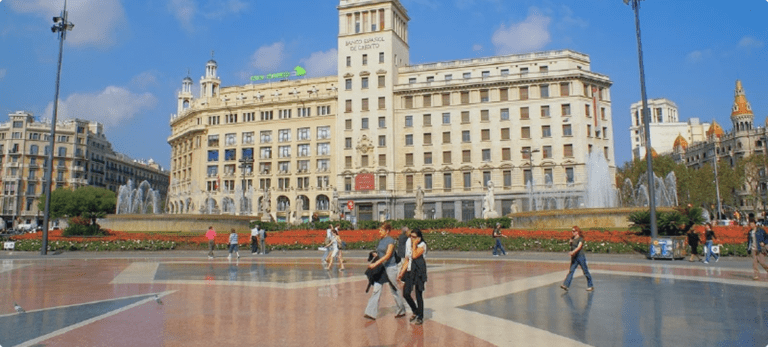
The nerve center of modern Barcelona, designed between 1925 and 1927 under the direction of Francesc Nebot. The guide explains why this square -and not the Gothic Quarter- was the arrival point for American popular culture in the 20th century: department stores, premiere cinemas, jazz halls and the first rock venues were concentrated here and on the axes radiating from it. Also the episode of July 19, 1936, when the square was the central stage of the anarchist uprising against the military coup.
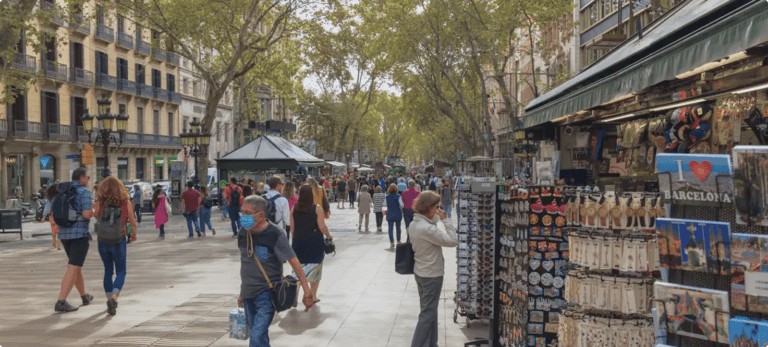
Barcelona’s most photographed promenade, laid out on the bed of the old Cagalell torrent and urbanized in the 18th century. The guide reconstructs the Barcelona seen by the Americans who came here in the 20th century: the war correspondents during the Civil War -Ernest Hemingway stayed at the Hotel Oriente, today NH Collection Las Ramblas, in 1937-, the soldiers on leave during World War II, the travelers of the Beat Generation in the 50’s. Also the function of Las Ramblas as an informal border between the Gothic Quarter and the Raval.
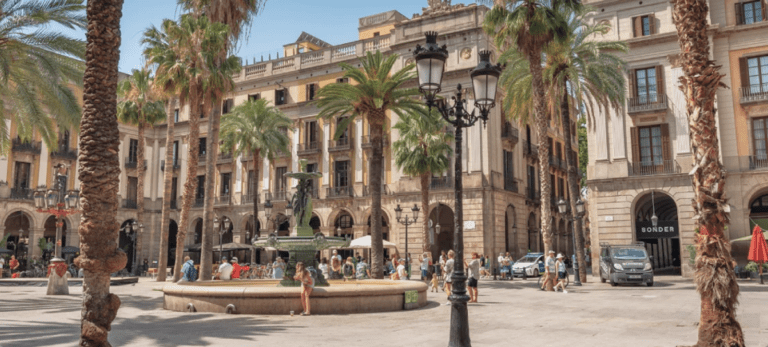
Built in 1848 on the site of a disentailed Capuchin convent, the Plaza Real is one of the few neoclassical spaces in the old town. Its lampposts, designed by Antoni Gaudí in 1879 as a commission from the City Council -one of his first works-, crown the space where American jazz found its first home in Barcelona. The guide points out the historic venues that imported swing and bebop from the 1920s, and the square’s function as a meeting point for American sailors and the nightlife of Chinatown.
They are not two different neighborhoods: Barrio Chino is the nickname used since 1925 for the southern sector of the Raval, the one closest to the port. The name was coined by journalist Francisco Madrid comparing the mix of cultures, poverty and nightlife of the area with the Chinatowns of American cities -especially San Francisco. The guide traces the neighborhood’s history as a recipient of U.S. popular culture: the re-release movie theaters that screened Hollywood films in original version, the bars where sailors from the port brought vinyl records and the first music stores that distributed them. Also the role of the neighborhood as a setting for the American crime novel set in Europe.
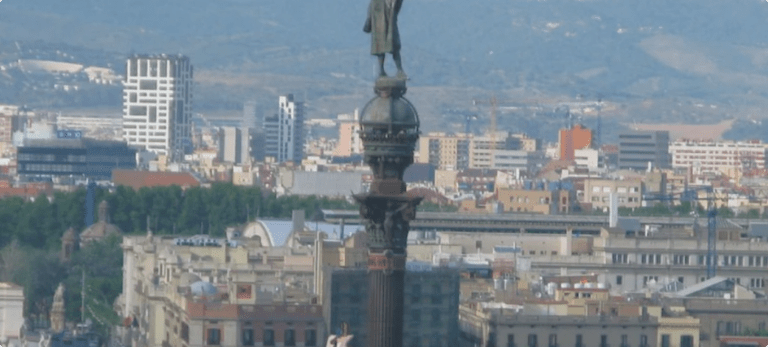
Built for the Universal Exposition of 1888, the monument is 60 meters high and is crowned by the figure of Christopher Columbus pointing his index finger in the direction of the Mediterranean – and not towards America, as is popularly believed. The guide explains the historical controversy about the origin of Columbus -Genoese, Catalan, Portuguese or Castilian, depending on the source-, the role of the Aragonese crown in the Colombian enterprise and why Barcelona, and not Seville or Lisbon, has the most imposing monument of the continent dedicated to the discoverer. Also the political context of 1888: the Universal Exposition as an image operation of the Spain of the Restoration.
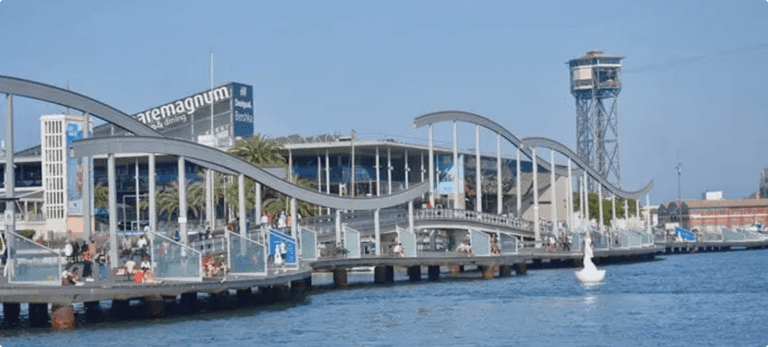
The promenade inaugurated in 1994 as an extension of Las Ramblas over the water is the latest chapter in Barcelona’s history with America: the port that in the 15th century saw ships depart for the Indies and in the 19th century concentrated commercial traffic with Cuba became, after the 1992 Olympic Games, a space for leisure and culture. The guide situates the Maremàgnum, the Aquàrium and the Port Vell complex within the Olympic transformation of the city – the most ambitious urban planning operation in the history of Barcelona – and closes the tour with a reading of the horizon from the end of the Rambla de Mar.
INCLUDED
NOT INCLUDED
The price is per group, not per people. The total is divided among all participants. The more people, the lower the cost per head.
| People | Total | Per person |
|---|---|---|
| 1 people | 199€ | 199€ / people |
| 2 people | 178€ | 89 / people |
| 3 people | 267€ | 89 / people |
| 4 people or more | - | 70 / people |
| People | Total | Per person |
|---|---|---|
| 1 people | 330€ | 330 / people |
| 2 people | 300€ | 150 / people |
| 3 people | 330€ | 110€ / people |
| 4 people or more | - | 90€ / people |
* Children (0 to 11 years old): free of charge. No hidden charges or reservation surcharges.
The private tour of Barcelona and its relationship with the USA is one of the most requested by American travelers – book early if you are arriving in high season.
* We recommend booking at least 7 days in advance to guarantee the assignment of the guide. In high season (May-September), the earlier you book, the more schedule options you will have available.
Your guide will be waiting for you next to the central fountain in Plaza de Catalunya. After booking we will provide you with the guide’s telephone number so that you can easily find him/her.
Plaza de Catalunya, central fountain
Free cancellation available
You can cancel free of charge up to 48 hours before the tour start time. Cancellations made less than 48 hours in advance or no-shows will not be refunded.
Barcelona was the city where Columbus presented the results of his first voyage to the Catholic Monarchs in 1493. The monument – inaugurated in 1888 on the occasion of the Universal Exposition – was an explicit vindication of Catalan participation in the American enterprise, in a political context of the rise of Catalanism and Barcelona’s desire to project itself as an international capital. The main promoter was Mayor Francesc Rius i Taulet. Seville, seat of the Casa de Contratación that managed the American trade since 1503, has Columbus monuments, but none of this scale.
Indianos is the name given to Catalan emigrants who went to Cuba, Puerto Rico and Mexico between 1820 and 1898 -until the loss of the last Spanish colonies- and returned with fortunes made in commerce, agriculture or the sugar industry. Their money financed part of the Eixample: apartment houses with historicist facades, parish churches, schools and cultural centers. During the tour, the guide points out some of the buildings in the historic center directly linked to American capital and explains the economic model that made them possible.
The name was coined in 1925 by journalist Francisco Madrid in an article for the weekly El Escándalo , comparing the mix of cultures, poverty and nightlife of the southern Raval with the Chinatowns of American cities -especially San Francisco. “Barrio Chino” and “El Raval” are not two neighborhoods: Barrio Chino is the popular nickname for the southern sector of Raval. There was never a significant Chinese community in the area. Since the 1990s the City Council has been promoting the official name of El Raval for the whole neighborhood.
Yes, Ernest Hemingway visited Barcelona on several occasions during the Spanish Civil War (1936-1939), covering the conflict as a correspondent. In 1937 he stayed at the then Hotel Oriente, in Las Ramblas -today NH Collection Las Ramblas-, and recorded his impressions in chronicles published in the American press and in his later work. He was not the only American writer present: John Dos Passos, Martha Gellhorn and George Orwell -the latter of British origin- also passed through Barcelona during those years and left written testimonies of the city at war.
No. The itinerary runs entirely through public spaces: squares, streets and the Port Vell promenade. There are no entrances included or access to the interior of buildings. If you are interested in combining this tour with a visit to the interior of the Gothic Quarter or the Columbus Monument -which has a viewpoint in the dome-, please contact us and we will suggest how to organize your day.
It is one of the most highly rated tours by travelers from the United States precisely because it connects what they are seeing with a history that is close to home. That said, it is not a general introductory tour of the city: if it is your first visit and you want to first get an overview of the essential neighborhoods, the Welcome Tour is the natural starting point. This tour works very well as a second or third guided tour during your stay, once you have the general context.
I knew that Columbus had arrived in America, but I didn't know that he had presented the trip in Barcelona. The guide's explanation of the Indianos and the Eixample buildings was the most interesting part of the trip.
The part of Chinatown and the history of American jazz in Las Ramblas surprised us a lot. We did not expect to find such a direct connection to American culture in the heart of the historic center.
We arrived at the Columbus Monument thinking it was just a beautiful statue. The guide explained to us the controversy about the finger - pointing to the Mediterranean, not America - and all the political history behind it. Impressive.
We have been in Barcelona for two days and this was the best tour. The guide connected each place to something concrete - Hemingway on Las Ramblas, jazz in Plaza Real, ships bound for Cuba. Real history, not postcard tourism.
If you have any questions or special needs before booking, write to us — we reply in less than 24 hours.