I had been seeing pictures of Casa Batlló for years and didn't understand anything. The guide explained the reading of the facade as the dragon of Sant Jordi and suddenly it all made sense. Completely worth the private tour.
Inicio / Tours privados / Private Tours in Barcelona / Tour of Passeig de Gràcia
Walking itinerary along Barcelona's Modernist axis: Casa Batlló, Casa Milà —La Pedrera—, Casa Amatller, and Casa Lleó Morera, with their facades, details, and the history of the movement that turned the Eixample into the open-air museum of Catalan Modernism. Guided tour with an official tour guide.


Passeig de Gràcia is the main avenue of the Eixample, the bourgeois expansion designed by Ildefons Cerdà in 1859 to triple the size of Barcelona. In the section between Gran Via and Diagonal, the late 19th-century upper class commissioned the city’s most ambitious buildings from the finest architects of the era. The result was the *Manzana de la Discordia* (Block of Discord): Barcelona’s most famous group of Modernista buildings integrated into a single facade, featuring three UNESCO World Heritage sites on a single block.
The guided itinerary covers this section of the avenue thoroughly and at a leisurely pace, studying each of the facades: the blue and green ceramics on the roof of Casa Batlló, designed by Gaudí to evoke the scales of Sant Jordi’s dragon; the system of stepped terraces of La Pedrera, which eliminates any right angles in an eight-story building; the medieval-style gables of Casa Amatller; and the arabesque arches of Casa Lleó Morera. Every detail has a purpose. The guided tour is designed to ensure you don’t miss a single one.
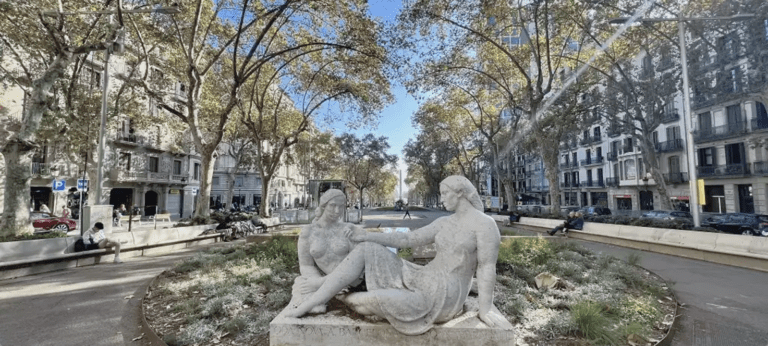
The tour ends at the Jardinets de Gràcia, the gardens connecting Passeig de Gràcia with the Vila de Gràcia neighborhood, flanked by two masterpieces of *Modernisme*: Casa Fuster by Domènech i Montaner (1911) and the Palauet by Pere Falqués i Urpí (1906), the very architect who designed the avenue’s famous lampposts.
The tour runs along Passeig de Gràcia from south to north, with stops at the most emblematic buildings and spaces of Catalan Modernisme. The order has a logic: from the urban context of the Eixample to the building-by-building analysis of the Manzana de la Discordia, and from there to La Pedrera as the top of the tour.
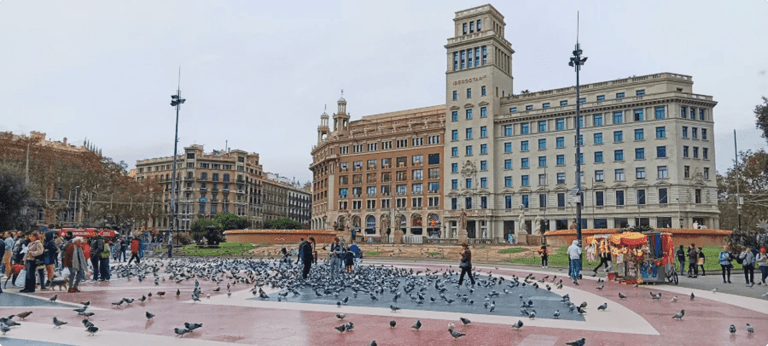
The square that connects the Old Town with the Eixample is the result of successive urban planning interventions between 1888 and 1927. The guide explains the Cerdà Plan of 1859 -the Eixample grid, the 45-degree chamfers, the blocks with landscaped interiors that real estate speculation eliminated- and why Passeig de Gràcia became the representative axis of the Catalan bourgeoisie that financed Modernisme.
The bluish-gray hexagonal tiles that cover the sidewalks of the promenade were designed by Antoni Gaudí in 1904 for the floor of the Casa Batlló. Pieces were left over and the City Council spread them all over the promenade. The guide points out the three motifs in the design – starfish, fish and octopus – and their relationship to the marine bestiary that appears in Gaudí’s other works.
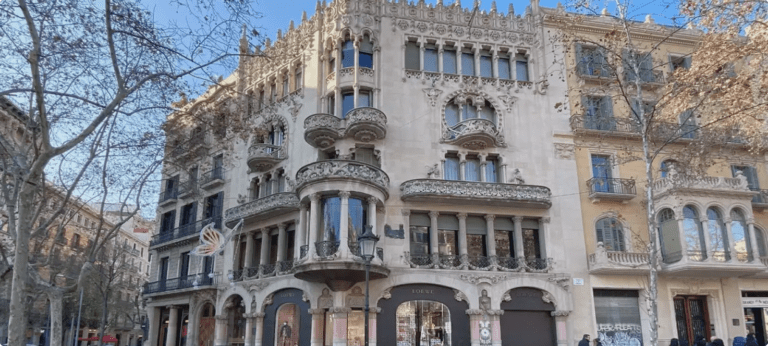
The least photographed building of the Manzana de la Discordia and the most punished by later reforms: the first floor was demolished in the 1940s to install a handbag store. On the upper façade survive the mosaics by Lluís Bru and the sculpture by Eusebi Arnau -the best artists of Modernisme in their respective disciplines-, and the corner with the allegorical figure of the lady holding an electric light bulb: an explicit reference to the electrification of Barcelona in those years.
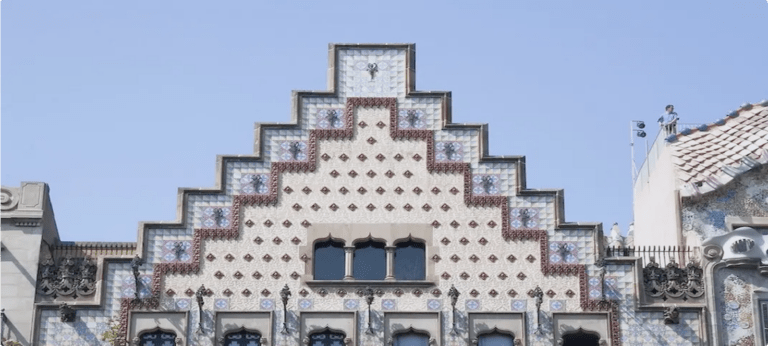
Antoni Amatller was a chocolate manufacturer and collector of photography. Puig i Cadafalch designed for him a palace with a Flemish-influenced facade – the stepped gables that crown the building were seen by the architect on his travels in Belgium and the Netherlands – and a sculptural program by Eusebi Arnau in which the characters in the doorway carry musical instruments and practice arts and crafts: the statement of an enlightened patron, not a nouveau riche. The guide shows the dragon devouring a man at the entrance and the frog reading a book at the base of the right column.
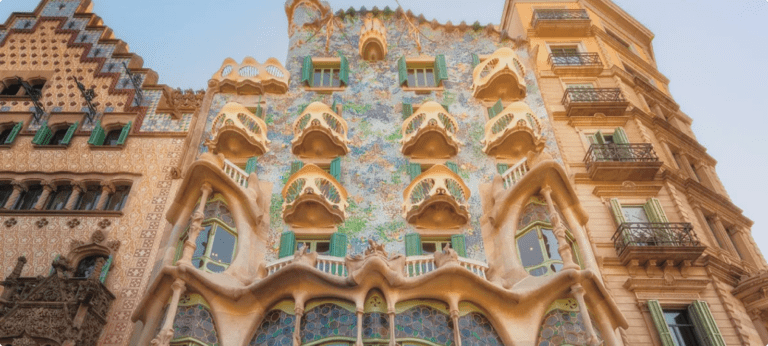
Josep Batlló i Casanovas acquired an 1877 building and commissioned Gaudí to redo it from top to bottom. The result is unprecedented in the history of architecture: the façade is covered with trencadís -mosaic of broken ceramics- in shades of blue and green that change color depending on the incidence of light; the roof imitates the back of a dragon with glazed ceramic scales; the balconies are shaped like skulls or carnival masks depending on how you look at them; and the tower culminates in a four-armed cross oriented to the cardinal points. The guide explains the reading of the building as the setting for the legend of Sant Jordi: the dragon on the roof, the bones of the victims on the balconies, the spine of the dragon on the interior staircase.
The last residential building Gaudí built before devoting himself exclusively to the Sagrada Família. Pere Milà i Camps commissioned a house that would be at once a home, a monument and a declaration of principles. The result was a building without a single right angle: the undulating facade of Garraf stone mimics the strata of a mountain, the roof terraces – with their twisted chimneys that the students of ’68 christened “the warriors” – are a walkable sculptural space unique in the world. The guide reads the façade from across the street and explains the structural system-eliminated load-bearing walls, iron columns and beams-that allowed Gaudí to design completely free-standing floors, without load-bearing partitions, decades before Le Corbusier theorized it.
The small gardens in front of La Pedrera, at the intersection of Passeig de Gràcia and Diagonal, are the natural closing point of the itinerary. From here the guide directs the group on what to see in the surroundings: the interior of La Pedrera if you have bought a ticket, the Palau del Baró de Quadras by Puig i Cadafalch two blocks away, or Park Güell if it is late in the trip.
INCLUDED
NOT INCLUDED
The price is per group, not per people. The total is divided among all participants. The more people, the lower the cost per head.
| People | Total | Per person |
|---|---|---|
| 1 people | 199€ | 199€ / people |
| 2 people | 178€ | 89 / people |
| 3 people | 267€ | 89 / people |
| 4 people or more | - | 70 / people |
| People | Total | Per person |
|---|---|---|
| 1 people | 330€ | 330 / people |
| 2 people | 300€ | 150 / people |
| 3 people | 330€ | 110€ / people |
| 4 people or more | - | 90€ / people |
* Children (from 0 to 11 years old): free. Tickets to the interior of Casa Batlló or La Pedrera, if you want to include them, are purchased separately on the official websites of each building. No hidden charges or booking fees.
The Passeig de Gràcia tour is one of the most popular tours for architecture and Modernisme lovers – book in advance if you arrive in high season. The tour runs in two daily time slots:
* We recommend booking at least 7 days in advance to guarantee guide assignment. In high season (May-September) the guides work at full capacity – the earlier you book, the more scheduling options you will have available.
Your guide will be waiting for you at Plaça de Catalunya. After booking we will provide you with the guide’s telephone number so that you can be reached without complications.
Plaça de Catalunya, Barcelona
Free cancellation available
You can cancel free of charge up to 48 hours before the tour start time. Cancellations made less than 48 hours in advance or no-shows will not be refunded.
No. The tour goes around the outside of the buildings, with detailed reading of each facade, and access to public spaces without entrance -the lobby of La Pedrera, the portal of Casa Amatller-. Tickets to the interior can be purchased separately: Casa Batlló from 29€ at casabatllo.es, and La Pedrera from 25€ at lapedrera.com. If you want to visit the interior of either on the same day of the tour, book in advance and let us know: we adjust the order of the itinerary to fit in with the schedule of your ticket. In high season tickets sell out, so please book several days in advance.
It is one of the most comfortable tours in the catalog. Passeig de Gràcia has wide sidewalks, smooth pavement and no unevenness throughout – no cobblestones, stairs or uneven sections. The total distance is just over a kilometer between Plaça de Catalunya and the Jardinets de Gràcia, with long stops in front of each building. The pace is set by the guide according to the group. Suitable for all ages and for people with reduced mobility.
This tour focuses exclusively on Passeig de Gràcia: the three buildings of the Apple of Discord and La Pedrera, with the urban context of the Eixample. The private tour of Antoni Gaudí’s Modernisme extends the tour to the whole of Gaudí’s work -including Park Güell- and focuses on the figure of the architect rather than on the movement. If you are interested in Modernisme as a collective cultural phenomenon – Gaudí, Domènech i Montaner, Puig i Cadafalch and his patrons – this is the tour for you. If you are interested in Gaudí in particular, the other is more appropriate. Many visitors do both on different days.
The name comes from the old hermitage of Nostra Senyora de Gràcia, which existed on the road that linked Barcelona with the town of Gràcia – an independent municipality until 1897, when it was annexed to the city. The promenade was originally that path, laid out outside the walls, which the people of Barcelona used to walk along on Sundays to go to the hermitage or simply to stroll outside the walled city. The redevelopment of the Eixample from 1860 onwards turned it into the boulevard representative of the Catalan industrial bourgeoisie, but the name, that of the old road to the hermitage, was kept.
It is block 292 of Passeig de Gràcia, between numbers 35 and 45, where three modernist buildings commissioned at the same time by three bourgeois rivals to the three best architects of Modernisme are concentrated: Casa Lleó Morera by Domènech i Montaner, Casa Amatller by Puig i Cadafalch and Casa Batlló by Gaudí. The “discord” refers to the competition between the three architects and their patrons to see who could build the most extraordinary building. All three are UNESCO World Heritage Sites.
Yes, and it is a common combination. The most convenient way is to do the tour in the morning -10:30 hs- and reserve the entrance to the interior of the building you are most interested in for the afternoon. Let us know when booking and we will guide you on the order that best fits your schedule.
I had been seeing pictures of Casa Batlló for years and didn't understand anything. The guide explained the reading of the facade as the dragon of Sant Jordi and suddenly it all made sense. Completely worth the private tour.
We knew nothing about Puig i Cadafalch or Domènech i Montaner. We left the tour wanting to go back just to see more modernist architecture. The level of detail of the guide was impressive.
We had been looking at La Pedrera from the street for two days without understanding why it doesn't have a right angle. The guide explained it to us with brutal clarity. Now that I know what's behind it, the building seems even more extraordinary.
We took this tour on the first day. It turned out that Casa Amatller was our favorite, not Batlló. We would never have discovered it without the guide - it is the building that is the least conspicuous from the outside and the one that hides the most history.
If you have any questions or special needs before booking, write to us — we reply in less than 24 hours.