We have been to Barcelona for three trips and we had never seriously visited Gràcia. The guide explained the history of each square with a level of detail you won't find in any guidebook. The Plaça del Diamant alone was worth the trip.
Inicio / Tours privados / Private Tours in Barcelona / Tour of Gràcia district
Walking tour through the Barcelona neighborhood that was an independent municipality until 1897 and still feels like one: squares and streets with names that evoke specific historical events, a 19th-century iron market designed by Rovira i Trias, and a density of daily life that does not exist in any other Barcelona neighborhood. Guided tour with an official tour guide.


Gràcia was an independent municipality until 1897, when the Barcelona City Council annexed it along with Sants, Sant Andreu, and other surrounding towns. It has about 120,000 residents concentrated within 4.19 km²—a population density similar to that of the Eixample—but with a radically different urban scale: narrow, irregularly laid-out streets, small squares that serve as communal living rooms, and a neighborhood life that Barcelonans from the rest of the city recognize as something unique.
What makes Gràcia unique isn’t its buildings, but the accumulation of history in everyday spaces: squares named after republicans, anarchists, or internationalists; a 19th-century iron market designed by Antoni Rovira i Trias; streets where residents have been painting, stenciling, and reclaiming public space on their own terms for over a century. None of this appears in conventional guidebooks.
On this 3-hour walking tour, the official tour guide will take you through the neighborhood’s squares and markets. The tour combines the context of the 19th century—explaining why Gràcia has this particular urban layout—with the history of the 20th century: anarchism, the anti-Franco resistance, and the language movement, all of which explain why its residents still feel distinct.
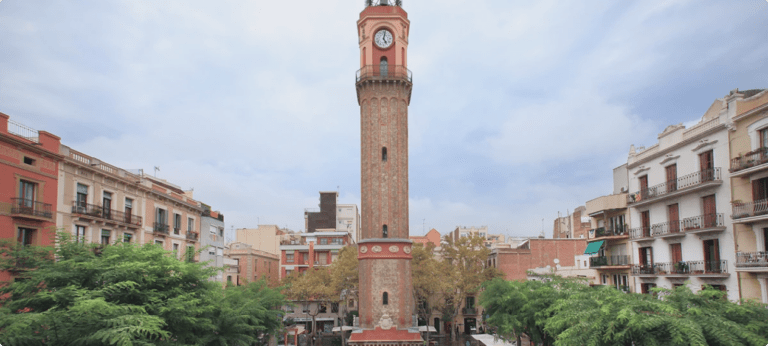
The tour starts at Plaça de la Vila de Gràcia and proceeds on foot through the heart of the neighborhood. The itinerary includes the following stops:
The civic center of the old municipality. The Ajuntament de Gràcia building, built in 1812, is today the seu del Districte de Gràcia. The guide explains the annexation process of 1897 and why Gràcia retained for decades a feeling of being its own municipality much more intense than the other towns absorbed by Barcelona.
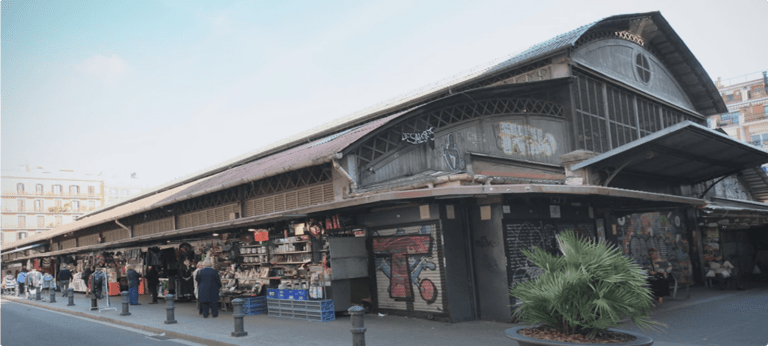
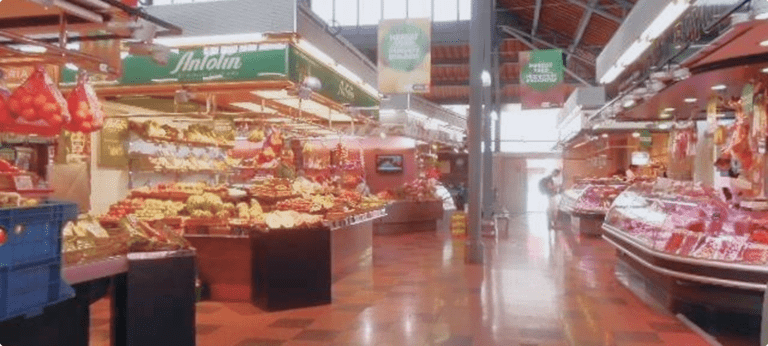
Inaugurated in 1892, designed by Antoni Rovira i Trias – the architect who won the Eixample competition before Cerdà replaced it by royal decree. The guide discusses the cast-iron structure, the history of local commerce and the market’s role in the daily life of the neighborhood.
A covered market of 1888, designed by Francesc Berenguer i Mestres, a direct collaborator of Gaudí. The guide situates Berenguer in Catalan Modernisme and explains the difference between the iron architecture of the Mercat de l’Abaceria and the more organic approach of the Llibertat.
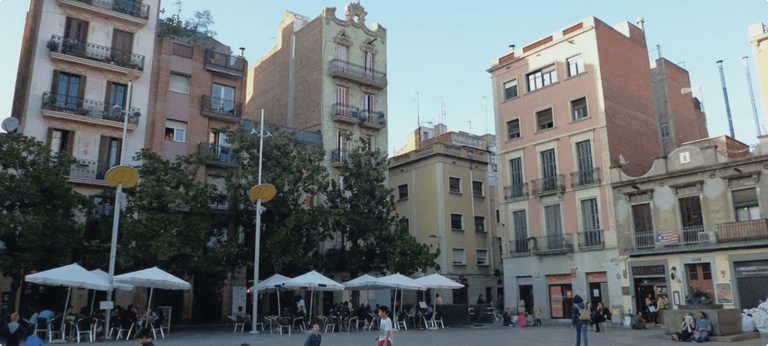
Barcelona’s most literary square: this is where most of Mercè Rodoreda’s La plaça del Diamant (1962), the most translated Catalan novel of the 20th century, takes place. The guide reviews the figure of Natàlia, the Civil War context that structures the novel and the 1982 monument by sculptor Enric Casanovas. He also explains why the name “Diamant” has no relation to precious stones.
One of the squares that best encapsulates the political character of Gràcia: its name refers to the Revolució de Setembre of 1868 that overthrew Isabel II. The guide explains the context of federalism and republicanism in the neighborhood, a tradition that runs through the history of Gràcia from the 19th century to the Second Republic.
Dedicated in 1994 to the young German Jewish girl whose diary became one of the most widely read documents on the Holocaust. The square is an example of the vindictive character of Gràcia when it comes to naming its public spaces: many of its squares are named after international figures linked to resistance and human rights.
Renamed by the neighborhood in 1981, shortly after the musician’s murder, as a spontaneous gesture of homage. The guide explains the participatory culture of the neighborhood in the management of public space and Gràcia’s tradition of appropriating the names of its streets and squares with its own criteria.
One of the squares less traveled by tourists and more frequented by the neighborhood. The guide comments on its role in the urban structure of Gràcia and the neighborhood logic that makes these small squares the connective tissue of the neighborhood.
Inaugurated in 2006 as a tribute to the women who participated in the defense of the Republic during the Civil War. The name explicitly refers to the year of Franco’s uprising. The guide contextualizes the historical memory of the neighborhood and the memory policy of Gràcia, one of the most active districts of Barcelona in the recovery of the Republican memory.
The busiest and most urban square in the neighborhood, the center of daily life in Gràcia and the scene of historic protests since the 19th century. The guide comments on the urban reform of 1982, the current context of the square and the Festa Major de Gràcia -celebrated every year in the week of August 15- in which the neighbors decorate the streets in competition by neighborhoods since the eighteenth century.
INCLUDED
NOT INCLUDED
The price is per group, not per people. The total is divided among all participants. The more people, the lower the cost per head.
| People | Total | Per person |
|---|---|---|
| 1 people | 199€ | 199€ / people |
| 2 people | 178€ | 89 / people |
| 3 people | 267€ | 89 / people |
| 4 people or more | - | 70 / people |
| People | Total | Per person |
|---|---|---|
| 1 people | 330€ | 330 / people |
| 2 people | 300€ | 150 / people |
| 3 people | 330€ | 110€ / people |
| 4 people or more | - | 90€ / people |
* Children (0 to 11 years old): free of charge. No hidden charges or reservation surcharges.
The private tour of the Gràcia neighborhood is one of the most popular neighborhood tours in the catalog – book early if you arrive in high season.
* We recommend booking at least 7 days in advance to guarantee the assignment of the guide. In high season (May-September) the guides work at full capacity.
Your guide will be waiting for you at Plaça de la Vila de Gràcia, in front of the facade of the old Ajuntament de Gràcia. After booking we will provide you with the guide’s phone number so that you can easily find him/her. The square is 5 minutes walk from the Fontana exit of the Metro L3.
Plaça de la Vila de Gràcia
Free cancellation available
You can cancel free of charge up to 48 hours before the tour start time. Cancellations made less than 48 hours in advance or no-shows will not be refunded.
No, Casa Vicens (1888), Gaudí’s first built work, is in the neighborhood of Gràcia, but this tour focuses on the squares and markets of the neighborhood. If you want to visit Casa Vicens you can do it on your own -it has ticketed visits- in combination with this tour. If you are looking for a guided tour of Gaudí’s work, the Gaudí Modernism Private Tour is the best option.
The Festa Major de Gràcia is celebrated every year during the week of August 15th. If you visit the neighborhood on those dates, the guided itinerary includes an explanation of the festa and a tour of the decorated streets. It is one of the best times of the year to visit Gràcia: the locals compete by neighborhood in decorating their streets and the atmosphere is completely different from the rest of the year. Please indicate this when booking if you are traveling in August.
It is not necessary to have read it. La plaça del Diamant (1962), by Mercè Rodoreda, is the most important novel in 20th century Catalan literature and the most translated into foreign languages. The guide explains the plot, the characters and the historical context -the Barcelona before and after the Civil War- in the very square where the action takes place. Many travelers who discover the novel through the tour read it after returning home.
It depends on what you are looking for. The afternoon has a practical advantage: the squares are livelier after 17:00h, with locals out for a drink and children playing – exactly the neighborhood life that makes Gràcia different. In the morning, the route is quieter and the markets are in full swing. Both time slots work well.
We have been to Barcelona for three trips and we had never seriously visited Gràcia. The guide explained the history of each square with a level of detail you won't find in any guidebook. The Plaça del Diamant alone was worth the trip.
The Mercat de l'Abaceria was a total surprise. It was ten minutes away from our apartment and we didn't even know it existed. The guide told us about the architect and the history of the building with incredible passion.
We did this tour on our last day in Barcelona and it was the best decision. Gràcia feels completely different from the tourist centre. Our guide explained the politics and the neighborhood identity in a way that made total sense.
We were four friends who wanted to see something different. The guide adapted the level of detail to our interest in the contemporary history of Catalonia and told us about the anti-Francoist resistance in the neighborhood. Absolutely recommended.
If you have any questions or special needs before booking, write to us — we reply in less than 24 hours.