The Raval section was what struck me the most. I would never have imagined that behind the neighborhood you see today there are centuries of deliberate segregation. The guide explained it without drama, with data. Much better that way.
Inicio / Tours privados / Private Tours in Barcelona / Tour of mysterious and forbidden Barcelona
Walking itinerary through El Raval, the Gothic Quarter, Las Ramblas, and Plaza Cataluña: secret passages, public execution sites, famous crimes, and the stories that the official version of the city would prefer to forget. Tour with an official tour guide.


For centuries, Barcelona has been building a narrative about itself: a cosmopolitan, Mediterranean, modern city. This private guided tour works on the other layer—the one that lies beneath. That of the Inquisition tribunal that operated for three centuries on Carrer dels Banys Nous. That of the public executions in Plaça de Sant Miquel that drew thousands of Barcelonans. That of El Raval’s
The tour starts at the exit of the Sant Antoni metro station, where the guide gathers the group and gives an introduction to the historical context of the tour before starting to walk. The itinerary progresses as follows:
Starting point and first context. The guide briefly explains what is about to be shown: not urban legends, but documented episodes of Barcelona’s history that the usual tourist narrative leaves out. The Raval that starts a few meters away was for centuries the space outside the medieval wall where the city placed what it did not want inside – convents, hospitals, brothels and, from the nineteenth century, the working population that came to work in the factories of the Eixample.
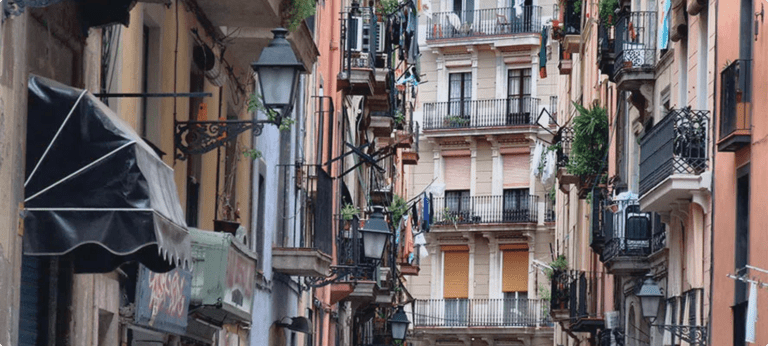
From Carrer de Sant Pau inwards: the guide walks through the streets of the southern sector of the Raval, historically known as the Chinatown, a term coined by journalist Francisco Madrid in 1925 in his chronicle Sangre en las Atarazanas to describe the area’s atmosphere of brothels, taverns and criminality. The guide explains the deliberate urbanistic function of the Raval as a space of social segregation, the attempts to “clean up” the neighborhood throughout the 20th century – including the demolition of part of the historic fabric to open up the Rambla del Raval in the 1990s – and what remained: the Hospital de la Santa Creu, founded in 1401 as a hospital for the poor and indigent, and the area around Carrer Nou de la Rambla, where Gaudí’s Palau Güell lived for decades with the most stigmatized neighborhood in the city.
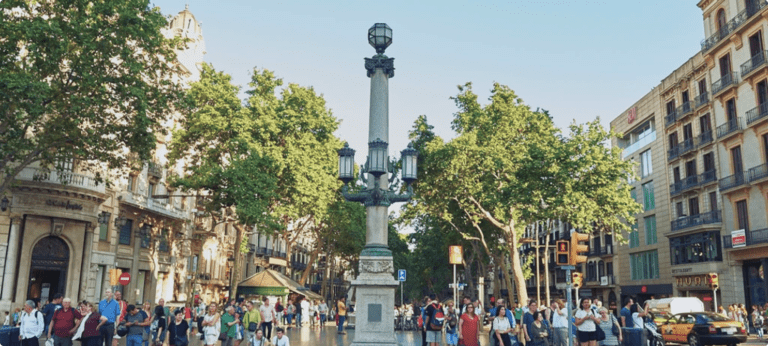
The guide goes through Las Ramblas not as a postcard but as a historical scene: the dry bed of the medieval torrent on which the promenade was built, the public executions that were held in the space outside the wall before the boulevard existed, the role of the Liceu – inaugurated in 1847 – as a symbol of the Barcelona bourgeoisie and the target of the anarchist attack by Santiago Salvador on November 7, 1893, which caused twenty deaths in the stalls. Also the bombings of the Italian aviation in the service of Franco in March 1938, which killed 42 people in Las Ramblas in three consecutive days.
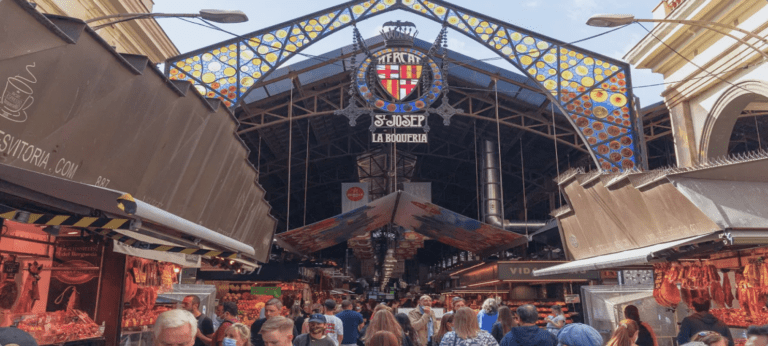
The Mercat de Sant Josep, known as La Boqueria, has occupied since 1840 the site of the convent of the Discalced Carmelites, disentailed and demolished during Mendizábal’s exclaustration in 1835. The guide explains the disentailment as a political process – not simply anticlerical, but also a transfer of properties from the Church to the liberal bourgeoisie – and its impact on the urban fabric of Barcelona: dozens of convents demolished to open streets, squares and markets in the heart of the city. The site where today we buy fruit and ham was for centuries the center of a closed religious community.
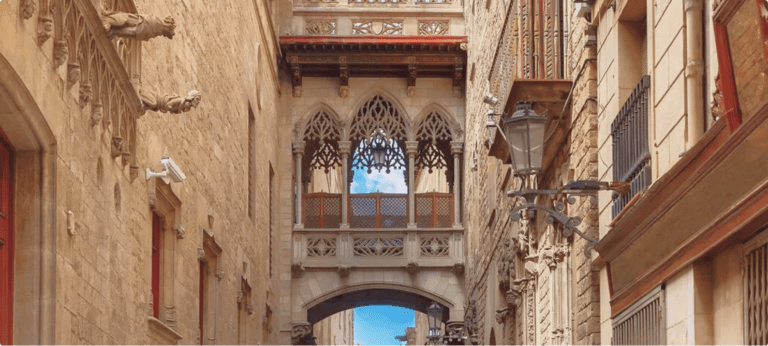
The Gothic quarter between Carrer dels Banys Nous and Plaça de Sant Felip Neri concentrates the most opaque history of the city. The guide locates the site of the tribunal of the Holy Office, which operated in Barcelona from 1487 until its final abolition in 1834 and prosecuted hundreds of people accused of heresy, covert Judaism, witchcraft and sodomy. The Plaça de Sant Felip Neri, with its shrapnel marks from the bombings of January 1938, is also the scene of one of the summary executions of the immediate post-war period: on January 30, 1939, two days after Franco’s troops entered Barcelona, a group of people were shot in this square.
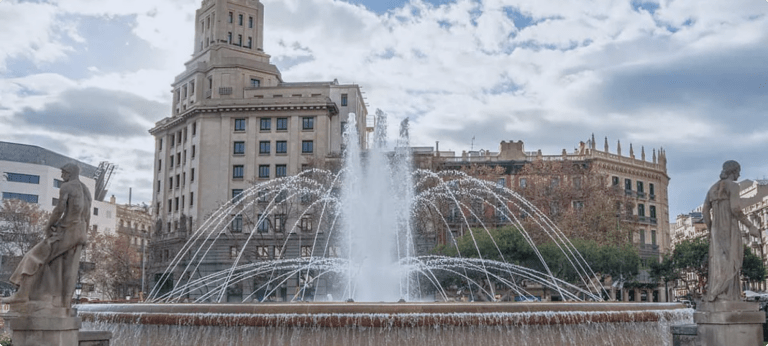
The tour concludes at Plaza Catalunya, where the guide closes the tour with a summary of what has been seen and time for questions. The space that is now Barcelona’s busiest square was for centuries the outer limit of the walled city – a threshold between the controlled Barcelona and all that remained outside.
INCLUDED
NOT INCLUDED
The price is per group, not per people. The total is divided among all participants. The more people, the lower the cost per head.
| People | Total | Per person |
|---|---|---|
| 1 people | 199€ | 199€ / people |
| 2 people | 178€ | 89 / people |
| 3 people | 267€ | 89 / people |
| 4 people or more | - | 70 / people |
| People | Total | Per person |
|---|---|---|
| 1 people | 330€ | 330 / people |
| 2 people | 300€ | 150 / people |
| 3 people | 330€ | 110€ / people |
| 4 people or more | - | 90€ / people |
* Children (0 to 11 years old): free of charge. No hidden charges or reservation surcharges.
This tour is one of the most popular for those looking for a different historical reading of the city – book early if arriving in high season. The tour runs in two daily time slots:
* We recommend booking at least 7 days in advance to guarantee guide assignment. In high season (May-September) the guides work at full capacity – the earlier you book, the more scheduling options you will have available.
Your guide will be waiting for you at the Villarroel exit of the Sant Antoni metro station (L2). The tour ends at Plaza Catalunya. After booking we will provide you with the guide’s telephone number so that you can be reached without complications.
Metro Sant Antoni L2 - Exit Villarroel
Free cancellation available
You can cancel free of charge up to 48 hours before the tour start time. Cancellations made less than 48 hours in advance or no-shows will not be refunded.
Barcelona has a dark history due to the accumulation of conflicts in a short space and time. Barcelona had the most active Inquisition of the Crown of Aragon for 350 years, experienced the most violent anarchism in Western Europe in the late nineteenth century, was bombed by Italian aircraft in 1938 and fell under Franco’s repression in 1939. All this within a radius of two kilometers. The route does not invent anything: it puts name and address to what was already there.
The Legends Tour works on folklore and oral tradition. This tour works on documented historical episodes that the official narrative tends to minimize: the Inquisition, the bombing of civilians, the deliberate segregation of the Raval. The result is darker precisely because it is real.
It is a tour of history. Each episode is worked within its political and urbanistic framework – the Inquisition as an instrument of state control, the Raval as the product of a deliberate urbanistic decision, the 1938 bombings as a documented military tactic. The guide does not seek to impress; he seeks to make sense of each place within a coherent reading of the city.
The most recent episode of the forbidden Barcelona are the executions in the Plaça de Sant Felip Neri on January 30, 1939, two days after Franco’s troops entered Barcelona. This route does not remain in the Middle Ages: it reaches the immediate post-war period, and the shrapnel marks on the walls of the square are still visible today.
The same scenarios – Las Ramblas, the Gothic Quarter, the Raval – with the missing layer of reading. The site of La Boqueria was a disentailed convent. Plaça de Sant Felip Neri has shrapnel holes that most tourists don’t identify. This tour does not take you to new places: it explains what you have already seen without understanding.
The Private Civil War Barcelona Tour is the natural complement: it goes into detail on the 1936-1939 conflict that this tour can only skim over. To delve deeper into the Raval, the Private Raval Neighborhood Tour covers the contemporary transformation of the neighborhood in more time and detail.
The Raval section was what struck me the most. I would never have imagined that behind the neighborhood you see today there are centuries of deliberate segregation. The guide explained it without drama, with data. Much better that way.
We had been doing the usual sightseeing circuit for three days. This tour was the one that made us really understand how the history of the city works. The stop at Plaça de Sant Felip Neri with the story of the executions was brutal.
We are amateur historians and the level of detail of the guide surprised us. The episode of the anarchist attack on the Liceu in 1893 with all the political context surrounding it - that level of depth you don't find on a free tour.
There were four of us and the guide adapted the tour to our pace of questions. We finished half an hour later than planned because we didn't want to stop. The section of La Boqueria on the site of the convent - I didn't know about it and found it fascinating.
If you have any questions or special needs before booking, write to us — we reply in less than 24 hours.